
TikTok Shop Product Seeding
Stop wasting 60-70% of seeded inventory on silent creators. Learn the 9-point scoring framework to vet TikTok Shop creators and maximize every sample you send.
Here's the brutal math most TikTok Shop brands refuse to confront: the average product seeding campaign wastes 60–70% of its inventory on creators who never post. That's not a rounding error — that's a hemorrhage.
- Score creators quantitatively using the 9-point framework instead of selecting based on vibes — 60–70% of seeded inventory goes to creators who never post.
- Prioritize engagement rate over follower count: nano-influencers (1K–10K followers) generate up to 5X higher engagement than macro-influencers.
- Check each creator's posting frequency before shipping — irregular posting is the strongest predictor they won't create content from your gift.
- Analyze audience-product demographic fit to avoid seeding creators whose followers will never convert for your specific product.
- Use data-backed creator selection to achieve 3–5X higher affiliate recruitment rates and dramatically lower customer acquisition costs versus paid-only approaches.
You ship 500 units.Maybe 150 creators actually make a video. Of those, perhaps 40 produce content that drives meaningful clicks.And of those, a handful generate actual sales.
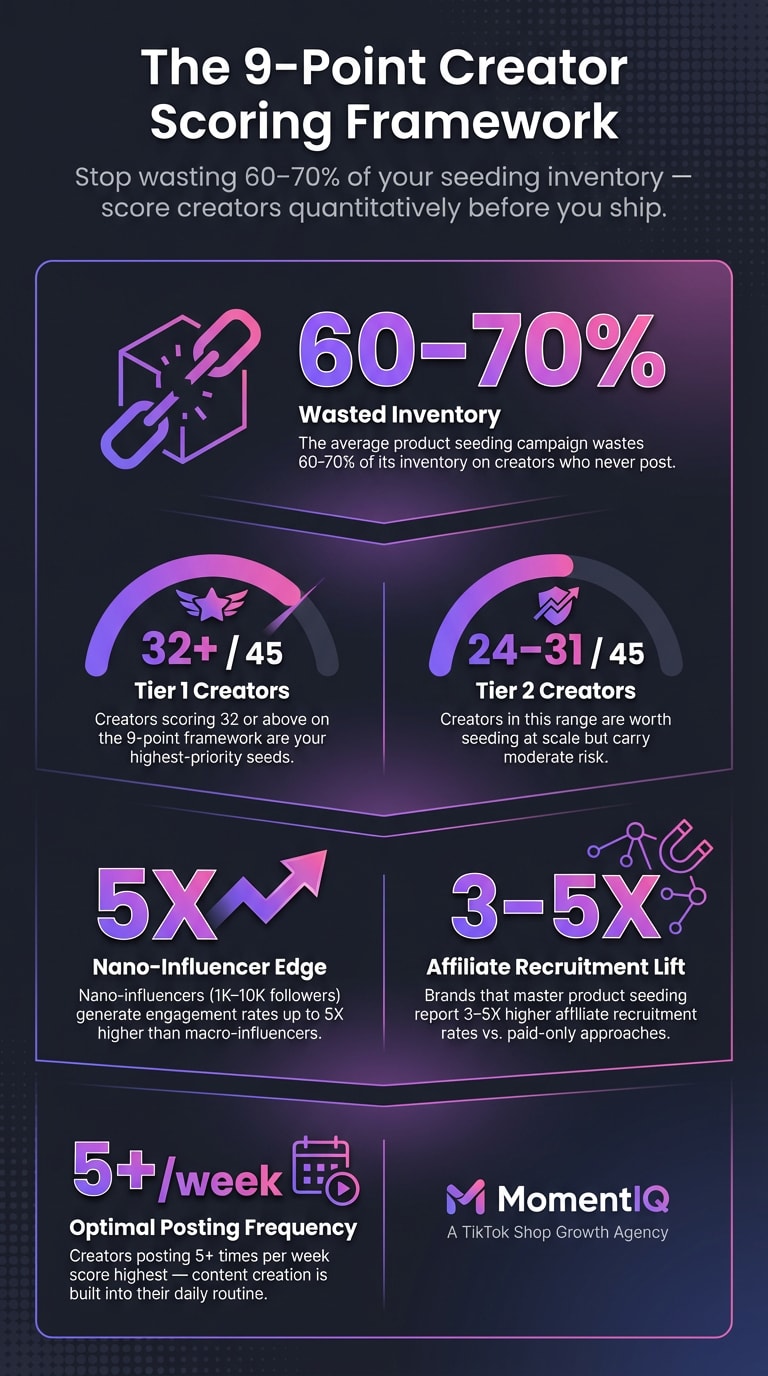
The problem isn't product seeding as a strategy.Product seeding remains one of the most powerful levers for TikTok Shop growth — brands that master it consistently report 3–5X higher affiliate recruitment rates and dramatically lower customer acquisition costs compared to paid-only approaches. The problem is who you're seeding to.
Most brands select creators based on vibes.They scroll through profiles, eyeball follower counts, maybe glance at a recent video, and fire off a package. That's not a strategy — that's a lottery ticket.
This post gives you the antidote: a quantitative, repeatable 9-point scoring framework for creator selection for product seeding that predicts which creators will actually post, produce quality content, and drive revenue. No more guessing. No more wasted samples. Just data-backed decisions that turn your seeding budget into a growth engine.
Let's build the machine.
Why Most Creator Selection for Product Seeding Fails (And What to Fix)

Before we dive into the framework, let's diagnose why the default approach to choosing creators for TikTok gifting consistently underperforms.
The Three Fatal Mistakes in Creator Selection

Mistake #1: Over-indexing on follower count. A creator with 500K followers and a 0.8% engagement rate will almost always underperform a creator with 15K followers and a 9% engagement rate in a seeding context. TikTok's algorithm rewards content quality, not audience size — and according to research from Influencer Marketing Hub, nano-influencers (1K–10K followers) generate engagement rates up to 5X higher than macro-influencers.
Mistake #2: Ignoring posting behavior patterns. If a creator hasn't posted in three weeks, or posts sporadically with long gaps, the probability they'll create content from your gifted product drops dramatically. Past behavior is the single strongest predictor of future behavior — yet most brands never check posting frequency before shipping.
Mistake #3: No audience-product fit analysis. A fitness creator with an audience of 18–24-year-old males is a terrible seeding target for a premium anti-aging skincare line, regardless of how good their content looks. Audience demographics and psychographics must align with your buyer persona, or you're generating views that will never convert.
These three mistakes compound. When you combine a vanity-metric-driven selection process with no behavioral analysis and no audience fit check, you get the 60–70% waste rate that plagues the industry.
The 9-Point Scoring Framework eliminates all three.
The 9-Point Creator Scoring Framework: How to Choose Creators for TikTok Gifting With Precision

This framework assigns each potential seeding recipient a score from 0 to 45 (each of the 9 criteria is scored 0–5). Creators scoring 32+ are your Tier 1 priority seeds. Creators scoring 24–31 are Tier 2 — worth seeding at scale. Below 24, you're gambling.
Let's break down each criterion.
Criterion 1: Engagement Rate Relative to Niche Benchmark (0–5 Points)

Raw engagement rate means nothing without context. A 4% engagement rate is exceptional for a fashion creator with 200K followers but mediocre for a pet creator with 20K followers. You need niche-adjusted engagement benchmarks.
Here's how to score it:
- 5 points: Engagement rate is 2X+ the niche average
- 4 points: Engagement rate is 1.5–2X the niche average
- 3 points: Engagement rate is at or slightly above the niche average
- 2 points: Engagement rate is slightly below the niche average
- 1 point: Engagement rate is significantly below average
- 0 points: Engagement rate is bottom-quartile for the niche
General TikTok engagement benchmarks for reference: beauty and skincare creators average 3–5% engagement, fitness creators average 4–6%, food and cooking creators average 5–8%, and tech review creators average 2–4%. These vary by follower tier — always compare apples to apples.
Pro tip: Calculate engagement rate using the median of the last 15–20 videos, not the average.Averages get skewed by viral outliers. The median tells you what typical performance looks like.
Criterion 2: Posting Frequency and Consistency (0–5 Points)

This is the most underrated predictor in the entire framework. A creator who posts 5–7 times per week has built content creation into their daily routine. Gifting them a product slots naturally into their workflow. A creator who posts once every two weeks? Your product will sit on a shelf.
- 5 points: Posts 5+ times per week consistently for the last 60 days
- 4 points: Posts 3–4 times per week consistently
- 3 points: Posts 2–3 times per week with minor gaps
- 2 points: Posts 1–2 times per week or shows inconsistency
- 1 point: Posts a few times per month with visible gaps
- 0 points: Hasn't posted in 14+ days or shows a declining trend
According to TikTok's own creator best practices, creators who post at least 3 times per week see significantly higher content distribution from the algorithm. This means consistent posters don't just create more content — each piece of content they create gets more reach.
Criterion 3: Previous Branded/Product Content History (0–5 Points)

Has this creator made product-focused content before? Have they tagged brands, used TikTok Shop links, or created haul-style or review-style videos? This is critical because creators who have already demonstrated willingness to create product content are dramatically more likely to do it again.
- 5 points: Regularly creates product-focused content with TikTok Shop links or affiliate tags
- 4 points: Has multiple product review/haul videos but doesn't always use commerce links
- 3 points: Occasionally features products but primarily creates lifestyle or entertainment content
- 2 points: Rarely mentions products; content is primarily personality-driven
- 1 point: Has almost no product content in their history
- 0 points: Content style is incompatible with product integration (e.g., purely meme or skit accounts)
This criterion alone can save you thousands of dollars in wasted samples. A creator with 100K followers who has never once mentioned a product in their content is a seeding black hole — no matter how good their engagement looks.
Criterion 4: Content Quality and Production Value (0–5 Points)
You're not just seeding for a post — you're seeding for content you can potentially amplify with Spark Ads and repurpose across channels. The quality of the creator's existing content tells you exactly what you'll get.
Evaluate: lighting, audio clarity, editing pace, hook strength, and overall watchability.
- 5 points: Professional-quality content with strong hooks, clean audio, good lighting, and compelling editing
- 4 points: High-quality content with minor inconsistencies
- 3 points: Decent quality — watchable but not exceptional
- 2 points: Below-average production value that would limit amplification potential
- 1 point: Poor quality content
- 0 points: Content quality is a liability — would damage brand perception
If you need a deeper dive on what makes TikTok Shop content truly high-performing, our guide on hook writing and storytelling frameworks breaks down the specific patterns that drive clicks and conversions.
Criterion 5: Audience Demographic Alignment (0–5 Points)
This is where data separates professionals from amateurs. You need to verify that the creator's audience actually matches your target buyer — not just assume it based on the creator's own demographics.
Key data points to check: audience age distribution, gender split, geographic concentration (especially important for TikTok Shop's shipping regions), and interest categories.
- 5 points: 70%+ audience overlap with your target buyer persona across age, gender, and geography
- 4 points: 50–70% audience overlap
- 3 points: Moderate overlap with some misalignment in one dimension
- 2 points: Significant misalignment in one or more key dimensions
- 1 point: Audience is largely mismatched
- 0 points: Audience has virtually no overlap with your buyer
Tools like TikTok Creator Marketplace provide some of this data for registered creators. For creators outside the marketplace, you can infer demographics from comment analysis, content themes, and audience interaction patterns.
Criterion 6: Average View-to-Engagement Depth Ratio (0–5 Points)
This is an advanced metric that most brands miss entirely — and it's a goldmine for predicting seeding ROI.
Don't just look at likes. Look at comments, shares, and saves relative to views. Comments and shares indicate an audience that is actively engaged and trusting — exactly the audience that converts on TikTok Shop product recommendations.
- 5 points: Comment-to-view ratio above 2% AND share-to-view ratio above 1%
- 4 points: Strong comment ratio (1.5%+) with decent shares
- 3 points: Average depth metrics for the niche
- 2 points: High likes but low comments and shares (passive audience)
- 1 point: Minimal deep engagement signals
- 0 points: Engagement pattern suggests bot activity or engagement pods
A creator with 50K views and 1,200 genuine comments will outsell a creator with 500K views and 800 comments almost every single time. Depth of engagement predicts purchase intent.
Criterion 7: Niche Relevance and Content Thematic Fit (0–5 Points)
This goes beyond basic category matching. A "beauty creator" who exclusively makes bold editorial makeup looks is a poor fit for a minimalist skincare brand, even though they're technically in the same category.
Evaluate how closely the creator's specific content themes, aesthetic, and values align with your product's positioning.
- 5 points: Creator's content niche is a perfect thematic match — your product would feel native in their feed
- 4 points: Strong thematic alignment with minor aesthetic differences
- 3 points: Same general category but different sub-niche or approach
- 2 points: Adjacent category — could work but requires creative stretching
- 1 point: Weak thematic connection
- 0 points: No logical content connection between creator and product
Criterion 8: Response Rate and Communication Signals (0–5 Points)
A creator who responds to your outreach quickly and enthusiastically is signaling something powerful: they're engaged, they're active, and they value the relationship. This correlates directly with posting probability.
- 5 points: Responds within 24 hours with enthusiasm and asks specific questions about the product
- 4 points: Responds within 48 hours with positive engagement
- 3 points: Responds within 72 hours with basic interest
- 2 points: Responds after multiple follow-ups
- 1 point: Eventually responds but shows minimal enthusiasm
- 0 points: Never responds (do not seed)
This is where outreach automation becomes critical. When you're evaluating hundreds or thousands of potential creators, you need systems that track response times, flag enthusiastic replies, and score communication quality automatically. can help automate the outreach workflow so you can focus your energy on scoring and selecting rather than chasing responses.
For proven outreach message templates that maximize response rates, check out our guide on TikTok Shop creator outreach templates.
Criterion 9: Growth Trajectory and Momentum (0–5 Points)
The final criterion captures something most static analyses miss: where is this creator headed? A creator who has grown from 5K to 25K followers in the last 90 days is riding an algorithmic wave. Content they create right now gets disproportionate distribution. That's exactly when you want your product in their hands.
- 5 points: Follower growth rate of 20%+ per month with accelerating view counts
- 4 points: Consistent growth of 10–20% per month
- 3 points: Steady growth of 5–10% per month
- 2 points: Flat growth — stable but not expanding
- 1 point: Declining metrics over the last 60–90 days
- 0 points: Account appears stagnant or in significant decline
Seeding rising creators is one of the highest-ROI moves in the entire TikTok Shop playbook. You get more reach per dollar, and you build relationships with creators before they become expensive to work with.
How to Implement the Scoring Framework: Step-by-Step Process
Now that you have the nine criteria, here's how to operationalize them at scale.
Step 1: Build Your Scoring Spreadsheet or CRM
Create a tracking system with columns for each of the 9 criteria, a total score column, and a tier assignment column (Tier 1: 32+, Tier 2: 24–31, Do Not Seed: below 24). If you're managing creator relationships at scale, a dedicated CRM system is essential — our guide on TikTok Shop Creator CRM covers how to build this infrastructure.
Step 2: Source Your Candidate Pool
Before you can score creators, you need a robust candidate list. Use TikTok Creator Marketplace, hashtag research, competitor affiliate analysis, and bulk recruitment strategies. Our bulk creator recruitment playbook details how to build lists of 1,000+ potential creators efficiently.
Step 3: Rapid Pre-Screen (Eliminate the Obvious Misses)
Before doing full 9-point scoring, run a quick pre-screen to eliminate creators who are obvious non-fits:
- Fewer than 1,000 followers? Skip (too early-stage for reliable seeding ROI)
- No posts in the last 30 days? Skip
- Content entirely unrelated to your product category? Skip
- Located outside your shipping region? Skip
This pre-screen typically eliminates 30–40% of your candidate pool and saves enormous scoring time.
Step 4: Full 9-Point Scoring for Remaining Candidates
Score each remaining creator across all 9 criteria. For a team of one, expect to score about 15–20 creators per hour once you've built the muscle memory. For larger operations, divide the scoring across team members with calibration sessions to ensure consistency.
Step 5: Tier and Prioritize
Sort by total score. Your Tier 1 creators (32+) get seeded first with your best packaging, personalized notes, and immediate follow-up. Tier 2 creators (24–31) get seeded in your next wave. Anyone below 24 stays on your watch list but doesn't receive product.
Step 6: Track Outcomes and Refine Weights
This is where the framework becomes truly powerful. After each seeding wave, track which creators posted, the quality of their content, and the sales generated. Then correlate outcomes back to your scoring criteria.
You may discover that for your specific product category, Criterion 6 (engagement depth) is twice as predictive as Criterion 1 (engagement rate). Adjust your weights accordingly. Over 2–3 seeding cycles, your framework becomes a precision instrument calibrated to your exact business.
Advanced Scoring Adjustments: Weighting Criteria by Product Category
Not all nine criteria carry equal weight for every product type. Here's how to adjust based on your category:
High-Consideration Products (Supplements, Electronics, Fitness Equipment)
Increase the weight on Criterion 6 (Engagement Depth) and Criterion 5 (Audience Demographics). For products where trust drives purchase decisions, you need creators whose audiences actively engage in conversation and whose demographics match your buyer precisely. A supplement brand, for example, needs creators whose audiences are already interested in health and wellness — and who trust the creator enough to act on their recommendations.
Impulse-Purchase Products (Beauty, Accessories, Snacks, Under $30 Items)
Increase the weight on Criterion 9 (Growth Trajectory) and Criterion 4 (Content Quality). For lower-consideration purchases, you want maximum reach and scroll-stopping content. Rising creators with great production skills will generate the viral moments that drive impulse buys.
Niche Products (Specialty Tools, Hobbyist Gear, Professional Equipment)
Increase the weight on Criterion 7 (Niche Relevance) dramatically. For niche products, a perfectly aligned creator with 5K followers will outperform a broadly relevant creator with 500K followers by orders of magnitude. The audience specificity is everything.
The Numbers That Prove This Framework Works
When brands shift from intuition-based creator selection to a structured scoring approach, the results are dramatic:
- Post-through rates (percentage of seeded creators who actually create content) typically improve from 25–35% to 55–70%
- Cost per piece of content drops by 40–60% because you're wasting fewer samples
- Content quality scores increase because you're pre-screening for production value
- Sales per seeded unit improve because you're matching products to aligned audiences
According to a 2024 Aspire study, brands using structured creator vetting processes reported 62% higher ROI on influencer gifting campaigns compared to brands using informal selection methods. The framework doesn't just save money — it multiplies returns.
How MomentIQ Eliminates the Guesswork From Creator Selection for Product Seeding
Let's be honest: implementing a 9-point scoring framework across hundreds or thousands of creators is powerful — but it's also time-intensive. This is exactly the operational challenge that MomentIQ was built to solve.
MomentIQ's algorithmic creator matching engine evaluates creators across engagement quality, content patterns, audience demographics, posting consistency, and growth trajectory — essentially automating the scoring framework described in this post at a scale no human team can match manually.
Here's what that looks like in practice:
- A home goods brand used MomentIQ's platform to identify and seed 300+ creators in a single campaign wave, with a post-through rate that far exceeded industry averages — because every creator was pre-qualified through data-driven matching, not gut instinct.
- A beauty brand leveraged MomentIQ's creator matching to build a seeding pipeline that generated consistent UGC content weekly, creating a flywheel of organic content that fed both their affiliate program and their Spark Ads strategy.
MomentIQ doesn't just find creators — it finds the right creators. The ones who will post. The ones who will create content worth amplifying. The ones whose audiences will actually buy.
And because MomentIQ handles the full lifecycle — from creator identification and scoring through product seeding logistics, follow-up, and performance tracking — your team can focus on strategy and growth instead of spreadsheet management.
Common Mistakes to Avoid When Scoring Creators for TikTok Shop Seeding
Even with the framework in hand, watch out for these pitfalls:
Mistake 1: Scoring Once and Never Updating
Creator performance is dynamic. A creator who scored a 38 three months ago may have stopped posting consistently or shifted their content focus. Re-score your active seeding list every 60–90 days.
Mistake 2: Ignoring Red Flags Because the Score Is High
If a creator scores 35 overall but has a 0 on Criterion 8 (communication responsiveness), don't seed them. A zero on any single criterion should be treated as a disqualifier, regardless of total score. Non-responsive creators almost never post.
Mistake 3: Not Tracking Post-Seeding Outcomes
The framework is only as good as your feedback loop. If you're not tracking which scored creators actually posted, what content they created, and what sales resulted, you can't refine your model. Build tracking into your creator CRM from day one.
Mistake 4: Applying Identical Criteria Weights Across All Product Categories
As we covered in the advanced adjustments section, different product types demand different weighting. A one-size-fits-all approach will leave performance on the table.
Putting It All Together: Your Creator Selection Action Plan
Here's your roadmap for implementing the 9-Point Scoring Framework starting this week:
- Day 1: Build your scoring template (spreadsheet or CRM) with all 9 criteria and 0–5 scales
- Day 2–3: Source your candidate pool using TikTok Creator Marketplace, hashtag research, and competitor analysis
- Day 4: Run pre-screens to eliminate obvious non-fits
- Day 5–7: Score your top 50–100 candidates across all 9 criteria
- Week 2: Seed Tier 1 creators (32+ scores) with personalized outreach and premium unboxing experiences
- Week 3: Seed Tier 2 creators (24–31 scores)
- Week 4–6: Track posting rates, content quality, and sales attribution
- Week 7: Analyze results, refine criterion weights, and begin your next scoring cycle
Once you've completed 2–3 full cycles, your framework will be calibrated specifically to your brand, your product, and your ideal creator profile. That's when seeding transforms from a cost center into a predictable, scalable growth channel.
Stop Wasting Samples. Start Scaling With Precision.
Product seeding is one of the most powerful growth levers available to TikTok Shop brands in 2025. But power without precision is just waste.
The 9-Point Scoring Framework gives you the precision. It transforms creator selection from a subjective guessing game into a data-driven process that predicts posting probability, content quality, and sales potential before you ship a single unit.
But if you want to skip the months of manual implementation and immediately access algorithmic creator matching that operates at a scale and accuracy level no spreadsheet can match — that's exactly what MomentIQ delivers.

MomentIQ helps TikTok Shop brands identify, score, seed, and manage creator relationships through a full-funnel commerce platform built specifically for the TikTok ecosystem. From creator matching and product seeding to live commerce strategy and content amplification, MomentIQ turns your TikTok Shop into a scalable revenue engine.
👉 Talk to a Strategist and discover how many high-converting creators are waiting to showcase your product — you just haven't found them yet.