TikTok Shop Ad Account Structure for Multi-SKU Brands
TikTok Shop ad account structure for multi-product brands: campaign architecture that stops SKU cannibalization and keeps budgets accountable.
Are you running ads for multiple SKUs on TikTok Shop, only to see your own products cannibalize each other? Many multi-product brands face this challenge: initial success quickly turns into inflated costs and cratering ROAS as your campaigns bid against themselves. This isn't just a creative problem; it's a fundamental issue with your TikTok Shop ad account structure.
- Restructure your TikTok Shop ad account with segmented campaign architecture once you exceed 3-5 SKUs to prevent self-cannibalization and margin erosion.
- Audit your ad groups for the 35-60% audience overlap that causes you to bid against yourself in TikTok's real-time auction model.
- Segment your campaigns by product category or audience to reduce CPAs by up to 42% compared to unstructured multi-product accounts.
- Stop blaming creative fatigue when ad costs climb — diagnose structural overlap issues first, as no amount of creative testing fixes architecture problems.
- Implement deliberate budget allocation across your catalog to prevent one product from randomly dominating spend while other SKUs starve.
Sound familiar?
Here's the uncomfortable truth most multi-product TikTok Shop sellers discover too late: the default ad account structure that works for single-product brands will actively destroy your margins the moment you scale past 3-5 products. Every additional SKU you add without proper campaign architecture creates exponential audience overlap, inflated CPMs, and a budget allocation nightmare that no amount of creative testing can fix.
According to TikTok's own Commerce Insights report, brands running 10+ SKUs with unstructured ad accounts experience 35-60% audience overlap across ad groups, effectively bidding against themselves in every auction. That's not a creative problem. That's not a targeting problem. That's a structural problem — and it requires a structural solution.
This guide breaks down the exact TikTok Shop ad account structure that prevents self-cannibalization, optimizes budget flow across your entire catalog, and lets you scale from 10 to 100+ SKUs without watching your ad costs spiral out of control.
If you're managing a multi-product TikTok Shop catalog and your ad costs keep climbing despite strong creative, Talk to a Strategist — we'll map your exact overlap issues and build a custom campaign architecture in a single session.
Why Most Multi-Product TikTok Shop Ad Strategies Fail
To understand why most multi-product TikTok Shop ad strategies fail, let's examine the core issues within an unstructured ad account.
The Audience Overlap Death Spiral
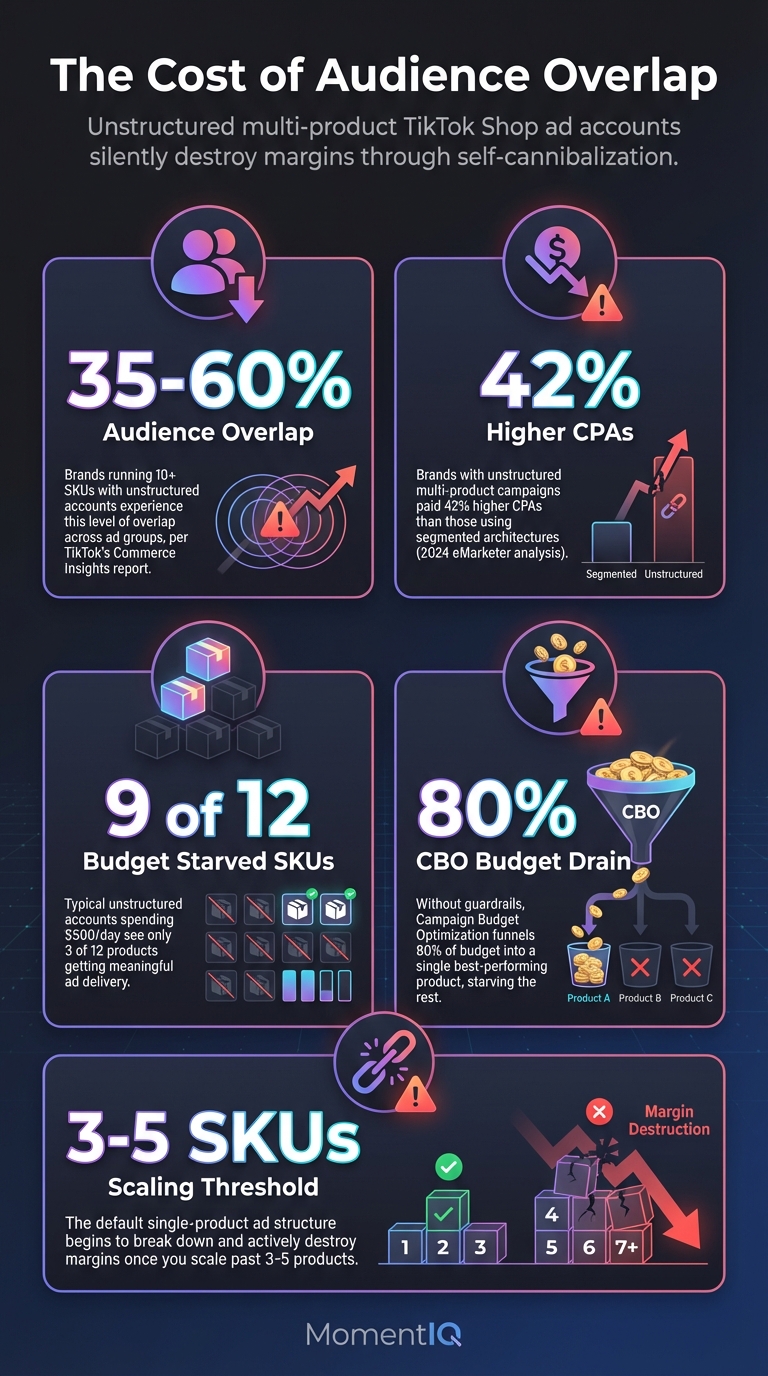
TikTok's ad delivery system uses a real-time auction model. When multiple ad groups target overlapping audiences, you're literally bidding against yourself. TikTok's real-time auction treats them as competing advertisers, regardless of brand.

The result:
- Inflated CPMs — you're driving up your own auction prices
- Suppressed delivery — TikTok throttles one ad group to avoid showing the same user two ads from the same account
- Inconsistent GMV — one product randomly dominates budget while others starve
- Misleading attribution — conversions are credited to the "winning" ad group, obscuring true product performance.
A 2024 eMarketer analysis of social commerce ad efficiency found that brands with unstructured multi-product campaigns paid 42% higher CPAs than those using segmented architectures — even when running identical creative quality.
This is the silent killer of multi-product TikTok Shop ad campaigns. And most brands don't even realize it's happening because the symptoms look like creative fatigue or audience saturation. Learn more about TikTok Shop Ad Creative Fatigue.
The Real Pain Points Multi-Product Sellers Face
If you're managing a TikTok Shop catalog with 10+ SKUs, you're probably dealing with several of these simultaneously:
- GMV inconsistency: One week your serum crushes it, the next week it flatlines while your moisturizer randomly spikes — with no clear explanation
- CAC inflation: Your cost per acquisition climbs despite weekly creative testing.
- Budget waste: You're spending significant amounts, but only a fraction of your products receive meaningful delivery.
- Creator content misallocation: Great UGC for Product A runs in campaigns targeting Product B's ideal customer.
- Scaling paralysis: Every time you add a new product to your ad account, everything else destabilizes. Avoid common TikTok Shop ad scaling mistakes that drain budgets.

These challenges are not random. They are direct consequences of a flawed TikTok Shop ad account structure.
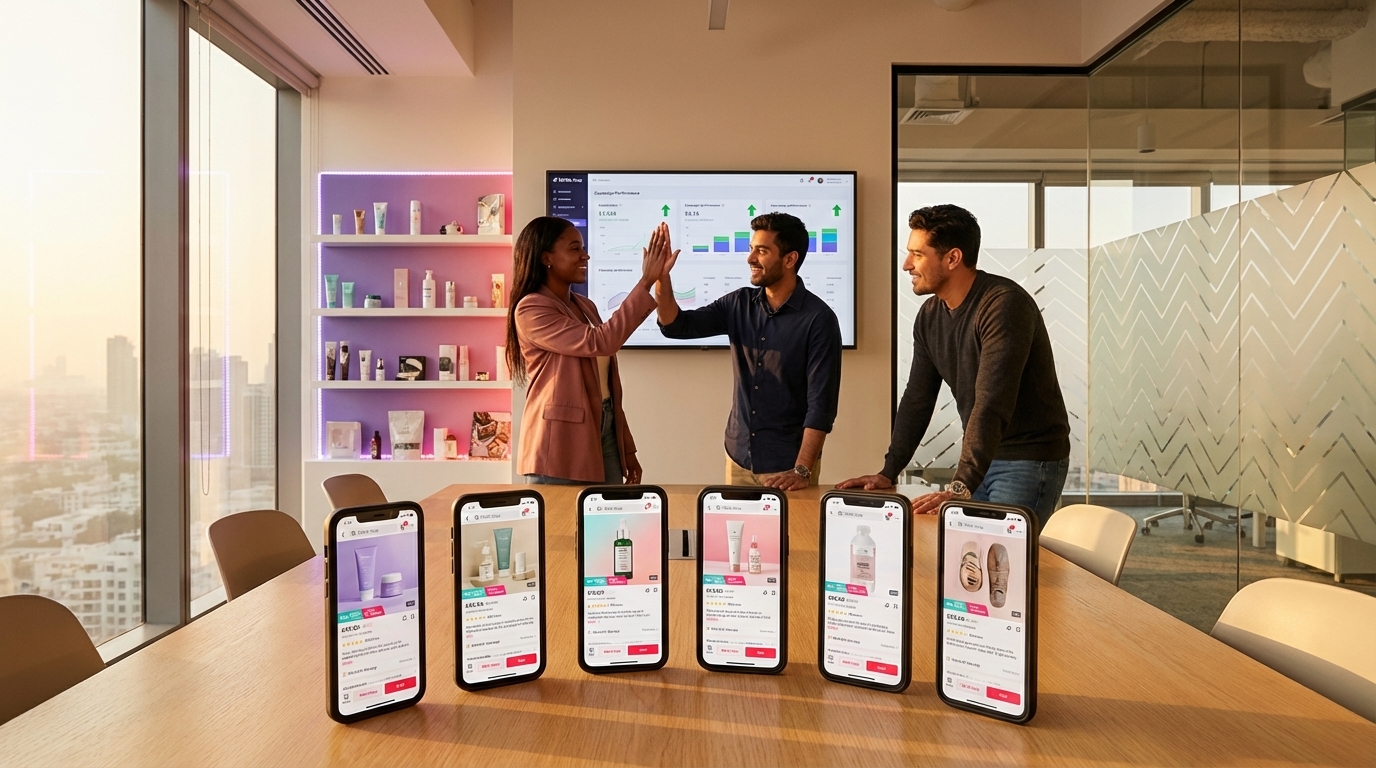
Optimized TikTok Shop ad campaigns are essential for scaling beyond organic reach.
The Multi-Product TikTok Shop Ad Account Structure Framework
This framework outlines the precise campaign architecture to prevent audience overlap, optimize budget allocation, and scale effectively across 10, 50, or even 100+ SKUs.

Step 1: Product Category Clustering
Before touching your ad account, cluster products into audience-defined categories, not just internal merchandising lines.
Most brands err by organizing campaigns by product line (e.g., "Skincare Line"). Instead, focus on purchase intent and audience profile.
Here's how to cluster correctly:
- Cluster by buyer persona, not product type. A $12 lip gloss and a $12 setting spray might share the same buyer even though they're in different product categories.
- Cluster by price point sensitivity. An $89 anti-aging serum attracts a fundamentally different audience than a $15 cleansing balm — even within the same brand.
- Cluster by purchase trigger. Impulse-buy products (under $25, visually compelling) need different campaign structures than considered purchases ($50+, benefit-driven).
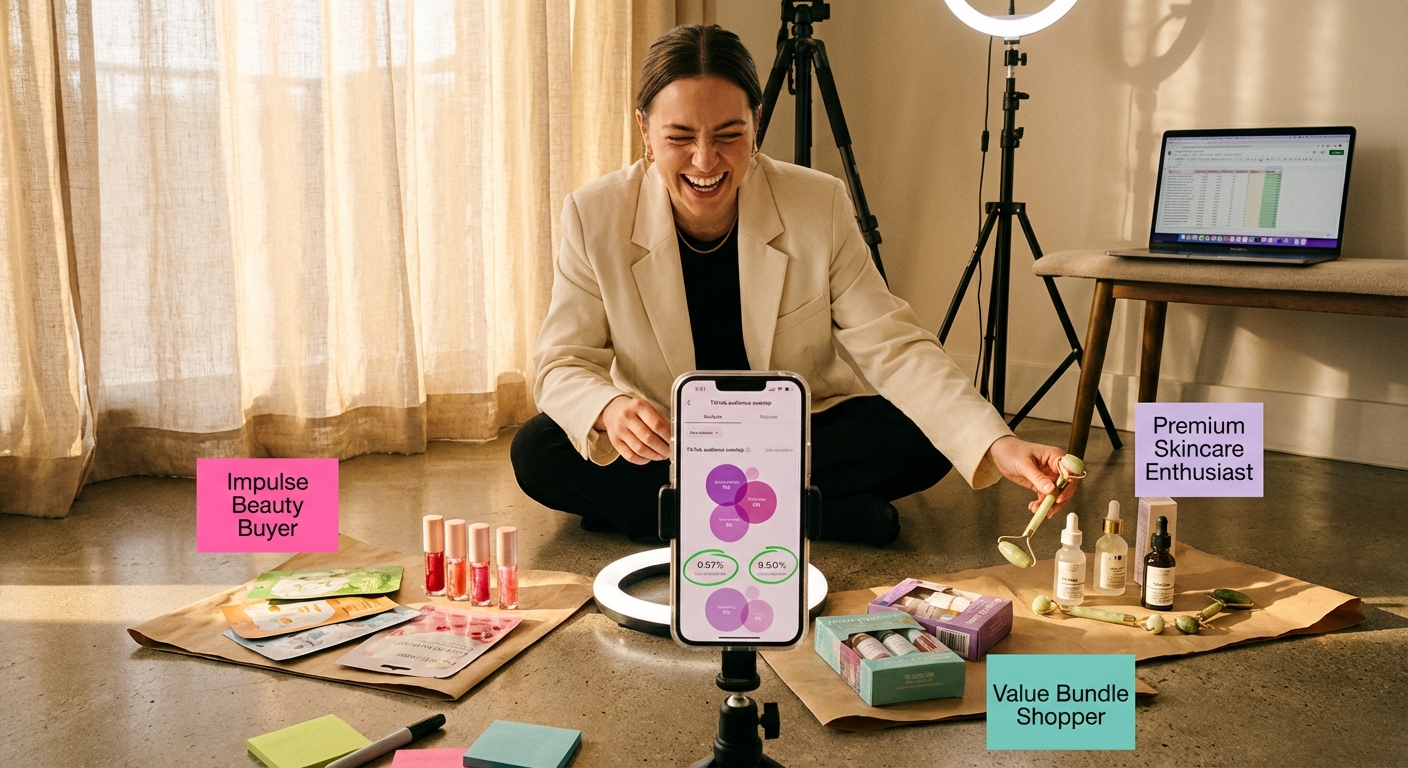
The goal: ensure each cluster has less than 15% estimated audience overlap with other clusters.
You can check overlap using TikTok Ads Manager's audience overlap tool under the "Audiences" section. If two clusters show more than 20% overlap, they need to be merged or their targeting needs to be differentiated further.
Step 2: Campaign-Level Architecture — CBO vs. ABO for Multi-Product Brands
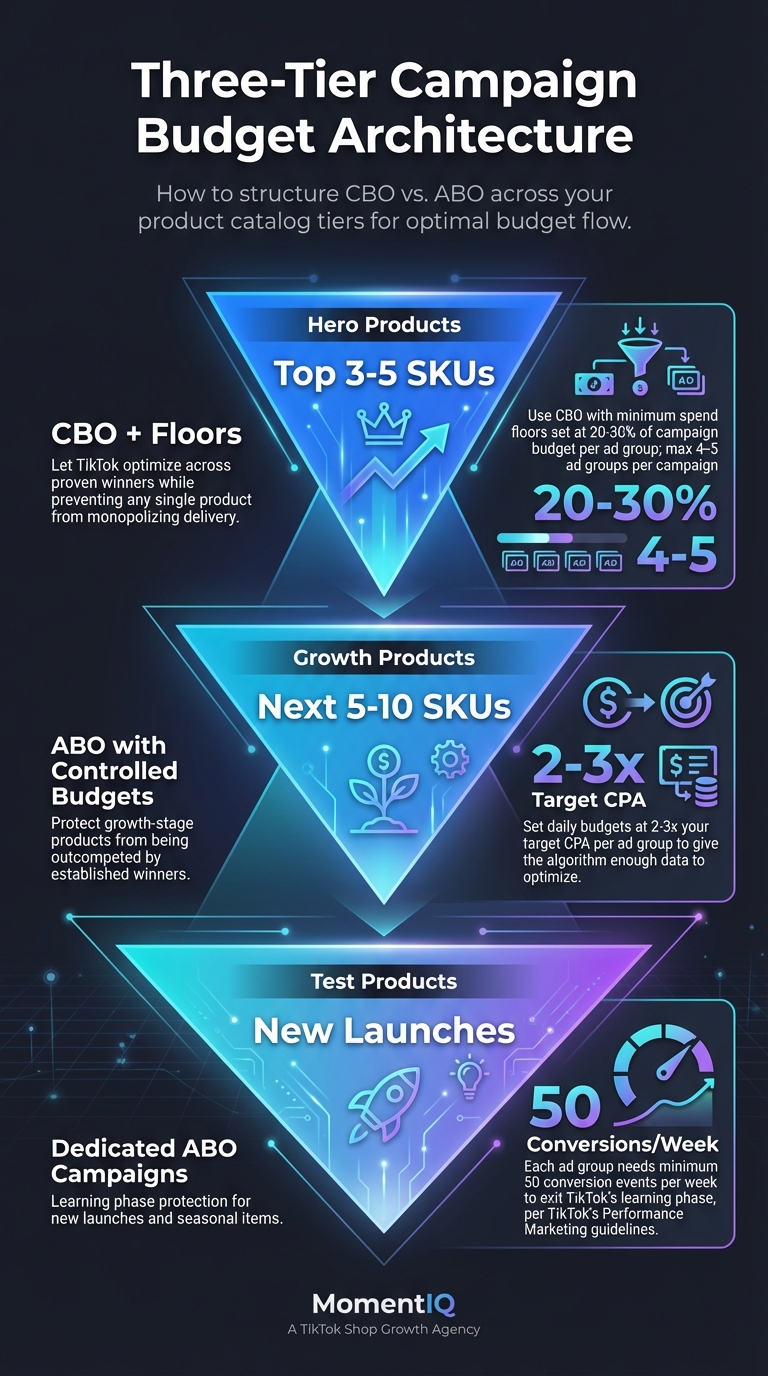
This decision dictates whether your budget flows intelligently or chaotically across your catalog.
Most sellers mistakenly default to Campaign Budget Optimization (CBO) for everything, assuming it's efficient. While CBO sounds hands-off, it can be detrimental for diverse catalogs.
However, for multi-product catalogs, CBO without guardrails often funnels 80% of your budget into a single best-performing product, starving others. This is ideal for a hero SKU strategy but catastrophic for a diversified portfolio.
The framework that works:
Tier 1: Hero Products (Top 3-5 SKUs by GMV) → CBO with Minimum Spend Floors
- Use CBO at the campaign level to let TikTok optimize across your proven winners
- Set minimum spend floors at the ad group level (typically 20-30% of the campaign budget per ad group) to prevent any single product from monopolizing delivery
- Maximum 4-5 ad groups per CBO campaign to maintain delivery efficiency
Tier 2: Growth Products (Next 5-10 SKUs) → ABO with Controlled Budgets
- Use Ad Group Budget Optimization (ABO) to give each product a dedicated, protected budget
- This prevents your growth-stage products from being outcompeted by established winners
- Set daily budgets at 2-3x your target CPA per ad group, providing sufficient data for algorithmic optimization.
Tier 3: Test Products (New launches, seasonal items) → ABO with Learning Phase Protection
- Dedicated ABO campaigns with minimum 50 conversions per week per ad group as your viability threshold
- If a product can't hit this threshold at your budget level, it needs to be consolidated into a broader ad group or tested through organic/creator content first
Pro tip: TikTok's Performance Marketing guidelines state ad groups require a minimum of 50 conversion events per week to exit the learning phase. For multi-product brands, ensure each product has enough budget to meet this threshold, or risk perpetual learning phases and wasted spend.
Step 3: Ad Group Segmentation Logic That Eliminates Overlap
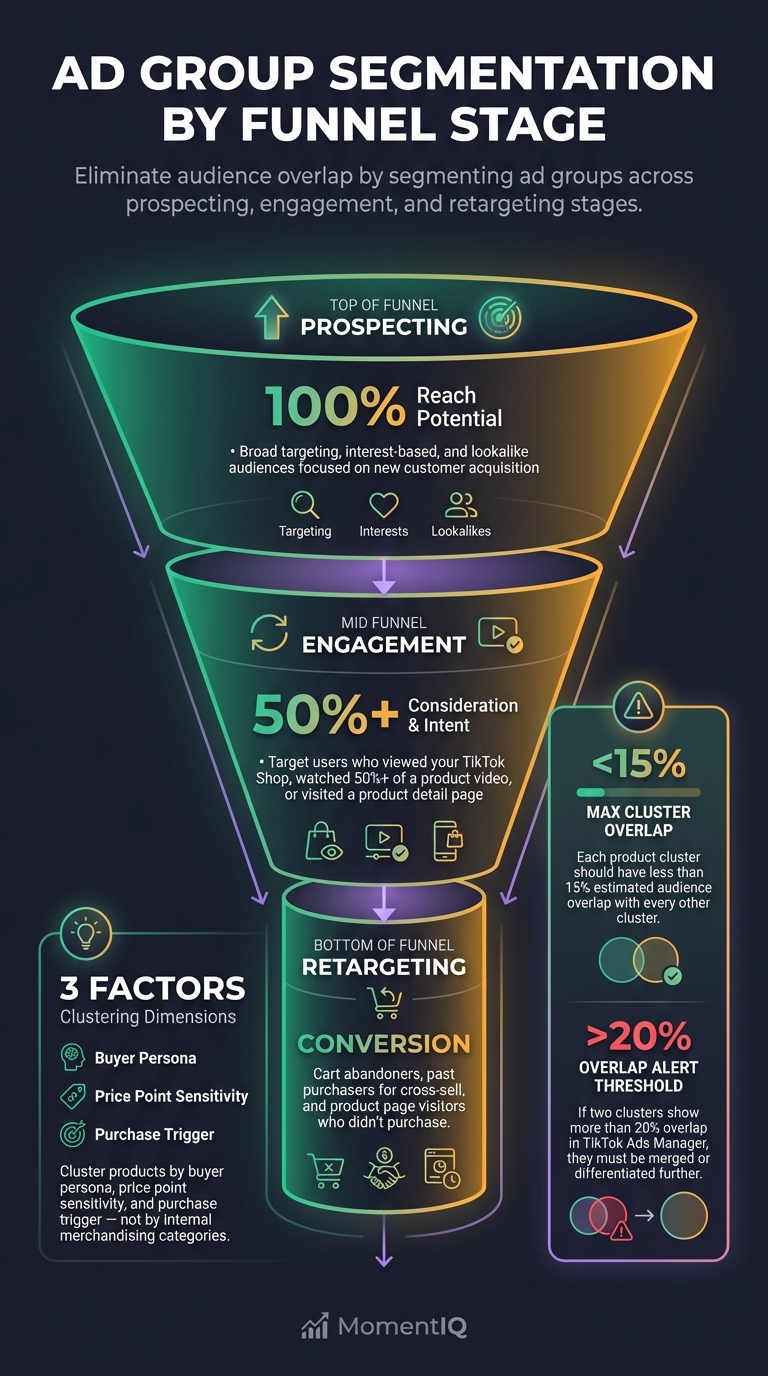
This is the core of effective architecture. Your ad group structure dictates whether products compete or complement each other.
The segmentation matrix for multi-product TikTok Shop ad strategy:
Dimension 1: Funnel Stage
- Prospecting ad groups: Broad targeting, interest-based, and lookalike audiences focused on new customer acquisition.
- Engagement ad groups: Targeting users who've viewed your TikTok Shop, watched 50%+ of a product video, or visited a product detail page
- Retargeting ad groups: Cart abandoners, past purchasers (for cross-sell), product page visitors who didn't purchase

Dimension 2: Product Cluster (from Step 1)
Each product cluster gets its own set of funnel-stage ad groups. Never mix product clusters within the same ad group.
Dimension 3: Audience Temperature
- Cold: No prior interaction with your brand
- Warm: Engaged with content but hasn't visited your shop
- Hot: Shop visitors, add-to-cart, initiated checkout
The resulting structure looks like this for a brand with 3 product clusters:
| Campaign | Ad Group | Audience | Product Cluster |
|---|---|---|---|
| Prospecting - CBO | AG1: Cold - Cluster A | Interest + Lookalike | Hero skincare |
| Prospecting - CBO | AG2: Cold - Cluster B | Interest + Lookalike | Impulse beauty |
| Prospecting - CBO | AG3: Cold - Cluster C | Interest + Lookalike | Premium sets |
| Retargeting - ABO | AG4: Hot - Cluster A | Cart abandoners | Hero skincare |
| Retargeting - ABO | AG5: Hot - Cluster B | Cart abandoners | Impulse beauty |
| Retargeting - ABO | AG6: Cross-sell | Past purchasers A → B | Impulse beauty |
This matrix ensures every dollar has a defined purpose, every audience a specific product, and prevents ad groups from competing for the same eyeballs.

Exclusion Audience Management: The Most Overlooked Lever in TikTok Shop Ad Campaign Organization
If campaign architecture is the skeleton, exclusion audiences are the immune system, preventing campaigns from self-cannibalization.
Here's the exclusion framework that prevents audience overlap across multi-product campaigns:
Mandatory Exclusion Rules
- Prospecting campaigns must exclude ALL retargeting audiences. While seemingly obvious, Statista's 2024 social advertising report reveals 67% of multi-product advertisers fail to maintain clean exclusion lists, leading to an average 28% budget waste.
- Each product cluster's prospecting ad groups must exclude converters from that cluster. If a customer purchased your vitamin C serum, stop prospecting them for that same product. Instead, move them into a cross-sell campaign for complementary items.
- Cross-sell campaigns must exclude recent purchasers within a product-specific cooldown window. Avoid hitting someone with a cross-sell ad just hours after purchase. Implement exclusion windows of 3-7 days post-purchase, tailored to your product category.
- High-frequency exclusions: Create a custom audience of users who've seen your ads 4+ times without engaging, then exclude them from prospecting. Stop paying to annoy non-customers.

Dynamic Exclusion Lists for 10+ SKU Catalogs
Managing exclusion audiences manually for 10+ products is a nightmare. Here's how to systematize it:
- Create audience segments by behavior, not by product. Instead of "People who bought Product A," create "All purchasers — last 30 days" and exclude from all prospecting.
- Use TikTok's automatic audience refresh to keep exclusion lists updated daily.
- Build a master exclusion spreadsheet mapping every ad group to its required exclusions. Update weekly.
This level of structural precision is why brands partnering with MomentIQ consistently outperform those managing ad accounts in-house. Our team builds and maintains these exclusion architectures across catalogs of 50-200+ SKUs — a level of operational complexity that breaks most internal teams within weeks.
For instance, a supplement brand spending $35K/month across 22 SKUs with a 1.8x blended ROAS saw remarkable improvement. After restructuring their campaign architecture and implementing proper exclusion management, they achieved 4.2x ROAS within 60 days — same budget, same creative, completely different structure. This demonstrates the power of architecture over execution.
Budget Allocation Frameworks for 10+ SKU Catalogs
With a structure preventing overlap, implement a budget allocation framework that maximizes total catalog GMV, not just your best-seller's performance.
The 60/25/15 Multi-Product Budget Framework
This allocation model has consistently delivered the strongest results for multi-product TikTok Shop brands:
- 60% → Proven performers (Tier 1 hero products): These cash cows fund the growth of other products. Run them in CBO campaigns with minimum spend floors.
- 25% → Growth products (Tier 2): Products with proven product-market fit but not yet at scale. Protected ABO budgets ensure sufficient data for optimization.
- 15% → Testing (Tier 3): New launches, seasonal pushes, creative experiments. Strict ABO with clear kill criteria (e.g., pause and iterate if CPA exceeds 2x target after 100+ conversions).
Budget Rebalancing Triggers
Don't set and forget. Rebalance weekly based on these triggers:
- Promote to Tier 1 when a Tier 2 product sustains target ROAS for 14+ consecutive days
- Demote to Tier 3 when a Tier 1 product's ROAS drops below 70% of target for 7+ days
- Kill a Tier 3 product's paid campaigns when it can't exit TikTok's learning phase after 2 budget cycles (reallocate to organic and creator content)
The brands crushing it on TikTok Shop treat budget allocation as a living system, not a quarterly planning exercise. TikTok's algorithm's preferences shift weekly; your budget should follow suit.
Advanced Architecture: Scaling From 10 to 100+ SKUs Without Structural Collapse
Most TikTok Shop ad account structures perform adequately at 10 products, but begin to crack at 25 and completely collapse beyond 50 SKUs.
Here's how to build architecture that scales:
The Modular Campaign Pod System
Instead of one monolithic account structure, organize your account into self-contained campaign pods — each pod manages 3-5 related products through the full funnel.
Each pod contains:
- 1 Prospecting CBO campaign (3-5 ad groups, one per product)
- 1 Retargeting ABO campaign (ad groups for cart abandoners, page viewers, video engagers)
- 1 Cross-sell ABO campaign (targeting purchasers of Pod products with complementary items)
- Shared exclusion audiences across the pod

Benefits of the pod system:
- Modular scaling: Add a new product by creating a new pod or slotting it into an existing one. No restructuring required.
- Clean performance tracking: Each pod has its own P&L. You can see exactly which product clusters are profitable.
- Team delegation: Different team members (or agency partners) can own different pods without stepping on each other.
- Controlled testing: New products enter a "test pod" before graduating to a permanent pod.
A home goods brand partnering with MomentIQ scaled from 8 to 67 active SKUs using this pod system over six months. Their blended ROAS improved from 2.1x to 3.8x during the scaling period — a counter-intuitive outcome compared to typical multi-product scaling challenges.

Naming Conventions That Prevent Chaos
While seemingly mundane, at 50+ products, poor naming conventions will cost you hours weekly in misallocated budgets and misread data. For official resources, see TikTok Ads Manager help center.
Use this format:
[Tier]-[Pod]-[Funnel Stage]-[Product Cluster]-[Audience Temp]-[Date]
Example: T1-Pod3-PROSP-AntiAging-COLD-0125
Every team member, every agency partner, every new hire can immediately understand what any campaign does, who it targets, and where it sits in your architecture.
"We Can Handle This In-House" — Why Multi-Product Ad Architecture Breaks Internal Teams
Let's address this directly because it's the most common objection we hear from brands spending $20K-$100K/month on TikTok Shop ads.
"We have a media buyer. We can structure our own campaigns."
You likely can for the first 10 products. Beyond that, the system often breaks due to:
- Exclusion list management across 50+ ad groups requires daily maintenance. One missed exclusion can waste thousands in a single weekend.
- Budget rebalancing across 15+ campaign pods requires monitoring 100+ data points daily. Most internal teams check weekly at best.
- Creative-to-structure alignment — knowing which ad creative belongs in which ad group based on audience temperature and product cluster — requires a level of systematic thinking that most media buyers aren't trained for.
- TikTok's algorithm changes require structural adaptation 4-6 times annually. If your media buyer juggles Meta, Google, and email, they won't catch these shifts in real-time.

According to TikTok's 2024 Commerce Partner Report, brands working with certified TikTok Shop Partners achieved 2.3x higher ROAS on average compared to self-managed accounts — and the gap widened significantly for brands with 15+ active SKUs.
This isn't about whether your team is smart enough. It's about whether multi-product TikTok Shop ad architecture is a full-time job — because it is.
And if you've been burned by agencies before, here's what makes this different: most agencies apply the same playbook across Meta, Google, and TikTok. TikTok Shop's commerce-native ad ecosystem, with its unique integration of Product Shopping Ads, Video Shopping Ads, Spark Ads, and LIVE Shopping Ads, demands a fundamentally different structural approach. Generic media buying expertise simply doesn't transfer.
MomentIQ is a TikTok Shop Partner of the Year and certified TikTok Marketing Partner. We don't adapt Meta strategies for TikTok; we build TikTok-native campaign architectures from the ground up, informed by proprietary data across hundreds of multi-product catalogs.

Effective TikTok Shop ad account structure is a specialized skill that yields significant returns.
The Audience Overlap Audit: How to Diagnose Your Current Account in 30 Minutes
Before rebuilding, diagnose the extent of the damage. Here's a quick diagnostic:
Step 1: Run the Overlap Report
In TikTok Ads Manager, go to Assets → Audiences → Audience Overlap. Select your top 10 ad groups by spend and check pairwise overlap.
- Under 15% overlap: Healthy. Your structure is working.
- 15-30% overlap: Warning zone. You're paying a tax but it's manageable.
- Over 30% overlap: Critical. You're actively bidding against yourself.
Step 2: Check Budget Concentration
Pull a report of spend distribution across all ad groups in the last 30 days.
- If 3 or fewer ad groups consumed 70%+ of total spend, your CBO campaigns are monopolizing budget.
- If more than 40% of ad groups spent less than $50 total, they never exited the learning phase and contributed nothing.
Step 3: Identify Frequency Stacking
Check average frequency across your account. If any audience segment sees your ads more than 4x per week across all campaigns combined, you have a structural overlap problem, not merely a frequency cap issue.
Step 4: Map Your Exclusions
List every ad group and its current exclusion audiences. Any prospecting ad group failing to exclude your retargeting audiences is an immediate fix, potentially yielding a 10-20% CPA reduction.
Putting It All Together: The 14-Day Implementation Roadmap
Here's how to restructure your multi-product TikTok Shop ad account without losing momentum:
Days 1-3: Audit & Cluster
- Run the overlap audit above
- Cluster your products by audience profile, price point, and purchase trigger
- Map your exclusion requirements
Days 4-7: Build New Architecture
- Create campaign pods for each product cluster
- Set up CBO campaigns for Tier 1, ABO for Tiers 2 and 3
- Implement all exclusion audiences
- Apply naming conventions
Days 8-10: Migrate & Launch
- Launch new campaigns at 50% of target budget
- Keep old campaigns running at 50% budget (don't kill them cold — you'll lose all learned data)
- Monitor delivery and overlap metrics daily
Days 11-14: Optimize & Transition
- Ramp new campaigns to full budget as they exit learning phase
- Pause old campaigns once new ones demonstrate stable delivery
- Set up weekly rebalancing cadence
Critical warning: Avoid restructuring your entire account on a Friday afternoon before the weekend. TikTok's algorithm requires supervised ramp-up periods. Brands that botch restructuring often make too many changes simultaneously without monitoring the transition.

The Cost of Waiting: Why Your Competitors Are Building This Architecture Right Now
TikTok Shop's U.S. GMV grew over 200% year-over-year in 2024, according to TikTok's Commerce division. eMarketer projects TikTok will capture $17.5 billion in U.S. social commerce sales by 2026. This rapid growth underscores the urgency of optimizing your TikTok Shop strategy.
The brands building sophisticated ad architectures now are locking in several compounding advantages:
- Algorithmic learning compounds over time. A well-structured campaign running for six months accumulates significantly more optimization data than a newly launched one, even with identical budgets.
- First-mover CPMs are lower. As more brands enter TikTok Shop ads, auction competition intensifies. Brands with established, efficient structures will maintain lower costs, while newcomers pay a premium.
- Cross-sell data builds your moat. Every purchase in your structured system feeds your cross-sell algorithms. A brand with 12 months of structured cross-sell data gains a targeting advantage that latecomers cannot replicate.
Statista projects social commerce ad spending will increase 34% in 2025 alone. Every month you operate an unstructured multi-product account, you incur a compounding overlap tax, while competitors with clean architecture reinvest those savings into growth.
Why MomentIQ Builds Multi-Product Ad Architectures Differently
Most agencies treat TikTok Shop ad management like a media buying exercise. Set up campaigns, optimize bids, test creative, report results.
MomentIQ treats it as a systems engineering problem.
Here's what that means in practice:
- Algorithmic creator matching through MomentIQ's proprietary platform ensures the right creator content feeds into the correct campaign pod, avoiding "good content" dropped into random ad groups.
- Full-funnel commerce integration connects your ad architecture to your organic content calendar, creator seeding program, and live commerce schedule, ensuring every channel reinforces rather than cannibalizes.
- Proprietary performance data from managing hundreds of multi-product TikTok Shop catalogs provides benchmarks your media buyer simply lacks.
- TikTok Shop Partner of the Year status means we have direct access to TikTok's commerce team for beta features, priority support, and platform insights that aren't publicly available.

One beauty brand with 34 SKUs, a $45K/month ad budget, and a 1.4x blended ROAS had previously tried two agencies applying generic social media strategies. Within 90 days of implementing our pod-based campaign architecture with proper exclusion management, they scaled to $340K/month in GMV at a 3.6x ROAS — without increasing their ad budget by a single dollar.
That's not magic. That's architecture.
MomentIQ's TikTok Shop ads team optimizes campaigns across Video Shopping Ads, Spark Ads, and Product Shopping Ads.
Your Next Move
If your multi-product TikTok Shop experiences climbing ad costs and flat GMV, the problem likely isn't your creative, products, or targeting.
It's your structure.
Structure, however, is a fixable problem with the right expertise.
Talk to a Strategist — we'll diagnose your exact audience overlap issues, map your ideal campaign architecture, and show you the specific ROAS improvement you can expect. No obligation, no generic pitch deck. Just a custom structural analysis of your ad account from the team that TikTok named Partner of the Year.

Brands that build the right architecture now will not only save on ad costs today but also gain a compounding algorithmic advantage, making them nearly impossible to outbid tomorrow.
The window is open. Your competitors are already walking through it.