TikTok Shop Content Calendar: The 60-Day Blueprint
A 60-day TikTok Shop content calendar blueprint: posting cadence, pillar rotation, and planning systems that end blank-page publishing for good.
Here's the uncomfortable truth most TikTok Shop sellers won't admit: they're publishing content without a plan.
- Unify your owned, creator, and paid content into a single coordinated calendar to avoid the three-silo problem bleeding your GMV.
- Amplify top-performing creator videos with Spark Ads immediately—delays of even a few days cause you to miss the algorithm window.
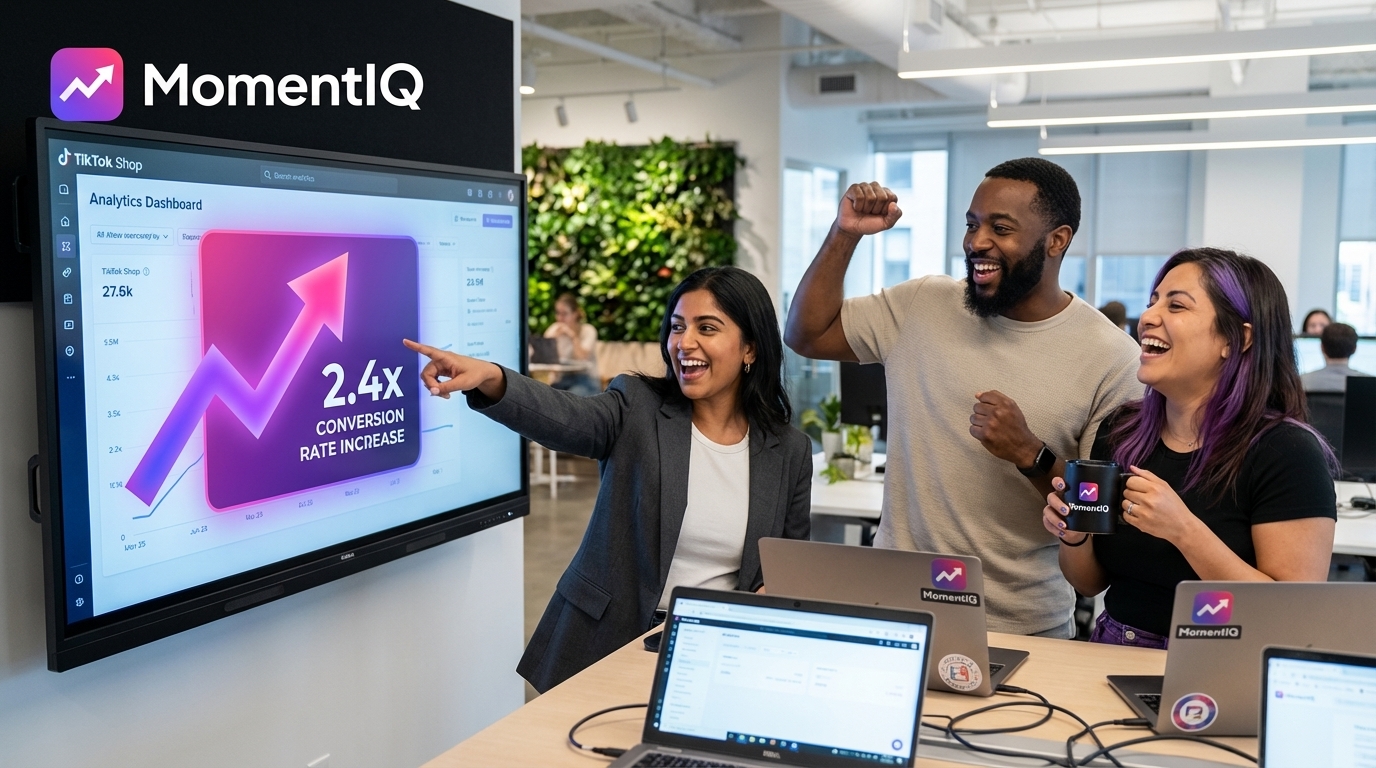
- Synchronize organic, creator, and paid content to achieve up to 2.4x higher conversion rates versus running each channel independently.
- Align creator and affiliate posting schedules with your promotional calendar so product launches have simultaneous social proof.
- Post brand content daily with strategic intent rather than reactively 2-3 times per week to drive up to 3.2x more organic discovery.
Your brand account posts when someone on the team "has time." Your affiliate creators publish whenever they feel like it — if they publish at all. Your paid ads launch on a completely separate timeline from everything else. And your GMV chart looks like an EKG reading — wild spikes followed by flatlines that make your CFO nervous.
Sound familiar?
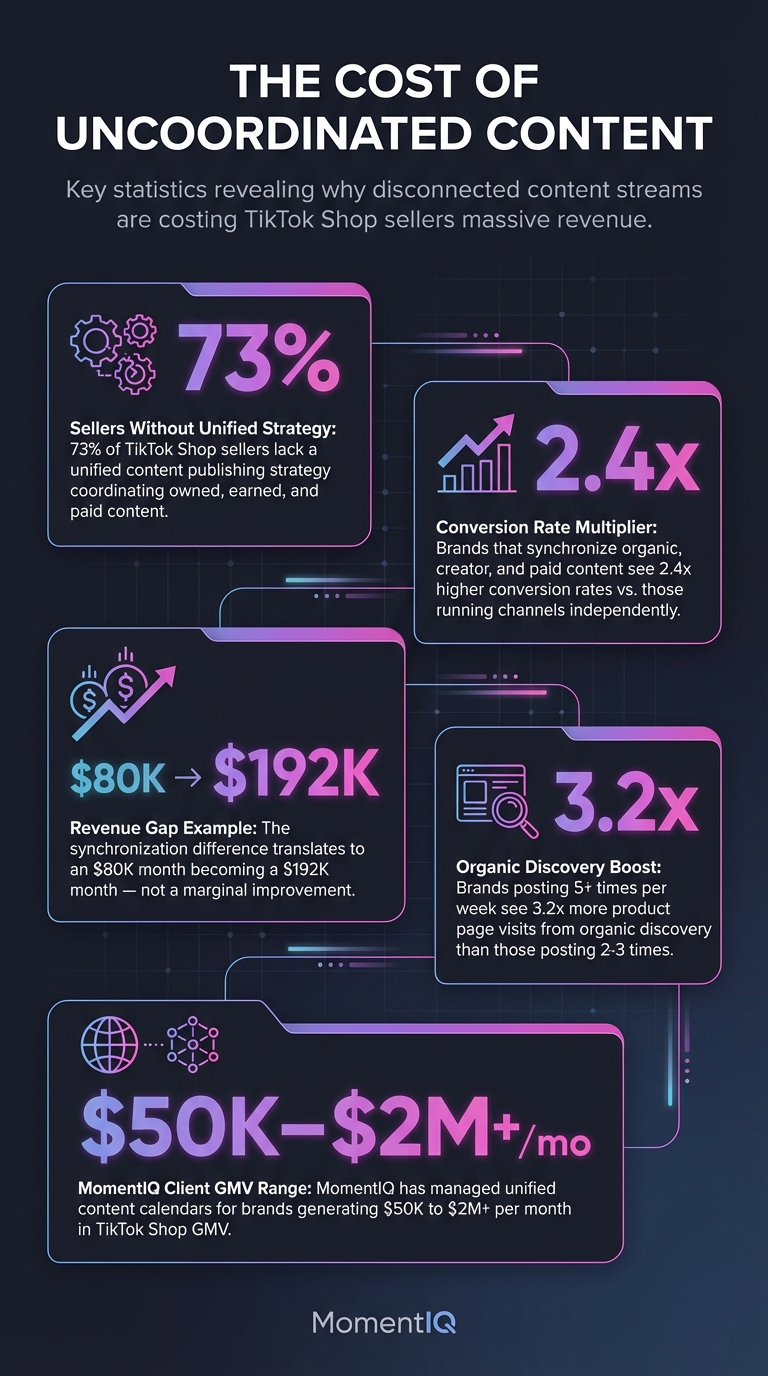
You're not alone. According to TikTok's own Commerce Insights report, 73% of TikTok Shop sellers lack a unified content publishing strategy that coordinates owned, earned, and paid content. They're running three separate content engines that never sync — and leaving massive revenue on the table because of it.
A proper TikTok Shop content calendar isn't just a nice-to-have organizational tool. It's the operational backbone that turns sporadic sales into predictable, compounding GMV growth. In this guide, we're giving you the exact 60-day posting schedule, automation triggers, and coordination framework that separates top sellers from everyone else scrambling for scraps.
If you'd rather have a team build and execute this entire calendar for you, Talk to a Strategist. As TikTok Shop Partner of the Year, MomentIQ has built and managed unified content calendars for brands generating $50K to $2M+ per month in TikTok Shop GMV.
Let's build yours.
Why Most TikTok Shop Posting Schedules Fail (And Cost You Thousands)
Before we hand you the blueprint, let's diagnose why your current approach is bleeding money.
The Three-Silo Problem
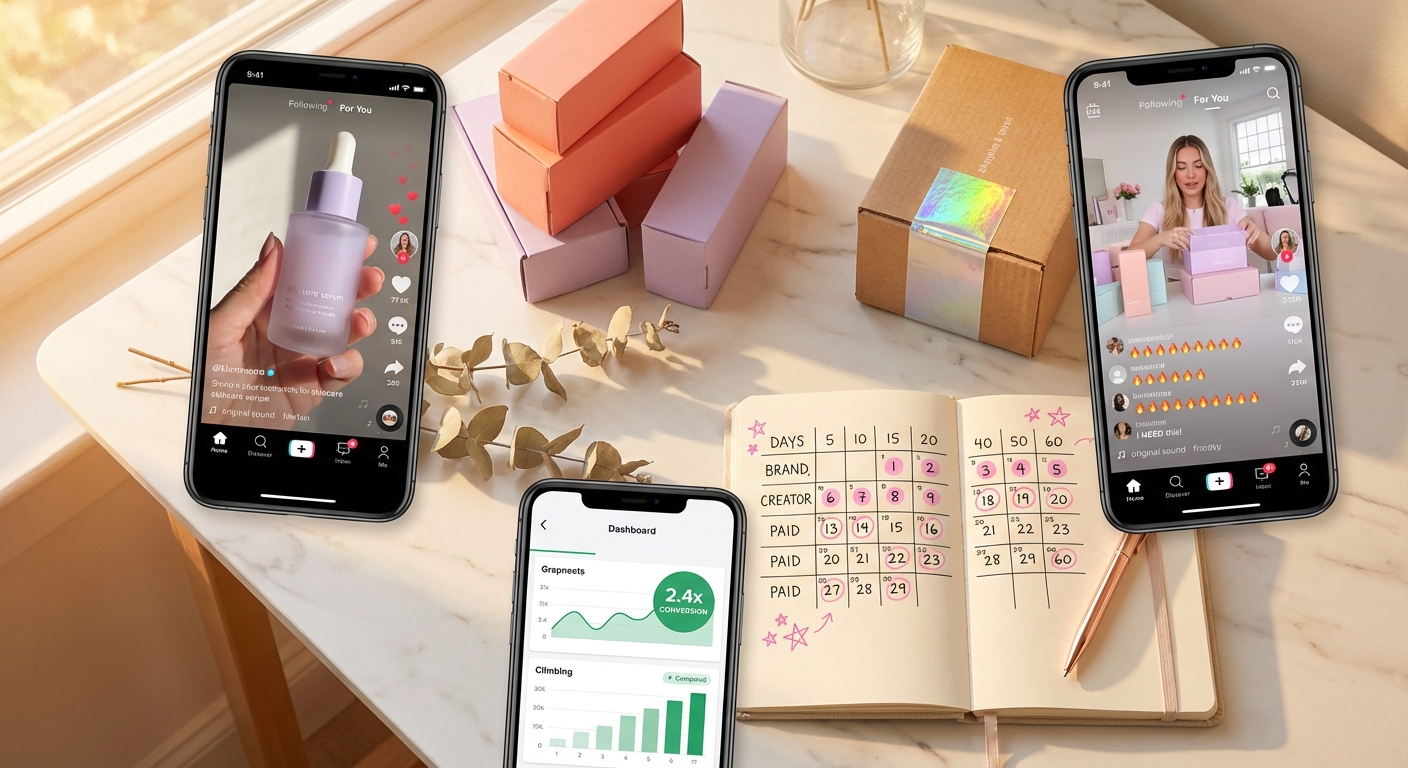
Most TikTok Shop sellers operate three completely disconnected content streams:
- Owned content (your brand's TikTok account) — posted reactively, usually 2-3 times per week with no strategic intent.
- Creator/affiliate content — published whenever creators get around to it, with zero coordination around your promotional calendar. Learn to coordinate your creator affiliate network.
- Paid ads — launched by a media buyer who has no visibility into what organic or creator content is performing, often leading to wasted small budget ad campaigns.
This fragmented approach leads to missed opportunities and inconsistent sales.
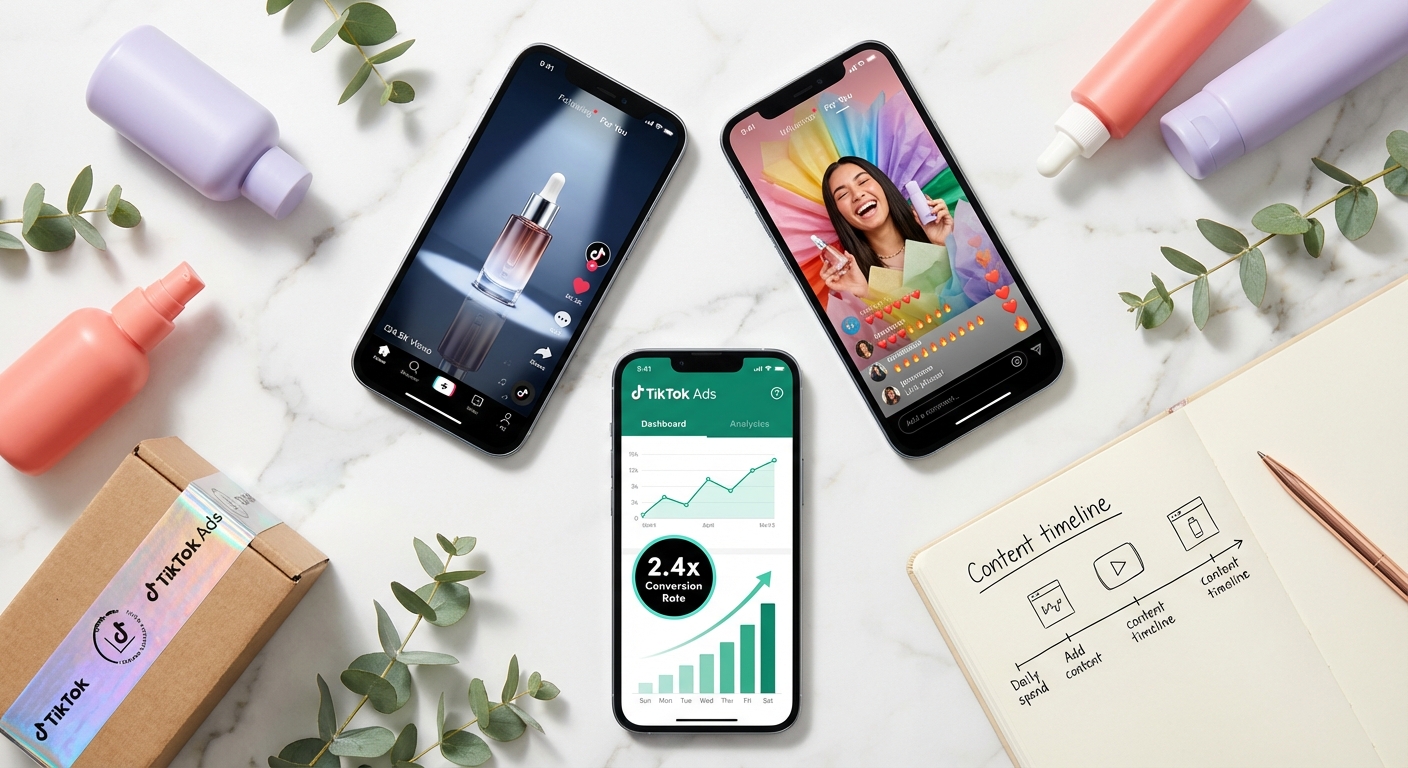
The result? Your best-performing creator video goes viral on Tuesday, but your ad team doesn't amplify it with Spark Ads until Friday — after the algorithm has already moved on. Your brand account teases a new product launch, but no creator content supports it for another two weeks. Your paid campaigns drive traffic to product pages with zero social proof because no recent creator reviews exist.
This isn't a content problem. It's a coordination problem. And it's the single biggest reason TikTok Shop sellers experience the gut-wrenching GMV inconsistency that keeps them up at night.
According to eMarketer's 2024 Social Commerce report, brands that synchronize organic, creator, and paid content see 2.4x higher conversion rates compared to those running each channel independently. That's not a marginal improvement — that's the difference between an $80K month and a $192K month.
Why a Generic Social Media Calendar Won't Work
You might be thinking: "I already use a content calendar. I have a spreadsheet."
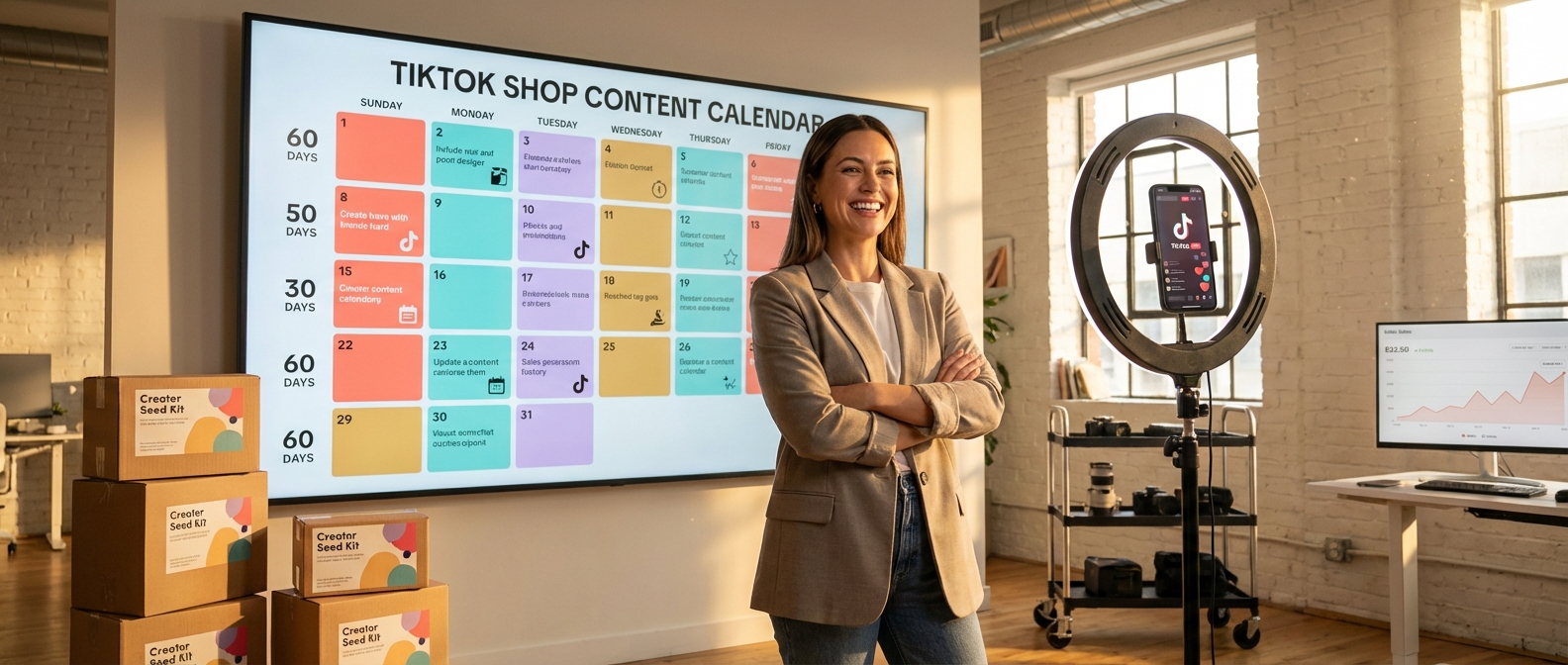
Here's what most sellers get wrong: a TikTok Shop content calendar is fundamentally different from a standard social media calendar. It's not about scheduling posts. It's about orchestrating a commerce ecosystem where every piece of content — owned, creator, and paid — reinforces the others at precisely the right moment in the buyer's journey.
A true TikTok Shop content calendar is a dynamic system, not just a static schedule.
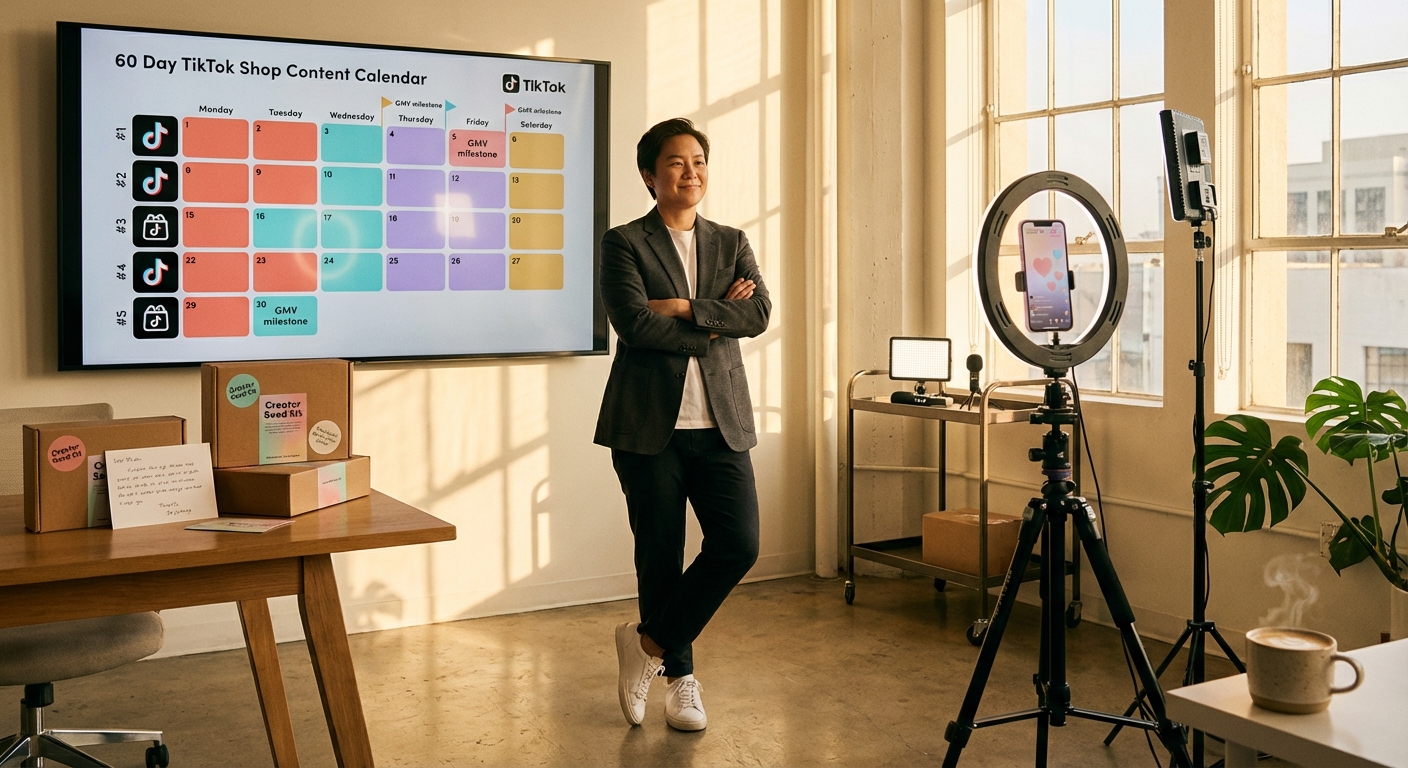
A standard content calendar tells you when to post. A TikTok Shop content calendar tells you:
- What content type to publish (product demo, unboxing, testimonial, comparison, tutorial).
- Which channel should carry it (brand account, specific creator tier, paid amplification).
- What commerce trigger it supports (new listing push, review velocity, algorithmic momentum, flash sale warm-up).
- What automation fires when performance thresholds are hit (Spark Ad activation, creator re-brief, inventory alert).
That's what we're building today. For deeper insights, check out our guide on The Ultimate TikTok Shop Creator Performance Dashboard.
Having a structured content strategy is what separates top-performing shops from the rest.
The TikTok Content Planning Framework: Three Content Pillars That Drive Commerce

Before mapping the 60-day schedule, you need to understand the three content pillars and how they interact.
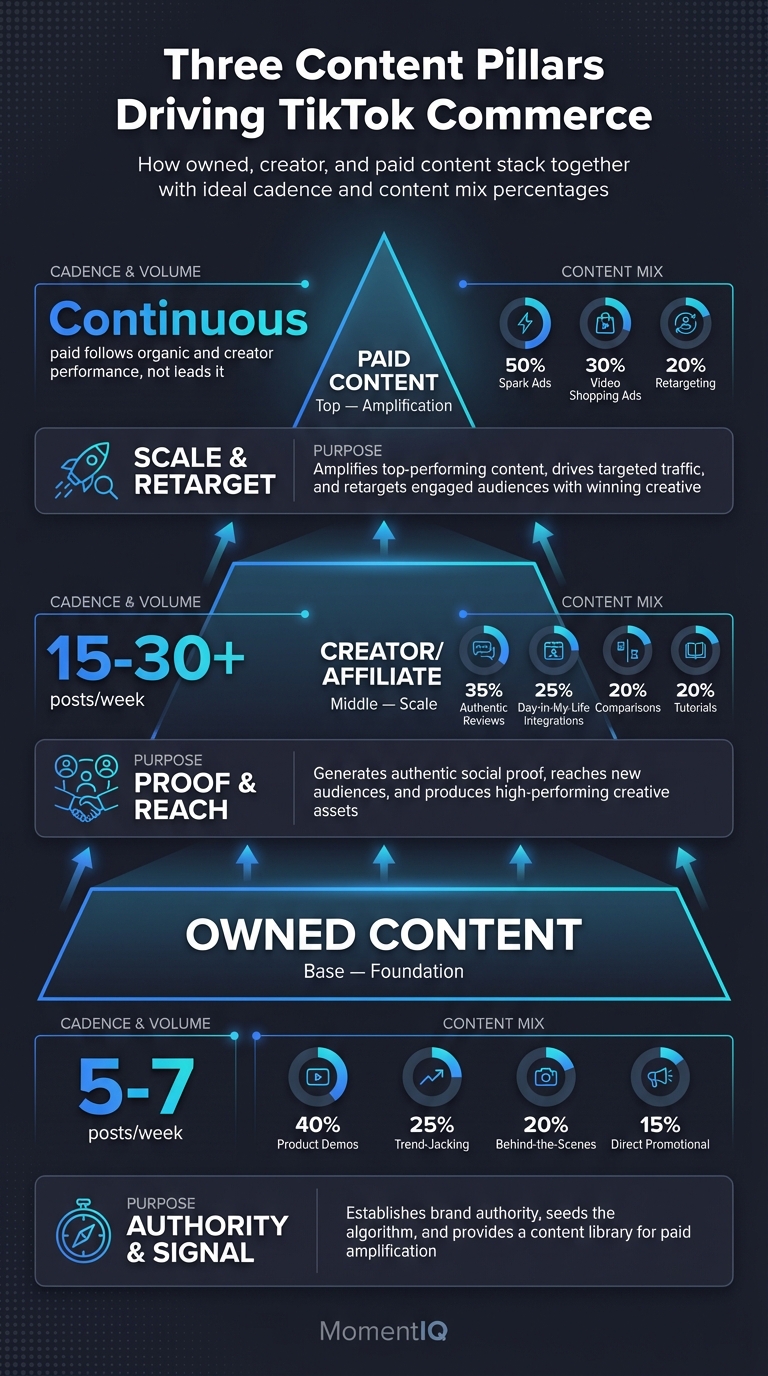
Pillar 1: Owned Content (Your Brand Account)
Purpose: Establish authority, showcase products in your brand voice, seed the algorithm with signals, and provide a content library for paid amplification.
Ideal cadence: 5-7 posts per week (yes, daily or near-daily).
Your brand's presence is the foundation.
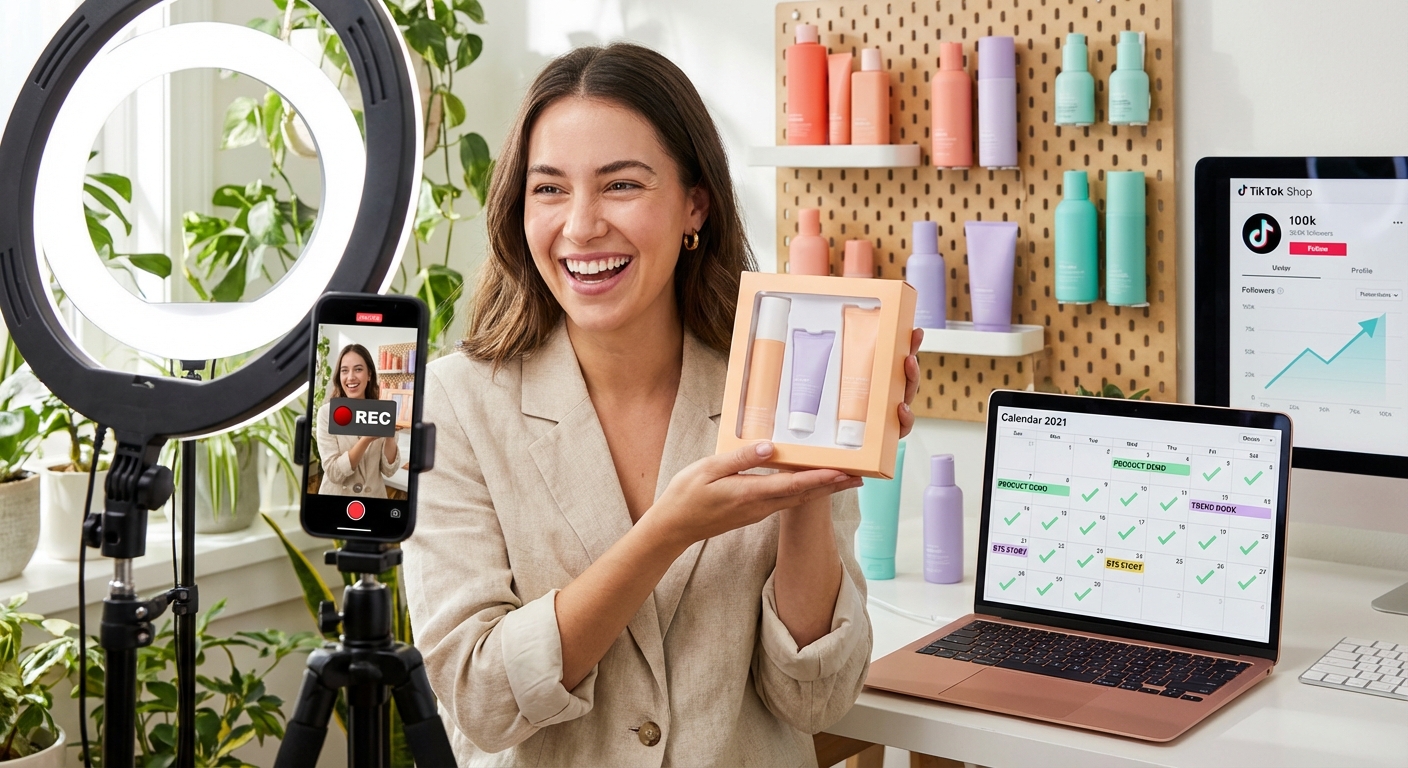
Content mix:
- 40% product demonstrations and tutorials. Master hook writing for scroll-stopping content.
- 25% trend-jacking with product integration.
- 20% behind-the-scenes and brand storytelling.
- 15% direct promotional (flash sales, bundles, limited offers).
This consistent output builds algorithmic trust.

Key insight: Your owned content isn't primarily about going viral. It's about creating a consistent signal to TikTok's algorithm that your brand is active, relevant, and commerce-ready. Brands posting 5+ times per week see 3.2x more product page visits from organic discovery than those posting 2-3 times, according to TikTok's 2024 Shop Seller Performance data.
Pillar 2: Creator/Affiliate Content
Purpose: Generate authentic social proof, reach new audiences, drive affiliate GMV, and produce high-performing creative assets for paid amplification.
Ideal cadence: 15-30+ creator posts per week (depending on your creator roster size).
Creators provide authentic social proof and reach new audiences.
Content mix:
- 35% authentic reviews and first impressions.
- 25% "day in my life" product integrations.
- 20% comparison and "why I switched" content.
- 20% tutorial and hack-style content.
The scaling challenge: This is where most sellers hit a wall. Managing 10 creators manually is doable. Managing 50-200+ creators — tracking who's posted, what's performing, who needs re-engagement, and which content to amplify — is a full-time operation. If you're feeling this pain, our existing guide on the creator scaling playbook dives deeper into operational frameworks.
Pillar 3: Paid Content (Video Shopping Ads & Spark Ads)
Purpose: Amplify top-performing organic and creator content, drive targeted traffic to product pages, retarget engaged audiences, and scale winning creative.
Ideal cadence: Continuous with weekly creative refreshes and daily budget optimization.
Content mix:
- 50% Spark Ads (amplifying top creator and owned content).
- 30% Video Shopping Ads (purpose-built ad creative, see our guide on TikTok Shop Ad Creative Strategy).
- 20% retargeting and dynamic product ads (learn more about TikTok Shop Dynamic Retargeting Ads).
Critical rule: Paid should follow organic and creator performance, not lead it. The brands burning through ad budgets fastest are the ones creating ads in a vacuum. The brands crushing ROAS are the ones watching what works organically, then pouring fuel on proven creative.
Paid amplification scales your most effective content.

The 60-Day TikTok Shop Content Calendar: Week-by-Week Breakdown
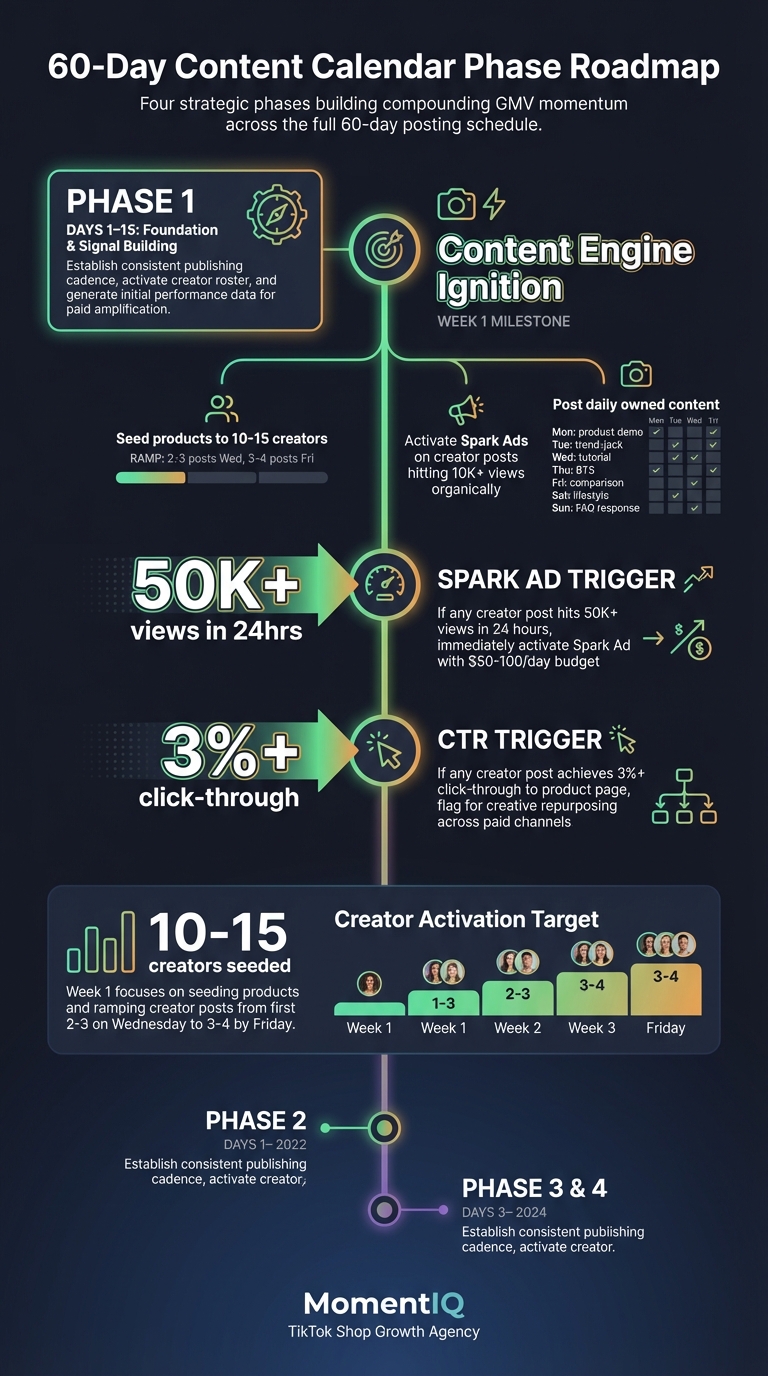
Here's your complete TikTok Shop posting schedule broken into four phases across 60 days. Each phase builds on the last, creating compounding momentum.
Phase 1: Foundation & Signal Building (Days 1-15)
Goal: Establish consistent publishing cadence, activate your creator roster, and generate initial performance data for paid amplification.
Week 1: Content Engine Ignition
| Day | Owned Content | Creator Content | Paid Content |
|---|---|---|---|
| Mon | Product demo (hero SKU) | Seed products to 10-15 creators | Set up Spark Ad campaigns (paused) |
| Tue | Trend-jack with product | — | — |
| Wed | Tutorial/hack video | First 2-3 creator posts go live | — |
| Thu | Behind-the-scenes | 2-3 more creator posts | — |
| Fri | Product comparison | 3-4 creator posts | Activate Spark Ads on any creator post hitting 10K+ views organically |
| Sat | Weekend lifestyle content | 2-3 creator posts | Monitor and scale |
| Sun | User question/FAQ response | — | — |
Week 1 automation triggers:
- If any creator post hits 50K+ views in 24 hours → Immediately activate Spark Ad with $50-100/day budget.
- If any creator post achieves 3%+ click-through to product page → Flag for creative repurposing in owned content.
- If creator hasn't posted within 5 days of receiving product → Trigger follow-up sequence.
Week 2: Amplification & Learning
Owned content cadence: Maintain 5-7 posts. Introduce 1-2 posts that directly reference or duet creator content ("Look what @creator discovered about our product").
Creator content cadence: Target 15-20 creator posts this week. Activate your second wave of product seeding to 15-20 additional creators.
Paid content moves:
- Allocate 60% of ad budget to Spark Ads on top-performing creator content.
- Launch 2-3 Video Shopping Ads using hooks and formats validated by organic performance.
- Begin A/B testing thumbnails and opening hooks (see our TikTok Shop Ad A/B Testing Playbook for the scientific framework).
Key metric to track: Cost per acquisition (CPA) differential between Spark Ads and standalone Video Shopping Ads. Statista reports that Spark Ads typically deliver 30-50% lower CPA than standard in-feed ads because they carry organic social proof.
Days 11-15: Data Consolidation

By day 15, you should have:
- 35-50 owned posts published.
- 25-40 creator posts live.
- Clear data on which content formats, hooks, and products drive the highest click-through and conversion.
- 3-5 "winning" creative assets identified for scaled paid amplification.
This is where most DIY sellers stall. They have the data but lack the systems to act on it fast enough. By the time they manually identify a winning creator video, brief new creators based on that format, and adjust their ad strategy, the algorithmic moment has passed.
This is exactly why MomentIQ's proprietary data analytics platform exists. Our systems identify winning content patterns within hours — not days — and automatically trigger creator re-briefs and paid amplification. The result? One supplement brand used this exact framework to scale from $18K to $420K/month in 90 days through MomentIQ's algorithmic creator matching and unified content orchestration.
Phase 2: Momentum Building (Days 16-30)
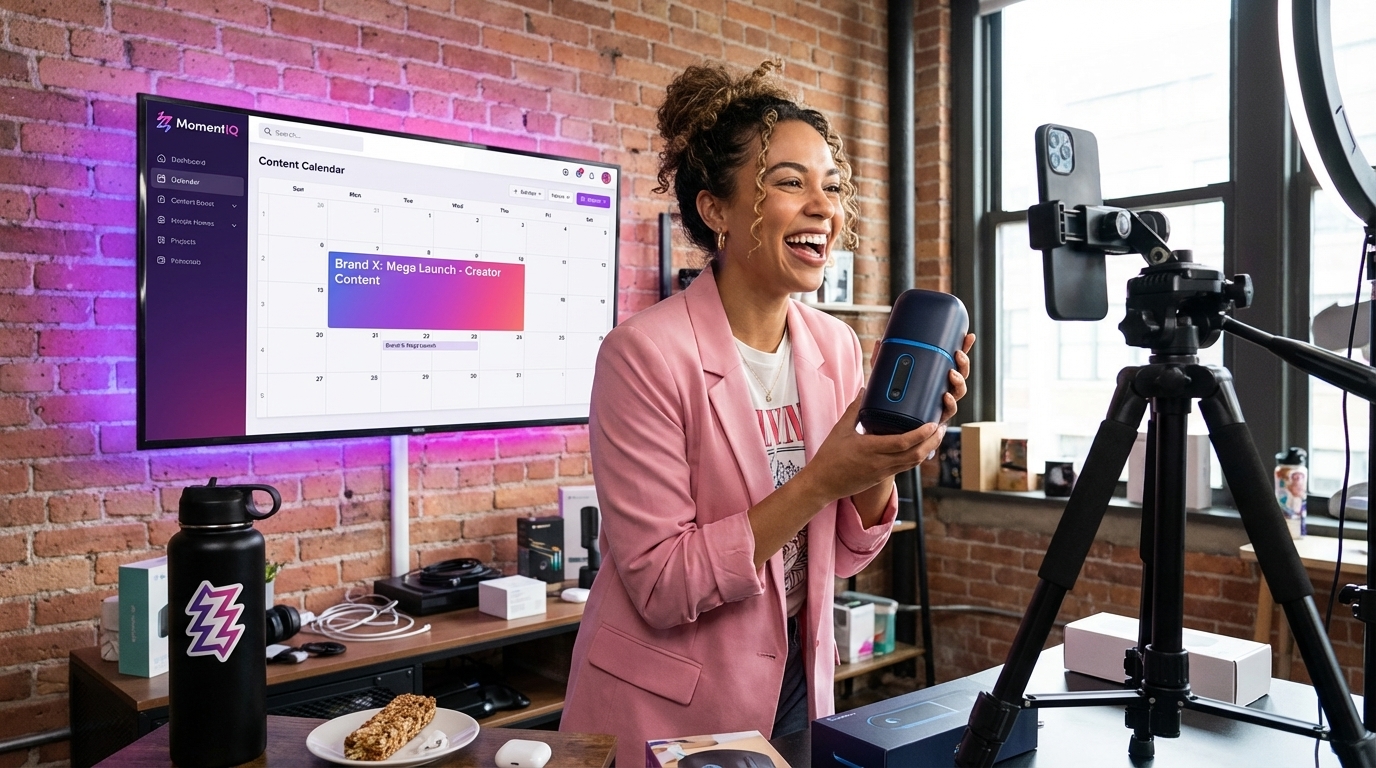
Goal: Scale what's working, introduce content variety, and build toward your first major promotional event.
Week 3-4 Content Cadence

Owned content evolution:
- Increase to 7 posts per week (daily publishing).
- Introduce "social proof compilation" content — stitch together clips from multiple creator reviews.
- Begin teasing an upcoming promotional event (flash sale, bundle drop, exclusive offer) starting Day 20.
- Publish 2 posts per week that directly address common customer objections or FAQs.
Creator content scaling:
- Target 25-40 creator posts per week by end of Phase 2.
- Introduce tiered content assignments:
- Top performers (top 10% by GMV): Brief them on specific high-converting formats identified in Phase 1.
- Mid-tier creators: Provide updated briefs incorporating winning hooks and angles.
- New recruits: Seed products with optimized briefs based on 15 days of performance data. For more on scaling, check out our guide on TikTok Shop Creator Management: Scale to 100+.
Paid content escalation:
- Increase budget 30-50% on proven Spark Ads.
- Kill underperforming ads (anything below 1.5x ROAS after $200 spend).
- Launch retargeting campaigns targeting users who watched 50%+ of any creator or owned content.
- Begin building lookalike audiences from TikTok Shop purchasers.
The Day 25 Promotional Warm-Up Sequence
This is where the unified calendar creates magic that siloed approaches can't replicate:
| Day | Action |
|---|---|
| Day 25 | Owned: Tease upcoming sale ("Something big is coming Friday") |
| Day 26 | 5-8 creators post "I heard [brand] is doing something crazy this week" content |
| Day 27 | Owned: Reveal the offer with countdown. Paid: Launch awareness ads featuring the offer |
| Day 28 | Creators post "last chance to grab this" content. Paid: Retarget all engaged users |
| Day 29 | PROMOTIONAL EVENT DAY. All three pillars fire simultaneously |
| Day 30 | Owned: Results/thank you post. Creators: "I can't believe this sold out" reaction content |
Why this works: TikTok's algorithm rewards content velocity and engagement clustering. When multiple accounts — your brand, 15+ creators, and paid ads — all reference the same product or offer within a 48-72 hour window, the algorithm identifies it as a trending topic and amplifies organic reach by 40-60%, according to TikTok's Creator Commerce Playbook.
Phase 2 benchmark: By Day 30, brands following this calendar typically see a 45-70% increase in daily GMV compared to their pre-calendar baseline.
Phase 3: Optimization & Scaling (Days 31-45)
Goal: Double down on winning formats, prune underperformers, and build systematic content loops.
The Content Flywheel

By Day 31, you should have enough data to build what we call the Content-to-Commerce Flywheel:
- Identify → Your analytics reveal which 3-5 content formats consistently drive the highest GMV per view.
- Brief → Update all creator briefs to prioritize these formats (reference our TikTok Shop Creator Brief Template Guide for the exact framework).
- Amplify → Allocate 70%+ of paid budget to Spark Ads on content matching winning formats.
- Replicate → Your owned content mirrors the winning creator formats with brand-specific angles.
- Measure → Track performance, identify the next wave of winning formats, repeat.
This flywheel is the difference between linear growth and exponential growth. And it's nearly impossible to execute manually at scale.
Week 5-6 Tactical Calendar

Owned content (7/week):
- 3 posts in proven high-converting formats.
- 2 trend-responsive posts (maintain algorithmic freshness).
- 1 behind-the-scenes/brand story post.
- 1 direct promotional post.
Creator content (30-50/week):
- Top 20% of creators: 2 posts/week each with performance-optimized briefs.
- Remaining active creators: 1 post/week.
- New creator onboarding: 10-15 new creators seeded per week to maintain pipeline.
Paid content:
- Weekly creative refresh — retire any ad running 7+ days with declining ROAS.
- Scale budget on top 3 Spark Ads by 20% every 3 days if ROAS holds.
- Launch Product Shopping Ads for hero SKUs with strongest review velocity.
Automation Triggers for Phase 3
These are the automation rules that separate amateur operations from professional TikTok Shop management:
- Creator post hits 100K views in 48 hours → Auto-activate Spark Ad, increase creator's commission tier, brief them for a follow-up post.
- Product review count drops below 5 new reviews/week → Trigger product seeding to 10 additional creators. For more on reviews, check our TikTok Shop Review Generation Playbook.
- ROAS on any ad drops below 1.2x for 3 consecutive days → Auto-pause and flag for creative refresh.
- Any SKU sells out 80% of inventory → Pause paid spend, notify creators, shift budget to next-best SKU. Learn more about TikTok Shop Inventory & Stockout Strategy.
- Competitor launches similar product → Trigger "comparison" content briefs to top 5 creators.
"We don't have the budget for an agency to manage all of this."
Let's do the math. A dedicated in-house TikTok Shop content coordinator costs $55-75K/year in salary alone — before tools, training, and management overhead. That person can realistically manage 20-30 creator relationships and publish 5 owned posts per week. They can't build algorithmic matching systems, can't process performance data across 200+ creator posts in real-time, and can't coordinate paid amplification triggers at the speed the algorithm demands.
MomentIQ delivers the output of an entire content operations team — creator matching, product seeding, content coordination, and paid amplification — at a fraction of the cost of building internally. One home goods brand replaced a 3-person in-house team with MomentIQ's managed services and saw GMV increase 280% in the first 60 days while reducing total content operations cost by 40%.
Phase 4: Compounding & Systematization (Days 46-60)

Goal: Lock in repeatable systems, plan the next 60-day cycle, and build the content moat that competitors can't easily replicate.
Week 7-8: The Compounding Effect
By this phase, your TikTok Shop content calendar should be generating compounding returns:
- Organic reach compounds as consistent posting trains the algorithm to favor your brand account.
- Creator content compounds as your growing library of reviews and demonstrations creates social proof that converts new viewers at higher rates.
- Paid efficiency compounds as your Spark Ad library grows and your retargeting audiences deepen.
- Data compounds as 45+ days of performance data gives you predictive insight into what will work next.
Statista projects TikTok Shop GMV in the US will reach $17.5 billion by end of 2025, up from $9 billion in 2024. The brands building systematic content operations right now are the ones who will capture a disproportionate share of that growth. Every week you delay building this system, your competitors are compounding their algorithmic advantage.
The Day 46-60 Calendar Focus

Owned content: Begin planning and teasing your next major promotional event (to land in the next 60-day cycle). Introduce new product lines or SKU expansions with dedicated content series.
Creator content:
- Conduct creator performance review — identify your top 10% and offer exclusivity or elevated commission tiers to lock them in (see our TikTok Shop Creator Exclusivity Deals Guide for when this makes sense).
- Offboard consistently underperforming creators (below 0.5% conversion rate after 3+ posts).
- Recruit 20-30 new creators based on lookalike profiles of your top performers.
Paid content:
- Consolidate budget into top 5 performing campaigns.
- Test new audience segments (interest-based, behavioral, lookalike expansion).
- Launch catalog-based dynamic ads for multi-SKU stores.
Building Your 60-Day Retrospective
At Day 60, document everything:
- Top 5 performing content formats (by GMV per view).
- Top 10 performing creators (by total GMV and content quality score).
- Winning hooks and angles (the first 3 seconds that drove highest watch-through).
- Optimal posting times (when your specific audience converts, not generic "best times to post" advice).
- Ad creative learnings (which Spark Ads outperformed, which standalone ads worked, ideal budget thresholds).
This retrospective becomes the foundation for your next 60-day cycle — and each cycle gets more efficient, more profitable, and harder for competitors to replicate.
TikTok Shop Content Calendar Template: Your Downloadable Framework
Here's the simplified template structure you can implement immediately:
Weekly Content Calendar Grid
| Monday | Tuesday | Wednesday | Thursday | Friday | Saturday | Sunday | |
|---|---|---|---|---|---|---|---|
| Owned | Product demo | Trend-jack | Tutorial | BTS/Story | Promo/CTA | Lifestyle | FAQ/Response |
| Creator | Wave 1 posts | Wave 1 posts | Wave 2 posts | Wave 2 posts | Wave 3 posts | Organic overflow | — |
| Paid | Review weekend data, adjust | Scale winners | Test new creative | Monitor | Amplify top organic | Scale for weekend | Analyze |
| Automation | Check creator posting compliance | Spark Ad triggers | Mid-week performance review | Creator re-engagement triggers | Promotional coordination | — | Weekly retrospective |
Content Type Rotation (Monthly)
To prevent audience fatigue, rotate emphasis across content types on a monthly basis:
- Month 1: Heavy on product demos and first impressions (building awareness).
- Month 2: Shift toward tutorials, comparisons, and social proof compilations (driving consideration).
- Month 3: Emphasize testimonials, results content, and urgency-driven promotional content (accelerating conversion).
According to TikTok Shop Seller Center, for official resources, see TikTok Creator Portal.
The Automation Layer: Triggers That Make Your Calendar Self-Optimizing
A static calendar is better than no calendar. But a self-optimizing calendar with automation triggers is what separates six-figure sellers from seven-figure sellers.
Essential Automation Triggers
Performance-based triggers:
- 📈 Viral detection: Any post (owned or creator) exceeding 3x average view count in first 6 hours → Auto-queue Spark Ad activation.
- 📉 Underperformance alert: Any owned post below 500 views after 24 hours → Flag for content audit, test alternative hook in next post.
- 💰 ROAS threshold: Ad ROAS drops below target for 48 hours → Auto-reduce budget by 30%, alert for creative refresh.
Creator management triggers:
- ⏰ Posting compliance: Creator hasn't posted within agreed timeline → Automated reminder sequence (Day 1: friendly nudge, Day 3: offer support, Day 5: escalation).
- ⭐ Performance reward: Creator post generates $1,000+ in attributed GMV → Automatic commission bonus notification and re-brief for follow-up content.
- 🔄 Content gap detection: No creator content featuring a specific SKU in 7+ days → Trigger targeted seeding to 5 relevant creators.
Inventory-based triggers:
- 📦 Low stock alert: SKU drops below 20% inventory → Reduce paid spend, notify creators to shift focus.
- 🆕 New product launch: New SKU listed → Auto-trigger seeding sequence to top 20 creators with pre-built brief.
"We've tried agencies before and they didn't understand TikTok Shop."
We hear this constantly. And honestly? Most agencies don't understand TikTok Shop. They understand influencer marketing. They understand social media management. But TikTok Shop is a commerce platform with its own algorithmic logic, affiliate mechanics, and conversion dynamics that generic agencies aren't built to navigate.
MomentIQ is different because we're TikTok-native. We're not a general influencer agency that added TikTok Shop to our menu. We're a TikTok Shop Partner of the Year and FastMoss Visionary Award winner that was built from the ground up for TikTok commerce. Our algorithmic creator matching system — powered by MomentIQ's proprietary creator matching platform — doesn't rely on manual outreach and gut feelings. It identifies creators whose audience demographics, content style, and engagement patterns align with your specific product category and price point.
That's why a beauty brand working with MomentIQ scaled from $12K to $340K/month in 90 days — not through more spending, but through smarter content orchestration across all three pillars.
Common Mistakes That Sabotage Your TikTok Shop Posting Schedule
Even with a solid calendar, these mistakes will undermine your results:
Mistake 1: Treating All Days Equal
TikTok Shop conversion rates vary significantly by day of week. Internal platform data suggests Thursday through Sunday drives 60-65% of weekly GMV for most consumer categories. Your calendar should front-load promotional and high-intent content toward the end of the week, while using Monday-Wednesday for awareness and engagement content. For more on boosting conversion, read our guide on Boost TikTok Shop Conversion Rate: 9 Steps.
Mistake 2: Ignoring Content Velocity Windows
When TikTok's algorithm picks up a piece of content, you have a 24-48 hour window to maximize its impact. If a creator video starts gaining traction on Tuesday morning and you don't activate a Spark Ad until Thursday, you've missed the wave. Your calendar needs real-time response protocols, not just scheduled posts.
Mistake 3: Publishing Without Commerce Intent
Every piece of content in your calendar should have a clear commerce function. If you can't identify which stage a piece of content serves, it shouldn't be on your calendar. For a comprehensive approach, explore our TikTok Shop Content Strategy: Ultimate Guide.
- Awareness content → Optimized for reach and profile visits.
- Consideration content → Optimized for product page clicks and add-to-cart.
- Conversion content → Optimized for purchase with clear CTAs, pricing, and urgency.
Mistake 4: Not Coordinating Creator Posting Windows
When 10 creators all post about your product within a 48-hour window, the algorithm treats it as a signal of trending interest. When those same 10 creators post sporadically over 3 weeks, each post is an isolated event with minimal algorithmic lift. Coordinate creator posting into waves — it's one of the highest-leverage calendar tactics available. Learn how to build a creator recruitment funnel for consistent waves.
Why This Calendar Becomes Impossible to Execute Manually at Scale
Let's be honest about the operational reality.
This 60-day calendar works beautifully when you're managing:
- 1 brand account.
- 10-20 creators.
- $5-10K/month in ad spend.
But TikTok Shop rewards scale. The brands generating $100K+ per month in GMV are typically managing:
- 1-3 brand accounts.
- 100-500+ active creators.
- $20-100K+/month in ad spend.
- 5-15 SKUs with different content strategies.
- Real-time performance monitoring across hundreds of content pieces.
At that scale, manual calendar management breaks. Spreadsheets can't process real-time performance data. A single content manager can't monitor 200 creator posts for Spark Ad activation triggers. Your media buyer can't watch organic performance across hundreds of videos to identify amplification opportunities. This is why top TikTok Shop tools are essential.
This is the exact scaling inflection point where MomentIQ becomes indispensable. Our managed content operations combine:
- Algorithmic creator matching that identifies and activates the right creators for each SKU — not through manual DMs, but through data-driven matching at scale. Discover how AI Creator Match can win TikTok Shop Sales.
- Managed product seeding that ensures creators receive products on schedule with optimized briefs.
- Real-time content performance monitoring with automated Spark Ad activation triggers.
- Unified calendar orchestration that synchronizes owned, creator, and paid content into a single revenue-driving system.
- Proprietary analytics that identify winning patterns and automatically feed insights back into creator briefs and ad strategy.
"TikTok Shop is too new and risky to invest heavily in."
The data says otherwise. TikTok Shop processed over $9 billion in US GMV in 2024, growing 150%+ year-over-year. eMarketer projects social commerce will represent 7.7% of total US e-commerce by 2025, with TikTok Shop capturing the largest share of that growth. The risk isn't investing in TikTok Shop — the risk is letting competitors build algorithmic advantages and creator relationships that become increasingly expensive to replicate.
Brands building systematic content operations today are locking in creator relationships, accumulating product reviews, training the algorithm to favor their content, and building retargeting audiences that compound over time. Every month you wait, the cost of catching up increases.
MomentIQ's content strategy team builds data-driven content calendars that align with TikTok's algorithm.
Your Next 48 Hours: Implementing the Calendar
Don't let this blueprint sit in a bookmarked tab. Here's your immediate action plan:
Today:
- Audit your current content output across all three pillars (owned, creator, paid).
- Identify your top 3 performing content formats from the last 30 days.
- Set up a shared calendar (Google Sheets, Notion, or Airtable) using the weekly grid template above.
Tomorrow:
- Brief your top 5 creators on the coordinated posting schedule for next week.
- Identify 3-5 existing creator posts eligible for Spark Ad activation.
- Set your first automation trigger: any post hitting 2x average views gets flagged for paid amplification within 6 hours.
This week:
- Map out your full Phase 1 (Days 1-15) calendar with specific content types, creator assignments, and paid activation thresholds.
- Begin product seeding to 10-15 new creators to build your content pipeline.
Or skip the learning curve entirely.
Talk to a Strategist and get a custom 60-day content calendar built by the team that's orchestrated unified content operations for brands generating millions in monthly TikTok Shop GMV. As the only agency with TikTok Shop Partner of the Year credentials and proprietary algorithmic creator matching technology, MomentIQ doesn't just plan your content calendar — we execute it, optimize it in real-time, and scale it to levels that in-house teams and generic agencies simply can't match.
The brands that will dominate TikTok Shop in 2025 aren't the ones with the best products. They're the ones with the best systems. Your 60-day calendar starts now — the only question is whether you build it alone or with the team that's already proven it works.