TikTok Shop Ad Copy: 21 Overlay and Caption Formulas
Discover 21 proven TikTok Shop ad copy formulas for text overlays & caption formulas that drive the highest CTRs in 2025. Stop guessing—start converting today.
You've crafted a scroll-stopping hook and a native-feeling creative. But is your TikTok Shop ad copy truly converting viewers into buyers?
- Treat text overlays, caption copy, and CTA phrasing as three interconnected conversion systems, not afterthoughts, to compound your results.
- Optimize your text overlays to capture the 35-40% of TikTok users browsing with sound off who rely entirely on on-screen copy.
- Use multi-modal messaging combining visual, audio, and text elements to boost ad recall by 56% and purchase intent by 23%.
- Craft captions that prime viewer expectations before the creative registers, as TikTok captions appear during the video, not below it.
- Audit your ad copy architecture first when diagnosing poor CTR — optimized text overlays alone can drive 40% higher click-through rates.
Here's what most sellers get wrong: they treat text overlays and captions as afterthoughts. A quick "Link in bio" slapped on the last frame. A caption stuffed with hashtags but zero persuasion. Meanwhile, the brands crushing it on TikTok Shop are treating every pixel of on-screen text and every character of caption copy as conversion real estate.
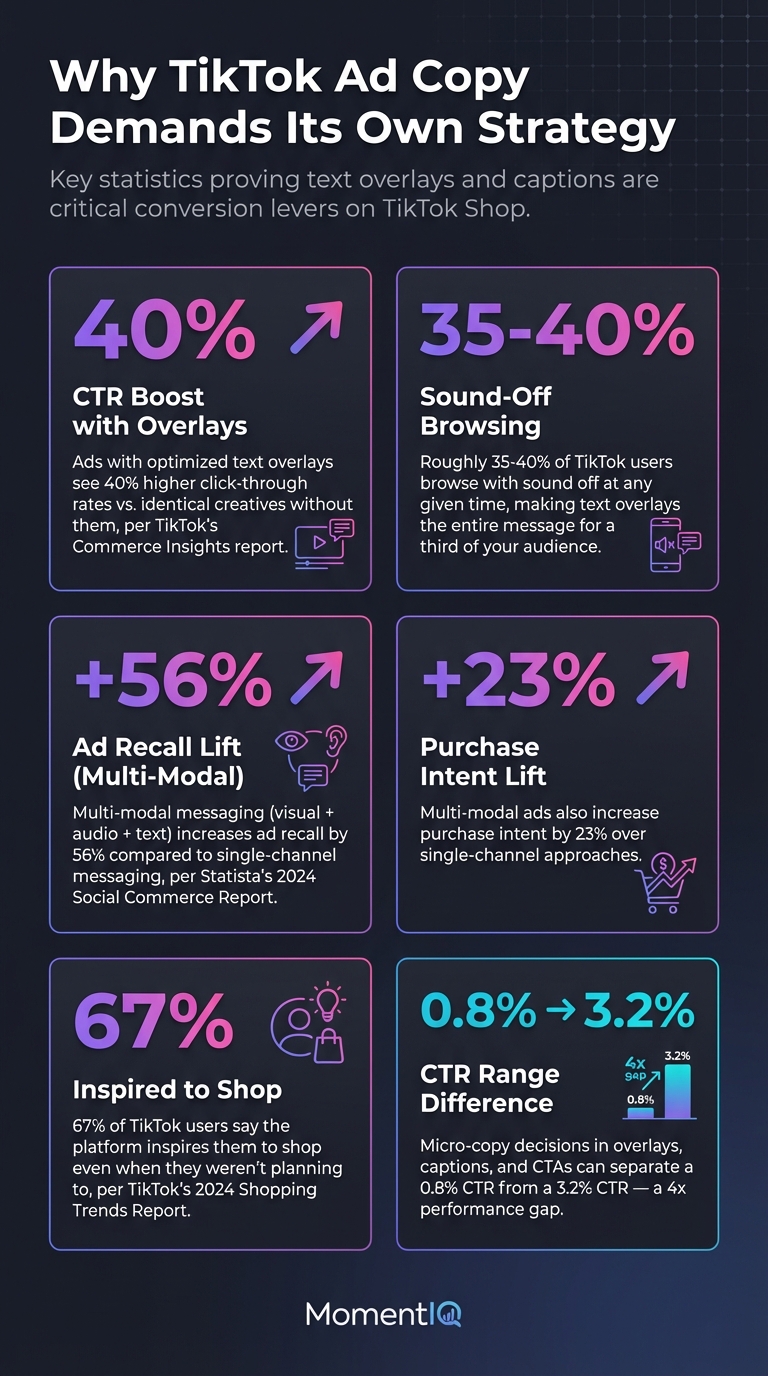
This isn't a piece about verbal hooks (we covered that in our Hook Writing Masterclass) or broad creative strategy. This is about the written elements — the TikTok ad text overlays viewers read mid-scroll, the TikTok ad caption formulas that frame the entire ad, and the CTA phrasing that turns passive viewers into buyers. These micro-copy decisions separate a 0.8% CTR from a 3.2% CTR.
According to TikTok's own Commerce Insights report, ads with optimized text overlays see 40% higher click-through rates compared to identical creatives without them. Yet most TikTok Shop sellers are still winging it.
Let's fix that. Here are 21 proven text overlay and caption formulas — organized by function — that are driving the highest CTRs on TikTok Shop ads in 2025.
Why TikTok Shop Ad Copy Deserves Its Own Strategy
Before we dive into formulas, let's establish why TikTok ad text overlays and captions require a fundamentally different approach than any other platform.
Understanding these unique user behaviors is crucial for effective ad copy. For instance, a significant portion of TikTok users browse with sound off, making on-screen text paramount.

TikTok is a sound-off-first environment for a massive chunk of users. Internal TikTok data suggests that roughly 35-40% of users browse with sound off at any given time — during commutes, at work, in bed next to a sleeping partner. For these users, your text overlays are the entire message. If your on-screen copy doesn't do the heavy lifting, you've lost a third of your potential buyers before they even hear your pitch.
This highlights the importance of multi-modal messaging, where text overlays reinforce the audio and visual elements. Analyzing your ad performance across these elements is key to optimizing your strategy.

But here's the nuance most brands miss: even for sound-on viewers, text overlays function as a secondary persuasion layer that reinforces the verbal message and adds information the speaker doesn't cover. Research from Statista's 2024 Social Commerce Report shows that multi-modal messaging (visual + audio + text) increases ad recall by 56% and purchase intent by 23% compared to single-channel messaging.
TikTok ad caption formulas operate differently too. Unlike Instagram, where captions sit below a static image, TikTok captions appear during the video — they're part of the viewing experience. A well-crafted caption primes the viewer's expectations before the creative even registers. A bad one? Invisible.
Successful brands recognize that TikTok Shop ad copy isn't just one element, but a symphony of text overlays, captions, and CTAs working together. Optimizing each component can unlock significant growth.
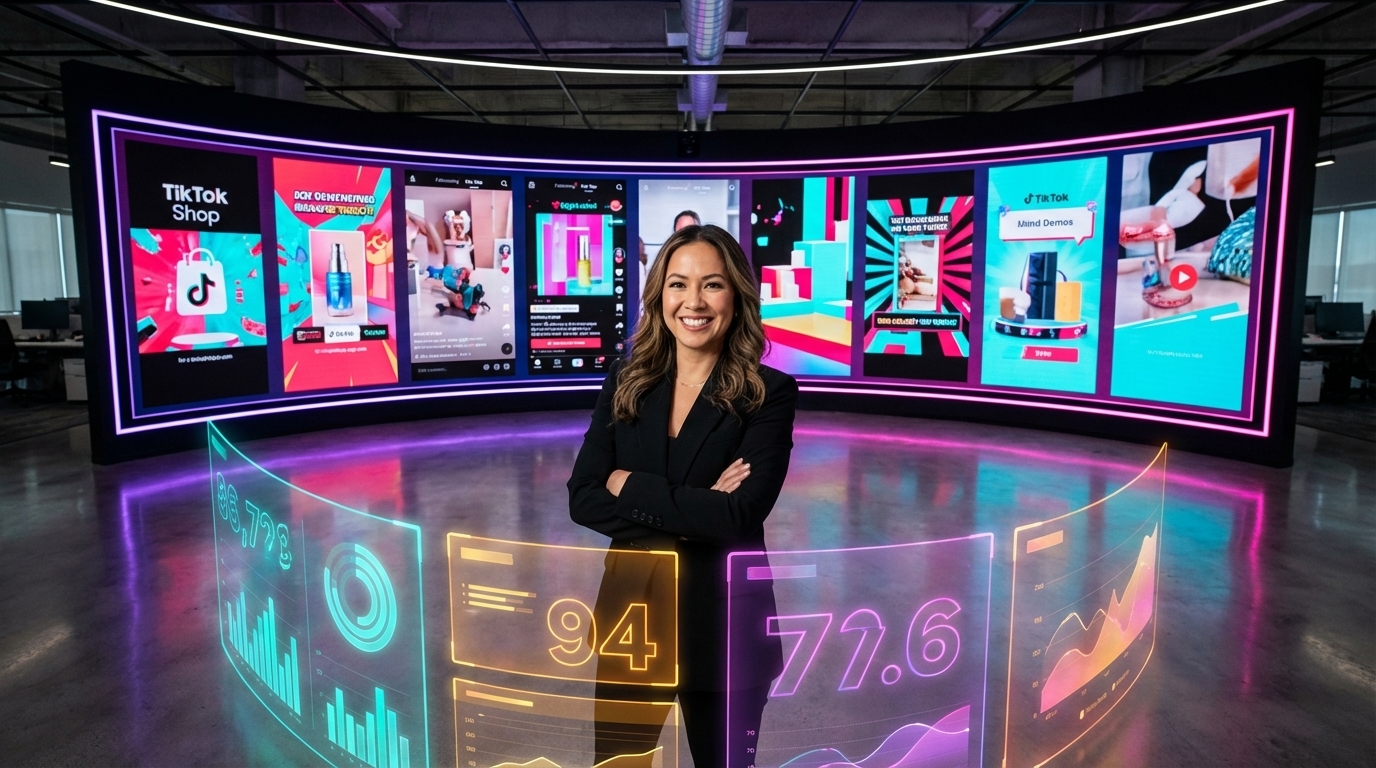
The brands scaling to six and seven figures on TikTok Shop understand that ad copy isn't one thing — it's three interconnected systems:
- Text overlays (on-screen copy that appears during the video)
- Caption copy (the text beneath the video that frames the ad)
- CTA phrasing (the specific language driving the click, tap, or purchase)
Each has its own rules. Each has its own formulas. And when all three work in concert, conversion rates compound.
If your ad performance is plateauing, a deep dive into your ad copy architecture is often the first step. Let's explore the specific formulas that drive results.
If you're struggling with inconsistent GMV or watching your CAC inflate month over month, there's a strong chance your TikTok Shop ad copy architecture is the bottleneck — not your product, not your targeting, not your budget. Talk to a Strategist to see exactly where your ad copy is leaking revenue.
Optimized TikTok Shop ad campaigns are essential for scaling beyond organic reach.
Part 1: Text Overlay Formulas That Stop the Scroll and Drive Clicks
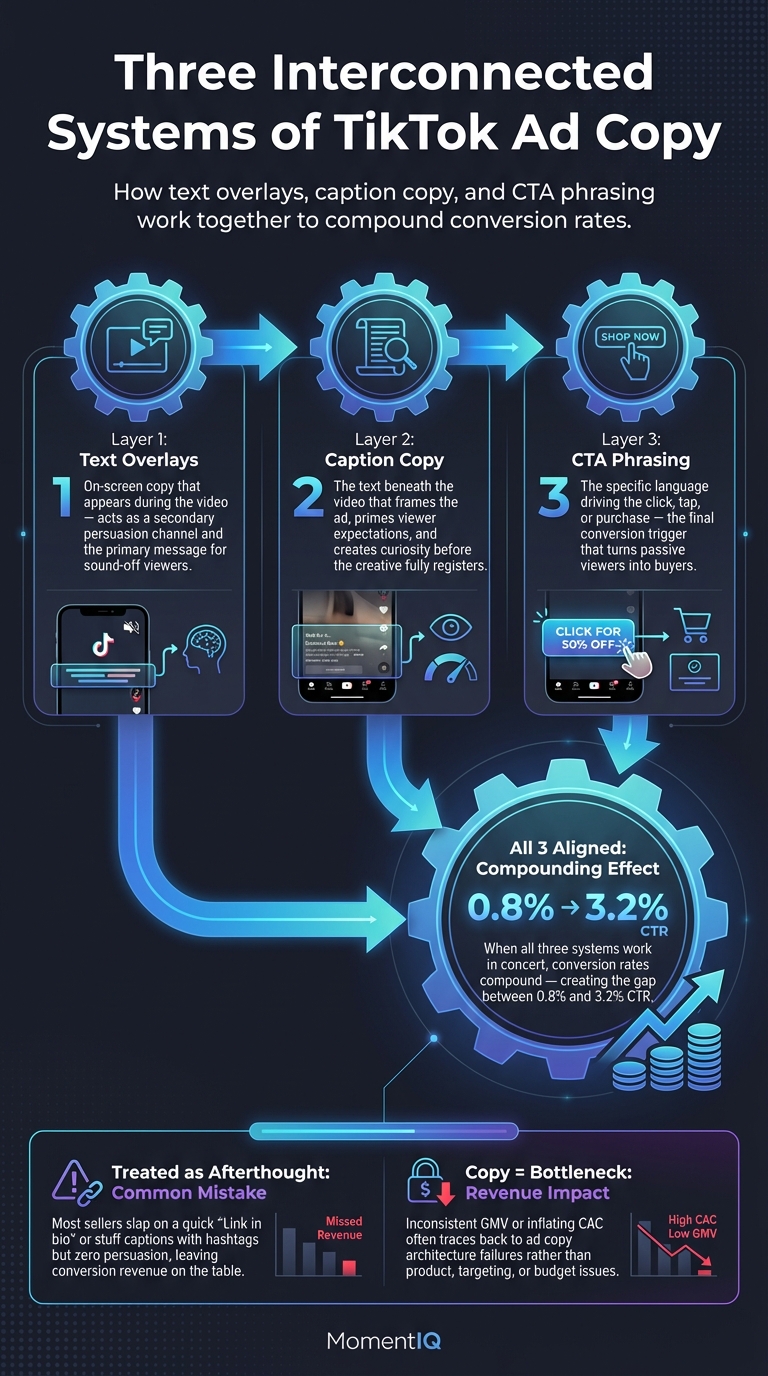
Text overlays are the unsung heroes of TikTok Shop ad performance. They appear on-screen during the video, giving you a second channel to persuade, inform, and direct action. Here are the highest-performing overlay formulas we're seeing across top-performing TikTok Shop ads in 2025.
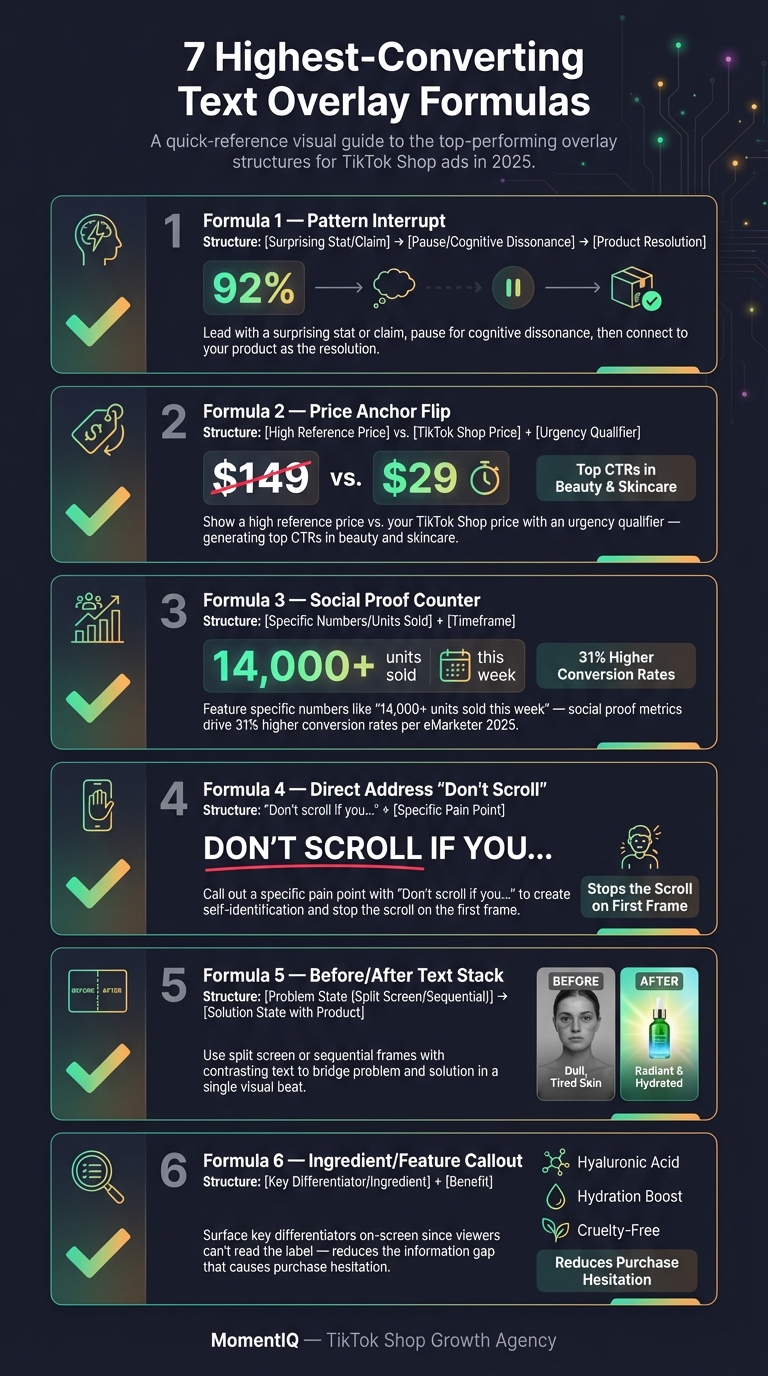
Formula 1: The "Wait, What?" Pattern Interrupt
Structure: [Surprising stat or claim] + [Pause] + [Product connection]
Example overlay sequence:
- Frame 1: "87% of people are using the wrong cleanser for their skin type"
- Frame 2: "Here's how to tell in 10 seconds"
- Frame 3: "This changed everything for me → [product shot]"
Why it works: The surprising stat creates cognitive dissonance. The viewer needs resolution, and your product provides it. TikTok's algorithm rewards watch-through rates, and this formula keeps eyes glued.
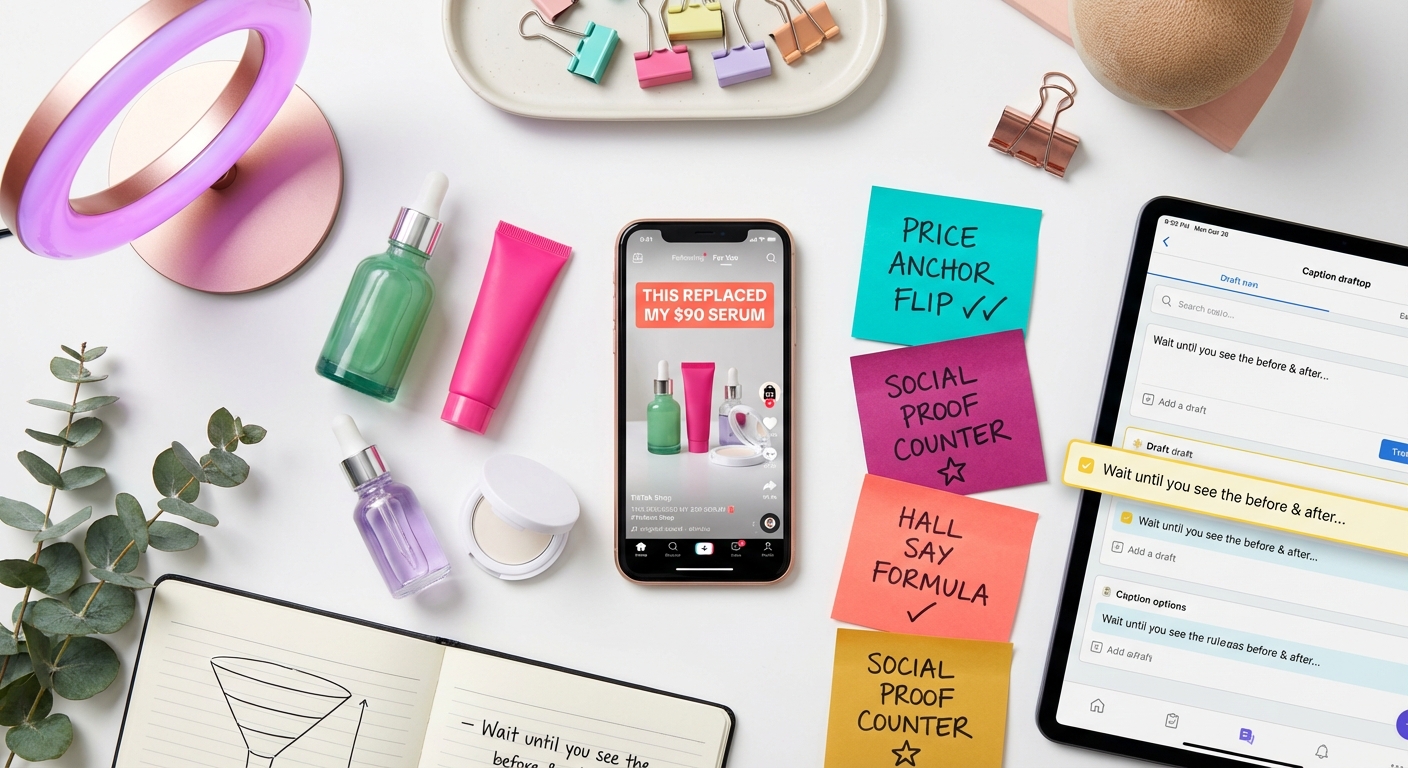
Formula 2: The Price Anchor Flip
Structure: [High reference price] → [Your TikTok Shop price] + [Urgency qualifier]
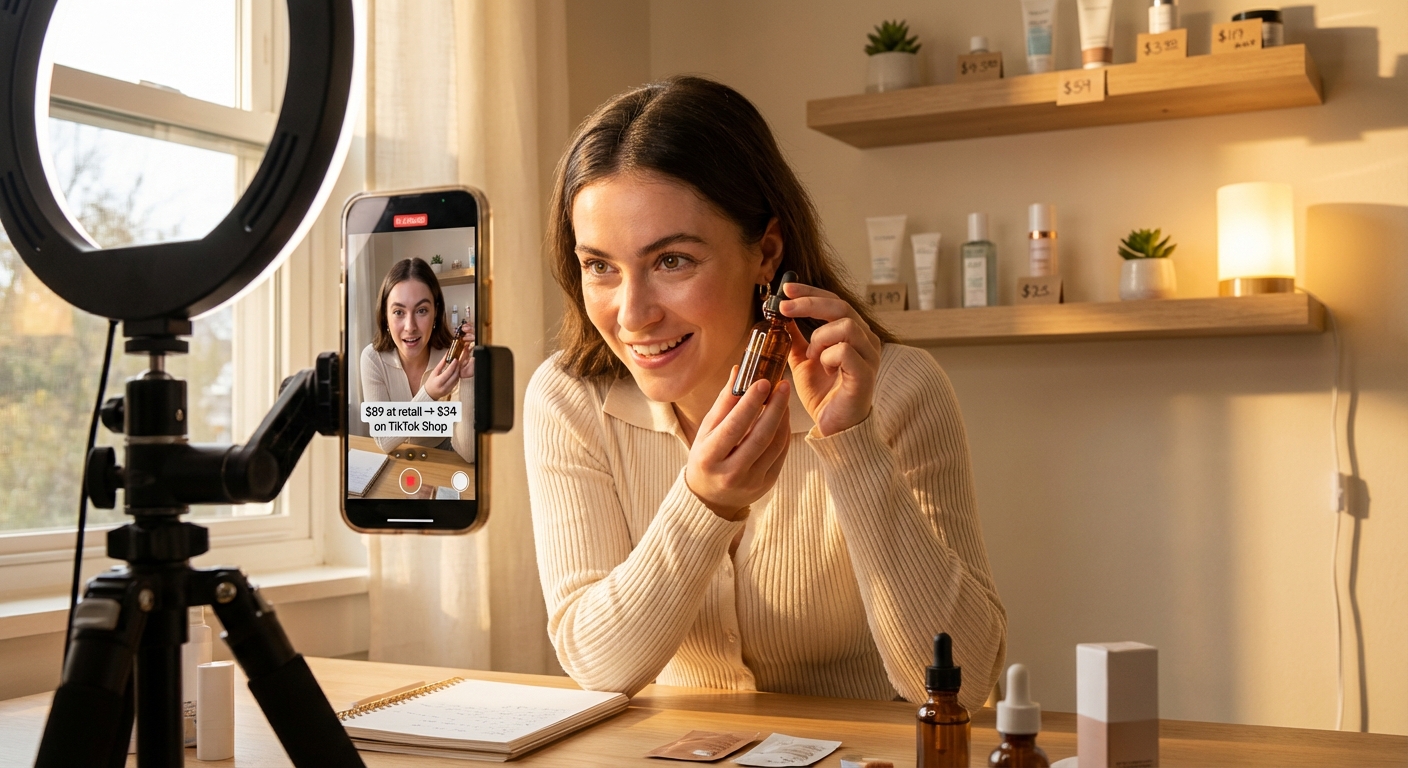
Example: "$89 at Sephora → $34 on TikTok Shop (today only)"
This overlay format is generating some of the highest CTRs in beauty and skincare TikTok Shop ads. The price comparison creates instant perceived value, and the urgency qualifier prevents the "I'll come back later" response that kills conversion.
These formulas are designed to grab attention and communicate value instantly. The Price Anchor Flip, for example, leverages psychological principles to highlight value.
Formula 3: The Social Proof Counter
Structure: [Specific number] + [people/units] + [action verb] + [timeframe]
Examples:
- "14,000+ units sold this week"
- "2.3M views — here's why everyone's switching"
- "Sold out 3x — finally restocked"
Data point: According to eMarketer's 2025 Social Commerce Forecast, product ads featuring social proof metrics see 31% higher conversion rates than identical ads without them. Numbers create legitimacy. Specificity creates believability.
Social proof is another powerful tool in your text overlay arsenal. Showing tangible numbers builds trust and encourages action.
Formula 4: The "Don't Scroll" Direct Address
Structure: "Don't scroll if you [specific pain point]" + [Solution tease]
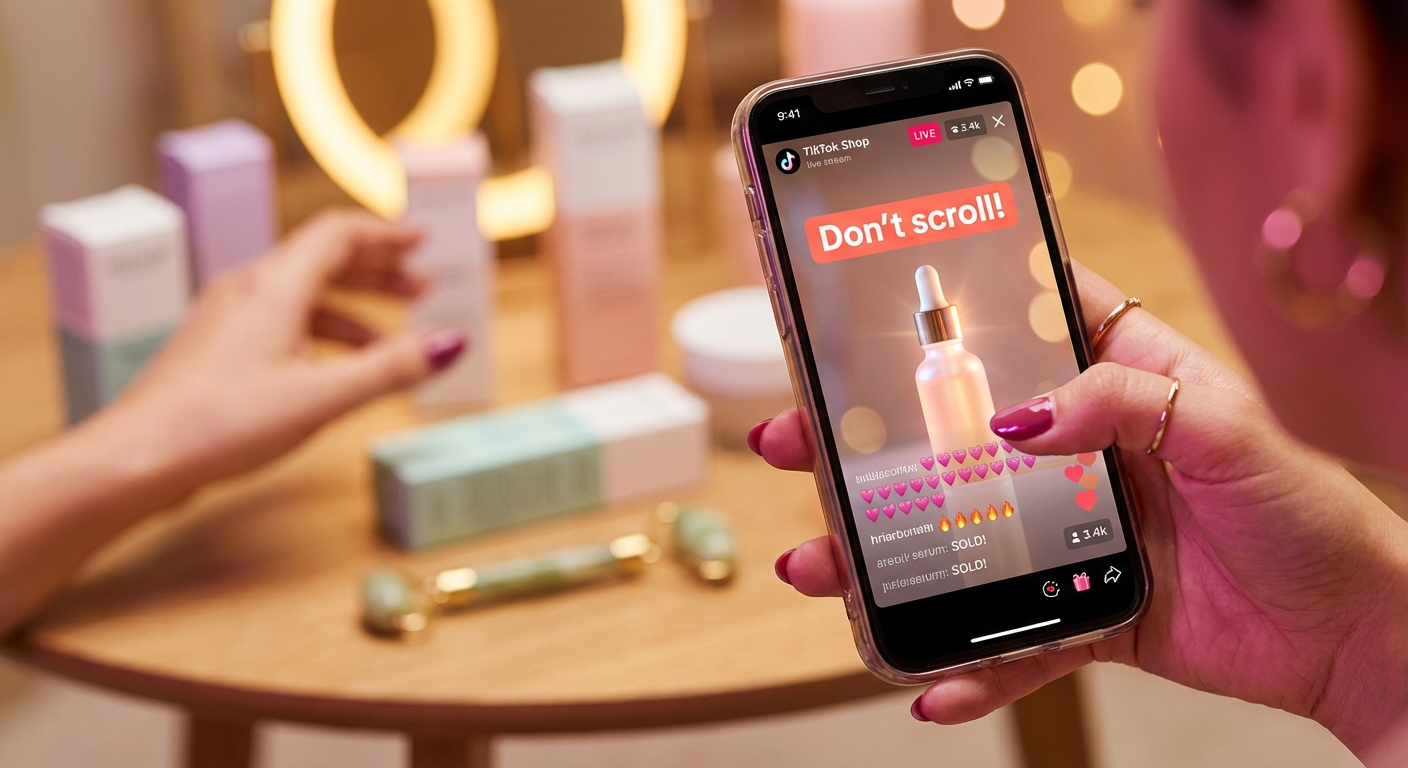
Example: "Don't scroll if your foundation oxidizes by noon — this $22 fix is insane"
Why it's effective: It calls out the viewer directly, creating a moment of self-identification. If the pain point resonates, the scroll stops. This formula works exceptionally well as a first-frame overlay paired with a visual hook.
Directly addressing a viewer's pain point can immediately stop the scroll. This creates an instant connection and positions your product as the solution.
Formula 5: The Before/After Text Stack
Structure: Split screen or sequential frames with contrasting text
Example:
- Left/Before: "Me spending $200/month on supplements that do nothing"
- Right/After: "Me after finding this $29 all-in-one on TikTok Shop"
This formula bridges the gap between problem and solution in a single visual beat. It's particularly powerful for products with tangible results — skincare, fitness, home organization, supplements.
Visual storytelling through text, like the Before/After stack, quickly illustrates transformation. This is especially effective for products with clear, demonstrable results.

Formula 6: The Ingredient/Feature Callout
Structure: [Key ingredient or feature] + [Benefit in plain language] + [Proof point]
Example overlay: "Contains 10% niacinamide → visibly smaller pores in 14 days (clinically tested)"
Why this matters for TikTok Shop specifically: Viewers can't pick up your product and read the label. Your overlay is the label. Brands that surface key product differentiators in overlay text see measurably higher add-to-cart rates because they reduce the information gap that causes hesitation.
Highlighting key ingredients or features in your overlays provides crucial product information at a glance. This helps overcome the barrier of not being able to physically examine the product.

Formula 7: The "TikTok Made Me Buy It" Framing
Structure: Reference the platform culture directly in the overlay
Examples:
- "OK I finally get why this has 47K reviews"
- "TikTok Shop find of the year — I'm not even exaggerating"
- "The viral [product category] that actually lives up to the hype"
This formula works because it positions the ad as a discovery, not a promotion. It taps into TikTok's native culture of sharing finds, which reduces ad resistance. According to TikTok's 2024 Shopping Trends Report, 67% of TikTok users say the platform inspires them to shop even when they weren't planning to. This overlay style leans directly into that behavior.
Finally, leveraging TikTok's native culture with phrases like 'TikTok Made Me Buy It' can significantly reduce ad resistance. Now, let's move on to optimizing your captions.
Part 2: TikTok Ad Caption Formulas That Frame and Convert
Captions are the most underestimated piece of TikTok Shop ad copy. Most sellers either write nothing meaningful or stuff them with hashtags. Neither works. The caption's job is to frame the video before the viewer fully processes the creative — setting expectations, creating curiosity, and priming the purchase decision.
Formula 8: The Curiosity Gap Caption
Structure: [Incomplete statement that demands the video for resolution]
Examples:
- "I can't believe this is only $__ on TikTok Shop rn"
- "The reason dermatologists are recommending this over [expensive alternative]…"
- "I was today years old when I found out about this"
Formula 9: The Objection-Preempt Caption
Structure: [Acknowledge the skepticism] + [Redirect to proof]
Examples:
- "I know, I know — another viral skincare product. But watch til the end."
- "Yes it's $19. No it doesn't feel cheap. Here's proof."
- "I was skeptical too until I saw my Day 14 results"
This is incredibly powerful for products in saturated categories. When viewers have been burned by overhyped TikTok products before, a caption that acknowledges their skepticism before they feel it disarms the resistance reflex.
Captions are your opportunity to build intrigue and address potential concerns before they arise. The Objection-Preempt Caption is particularly effective for this.

Formula 10: The Micro-Story Caption
Structure: [Personal context in 1-2 sentences] + [Discovery moment] + [Soft CTA]
Example: "Been dealing with hormonal acne since college. My esthetician recommended this and I'm genuinely shook. Link in bio before they sell out again."
Formula 11: The List Tease Caption
Structure: [Number] + [reasons/ways/things] + [outcome]
Examples:
- "3 reasons this replaced my entire morning routine"
- "5 things I wish I knew before buying a [product category]"
- "The 2 ingredients that make this different from every competitor"
List-format captions consistently outperform paragraph captions because they set clear expectations for what the viewer will learn, increasing the likelihood of full watch-through.
Formula 12: The "For You" Segmentation Caption
Structure: "This is for [specific audience segment]" + [Pain point]
Examples:
- "For my girlies with fine hair who've given up on volume"
- "If you work from home and your back is destroyed — watch this"
- "New moms who haven't slept in 6 months, this one's for you"
Why this drives higher CTRs: It creates instant self-selection. The viewer either identifies with the segment or doesn't — and those who do are exponentially more likely to convert because the ad feels personally relevant.
Segmenting your audience directly in the caption makes the ad feel hyper-personal. This dramatically increases relevance and click-through rates.
Formula 13: The Urgency-Stack Caption
Structure: [Time-limited element] + [Scarcity element] + [Value element]
Example: "Flash sale ends tonight — only 200 units left at this price. $67 value for $24 on TikTok Shop."
Stack urgency, don't just state it. A single urgency signal ("limited time") is easy to dismiss. Three urgency signals stacked together create genuine FOMO that drives immediate action.
Stacking urgency signals in your caption creates a powerful call to immediate action. This taps into FOMO and encourages quick decisions.
Formula 14: The Comparison Caption
Structure: "[Popular alternative] vs. this" or "I switched from [known brand] and…"
Examples:
- "Dyson Airwrap vs. this $45 TikTok Shop find — the results are wild"
- "I switched from [premium brand] to this and saved $300/year"
Comparison captions provide instant context and value proposition, especially for products competing with well-known brands. Now, let's focus on the final, critical step: your Call to Action.
Part 3: CTA Phrasing That Drives the Actual Click

Here's where revenue is won or lost. You've stopped the scroll with your overlay. You've framed the ad with your caption. Now the viewer needs to do something. The brands generating the highest ROAS on TikTok Shop are obsessively testing CTA language — and the differences are massive.
According to TikTok's Creative Best Practices guide, ads with clear, specific CTAs outperform generic CTAs by 37% in click-through rate. "Shop now" is not a strategy. Here's what works.
Formula 15: The Directional CTA
Structure: [Tap/Click] + [specific location] + [what they'll get]
Examples:
- "Tap the orange cart to grab yours before they sell out"
- "Click the product link below — it's literally $19"
- "Hit the yellow bag icon → your shade is in there"
Why this outperforms generic CTAs: Many TikTok Shop users, especially newer ones, don't instinctively know where to click. Directional CTAs reduce friction by telling them exactly what to do and where to do it. One health supplement brand saw a 22% increase in click-through rate simply by changing "Shop now" to "Tap the orange cart below."
Formula 16: The Loss-Aversion CTA
Structure: [What they'll miss] + [Action to prevent it]
Examples:
- "This sold out in 6 hours last time — don't miss the restock"
- "Price goes back to $49 tomorrow — grab it at $27 while you can"
- "Only 3 shades left in stock rn"
Loss aversion is 2x more powerful than gain framing according to behavioral economics research. Telling someone what they'll lose by not acting outperforms telling them what they'll gain by acting.
Loss aversion is a potent psychological trigger that can significantly boost your CTA's effectiveness. Framing what a customer might miss out on often works better than what they stand to gain.
Formula 17: The Permission CTA
Structure: "You deserve [outcome]" + [Low-commitment action]
Examples:
- "You deserve skincare that actually works — try it risk-free"
- "Treat yourself — it's $23 and it ships free"
- "Your morning routine shouldn't be this hard. Fix it for under $30."
Formula 18: The Social Validation CTA
Structure: [What others are doing] + [Invitation to join]
According to TikTok for Business,
For official resources, see TikTok Ads Manager help center.
Examples:
- "Join the 50K+ people who already switched"
- "There's a reason this has 12,000 five-star reviews — see for yourself"
- "Everyone in the comments is saying the same thing — just try it"
Formula 19: The Objection-Killer CTA
Structure: [Pre-handle the hesitation] + [Action]
Examples:
- "Free returns if you don't love it — tap to try"
- "Still not sure? Read the 8,000 reviews, then decide"
- "$0 risk, $0 shipping — what are you waiting for?"
This formula is critical for higher-priced products on TikTok Shop. When the price point exceeds impulse-buy territory ($40+), the CTA needs to actively reduce perceived risk.
For higher-priced items, proactively addressing objections in your CTA can reduce perceived risk. This builds confidence and encourages the final click.

Formula 20: The Specificity CTA
Structure: [Exact outcome] + [Exact timeframe] + [Action]
Examples:
- "Visibly brighter skin in 7 days — order today, start tomorrow"
- "Your kitchen will smell like a bakery in 15 minutes — grab the set"
- "Feel the difference in your first workout — ships in 2 days"
Formula 21: The Two-Step CTA
Structure: [Step 1: Low commitment] → [Step 2: Purchase bridge]
Examples:
- "Save this video → then tap the link when you're ready"
- "Follow for more finds like this + grab yours before it's gone"
- "Screenshot your shade → tap the cart to order"
The two-step CTA is underutilized but powerful. It reduces the psychological weight of the purchase decision by breaking it into two smaller actions. The first action (save, follow, screenshot) creates a micro-commitment that makes the second action (purchase) feel like a natural continuation.
The Two-Step CTA subtly guides users towards purchase by breaking down the commitment. This reduces friction and makes conversion feel less daunting. But remember, even the best formulas need rigorous testing.
The Ad Copy Testing Framework Most Sellers Skip
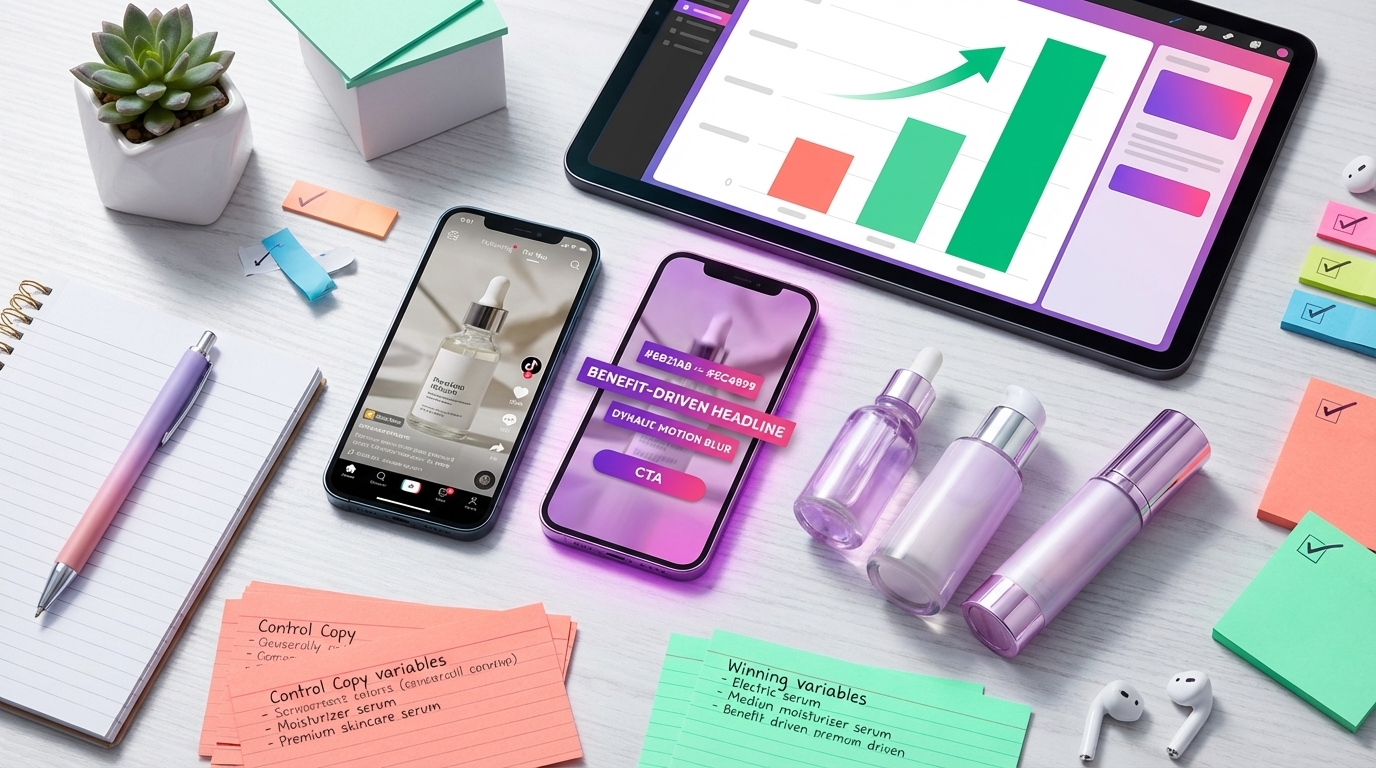
Here's the uncomfortable truth: even the best formula won't work universally across every product, price point, and audience segment. The brands generating consistent, scalable GMV on TikTok Shop aren't just using these formulas — they're systematically testing them.
But most sellers test wrong. They change the creative, the targeting, the copy, and the product all at once, then have no idea what actually moved the needle.
Systematic testing is the cornerstone of scalable growth on TikTok Shop. Without isolating variables, you can't truly understand what's driving your results.
Here's the framework that works:
- Isolate the variable. Test one text overlay formula against another with identical creative, targeting, and caption. Then test captions. Then CTAs.
- Test in cohorts of 3-5 variations. Single A/B tests are too slow. Run 3-5 overlay variations simultaneously and kill the losers after 48-72 hours.
- Measure CTR and CVR separately. A high-CTR overlay with a low-CVR caption tells you the overlay is working but the caption is misaligned. Diagnose each layer independently.
- Refresh every 7-14 days. TikTok's algorithm penalizes creative fatigue faster than Meta. Even your best-performing copy will decay. Have a rotation system ready.
This level of rapid iteration and data-driven decision-making is what separates top-performing brands. It requires dedicated resources and expertise.

This is where most in-house teams hit a wall. Testing at this velocity requires dedicated creative resources, rapid iteration cycles, and deep platform knowledge that's hard to maintain alongside everything else a brand team handles — from inventory management to customer service to creator recruitment.
One supplement brand working with MomentIQ scaled from $18K to $420K/month in 90 days — and a significant portion of that growth came from systematic ad copy testing across 200+ creative variations. They weren't guessing which overlay formula would work. They were running a data-driven system.
If your team is stretched thin and your TikTok Shop ad performance has plateaued, Talk to a Strategist to see how algorithmic creative optimization can unlock your next growth phase.
Common TikTok Shop Ad Copy Mistakes That Tank CTR
Before you implement these formulas, make sure you're not sabotaging yourself with these high-frequency mistakes:
Mistake 1: Too Much Text, Too Little Time
Viewers have approximately 1.5-2 seconds to read each overlay frame. If your on-screen text requires more than 8-10 words per frame, most viewers won't finish reading before the next frame hits. Keep overlays punchy. Use captions for context.
Mistake 2: Generic CTAs That Blend Into the Feed
"Shop now" and "Learn more" are invisible on TikTok. They've been conditioned out of viewer attention. Every CTA should include at least one specific detail — a price, a timeframe, a quantity, a benefit. "Shop now" becomes "Grab yours for $24 before midnight." Night and day.
Mistake 3: Mismatched Tone Between Overlay and Creative
If your video is casual and authentic but your text overlays read like a corporate press release, viewers feel the dissonance immediately. Your overlay copy should match the energy of the video. Casual creator content gets casual overlays. Polished product demos can handle slightly more structured copy.
Mistake 4: Ignoring Caption Copy Entirely
We audit dozens of TikTok Shop ad accounts monthly, and over 60% of underperforming ads have captions that are either empty, hashtag-only, or copy-pasted from the brand's Instagram. The caption is prime persuasion real estate. Use it.
Mistake 5: No Text Hierarchy
Not all overlay text is created equal. Your primary message (the hook or key benefit) should be larger, bolder, and positioned centrally. Supporting details should be smaller and positioned lower. Without visual hierarchy, the viewer's eye has nowhere to land — and they scroll.
Understanding these common mistakes will help you refine your approach and ensure your ad copy is set up for success. Now, let's consider why TikTok Shop requires a unique strategy.
Why TikTok Shop Ad Copy Requires a TikTok-Native Approach

Let's address the elephant in the room. Some brand managers reading this are thinking: "We can just adapt our Meta ad copy for TikTok."
That approach is failing spectacularly in 2025.
Here's why: Meta ads operate in a feed where users expect ads. TikTok operates in a feed where users expect entertainment. The copy conventions are fundamentally different:
| Element | Meta/Instagram | TikTok Shop |
|---|---|---|
| Tone | Polished, brand-forward | Casual, creator-forward |
| Overlay text | Optional enhancement | Essential conversion driver |
| Caption length | Long-form acceptable | Short, punchy, curiosity-driven |
| CTA style | "Shop Now" button | Directional, specific, embedded |
| Urgency framing | Discount-led | Scarcity + social proof-led |
Generic influencer agencies and in-house teams often default to what they know — Meta-style copy frameworks — and then wonder why their TikTok Shop CTRs are 50-70% below platform benchmarks.
The fundamental difference in user expectation between Meta and TikTok demands a native approach to ad copy. What works on one platform rarely translates directly to the other.

This is exactly why MomentIQ exists. As TikTok's Shop Partner of the Year and a certified TikTok Marketing Partner, MomentIQ's team lives inside the TikTok ecosystem daily. The ad copy formulas in this post aren't theoretical — they're derived from managing thousands of TikTok Shop ad variations across dozens of verticals.
MomentIQ's approach combines:
- Algorithmic creator matching through MomentIQ's proprietary creator matching platform — ensuring the right creators produce the right content for the right audiences
- Data-driven copy optimization — testing overlay, caption, and CTA variations at a scale no in-house team can match
- Full-funnel commerce support — from creative production to ad management to conversion optimization
- Proprietary performance analytics — identifying which copy elements drive revenue, not just clicks
One home goods brand went from a 0.6% CTR to a 2.8% CTR in 30 days simply by implementing systematic overlay and caption testing through MomentIQ's managed creative process. Their monthly GMV tripled in the same period.
MomentIQ's expertise is built on this TikTok-native understanding, combining algorithmic insights with creative optimization. This integrated approach drives measurable results.
The Window Is Closing — And Your Competitors Know It

Here's the reality of TikTok Shop in 2025: the platform is projected to reach $17.5 billion in U.S. GMV this year, according to eMarketer's latest forecast. That's a 150%+ increase from 2024.
But here's what the raw growth numbers obscure: the sellers who are building optimized ad copy systems right now are establishing algorithmic advantages that will compound over time. TikTok's ad auction rewards historical performance. Accounts with higher CTRs earn lower CPMs. Lower CPMs enable more testing. More testing produces better copy. Better copy drives higher CTRs.
It's a flywheel — and the brands that start spinning it first will be nearly impossible to catch.
The opportunity on TikTok Shop is immense, but the window for establishing a dominant position is closing. Competitors are already building these optimized systems.
"We'll figure out TikTok Shop next quarter" is the most expensive sentence in ecommerce right now. Every month of delay isn't just lost revenue — it's ground ceded to competitors who are already optimizing every text overlay, every caption, every CTA.
"We don't have the budget for an agency" is the other phrase we hear constantly. But consider the math: if your current TikTok Shop ads are generating a 2x ROAS and systematic copy optimization can push that to 4-5x (which is exactly the range we see when brands move from generic copy to formula-driven, tested copy), the agency investment pays for itself within the first 30-60 days. The real question isn't whether you can afford expert help — it's whether you can afford to keep leaving money on the table.
"We've tried agencies before" — and we get it. Most agencies treat TikTok Shop like an afterthought or apply Instagram playbooks to a fundamentally different platform. MomentIQ is different because TikTok Shop is the entire business. Not a side offering. Not an add-on. The FastMoss Visionary Award and TikTok Shop Partner of the Year recognition aren't participation trophies — they're earned through measurable client results.
MomentIQ's TikTok Shop ads team optimizes campaigns across Video Shopping Ads, Spark Ads, and Product Shopping Ads.
Your Next Move: From Formulas to Revenue

You now have 21 battle-tested formulas for TikTok Shop ad copy — text overlays, captions, and CTAs that are driving the highest click-through rates on the platform in 2025.
But formulas alone don't scale brands. Implementation at speed, systematic testing, and continuous optimization do.
The brands that prioritize systematic ad copy optimization now will gain an insurmountable algorithmic advantage. Don't let your competitors outpace you.



Here's what separates brands doing $20K/month from brands doing $200K/month on TikTok Shop:
- Volume of creative testing — top performers test 50-100+ ad copy variations per month
- Speed of iteration — killing losers within 48 hours and scaling winners immediately
- Cross-element optimization — aligning overlay copy, caption copy, CTA phrasing, creator selection, and targeting into one cohesive system
- Data infrastructure — tracking which specific copy elements drive revenue, not just engagement
This is what MomentIQ builds for brands every day. From algorithmic creator matching to managed ad copy optimization to full-funnel TikTok Shop commerce support — the entire system is designed to turn TikTok Shop from an inconsistent revenue channel into a predictable growth engine.
The brands building these systems now will own the algorithmic advantages that latecomers simply can't replicate.
👉 Talk to a Strategist and get a custom roadmap showing exactly where your ad copy is underperforming — and how to fix it in 30 days or less.
The formulas are here. The window is open. The only question is whether you'll move fast enough to capture it.