TikTok Shop Creator UGC Content Guidelines
Discover the brand safety framework that scales TikTok Shop content across 500+ creators without sacrificing authenticity. Balance UGC guidelines with raw, algo
Here's the paradox that's quietly destroying TikTok Shop brands from the inside out:
- Use a tiered content guidelines framework to scale beyond 30-75 creators without sacrificing authenticity or brand safety.
- Avoid overly polished brand guides — UGC-style content outperforms branded content by 2.2x in engagement and 1.7x in conversion on TikTok Shop.
- Recognize that at 100+ creators, you're 4.7x more likely to face compliance incidents, so build guardrails before scaling.
- Address FTC compliance, TikTok policy, IP infringement, and ad account health explicitly in every creator brief you send creator brief you send.
- Don't choose between restrictive scripts and zero guidance — give creators clear non-negotiable boundaries with creative freedom inside them.
You need hundreds of creators posting authentic, raw, algorithm-friendly content to scale GMV. But every creator you add without proper guidelines is a brand safety liability waiting to detonate.
One creator makes a medical claim about your supplement. Another films your product next to a competitor's logo. A third uses copyrighted music in a Spark Ad you just whitelisted. Suddenly, your listing is flagged, your ad account is restricted, and your legal team is drafting cease-and-desist letters instead of growth plans.
Sound familiar? You're not alone.
According to TikTok's 2024 Commerce Ecosystem Report, brands working with 100+ creators are 4.7x more likely to experience a content compliance incident than those working with fewer than 20. Yet those same high-volume brands generate 11x more GMV on average. The math is clear: you can't scale without volume, and you can't survive without guardrails.
The problem isn't that brands don't have TikTok Shop UGC guidelines.It's that they have the wrong kind — either so restrictive that every video feels like a corporate ad (and the algorithm buries it), or so loose that creators go rogue and put the brand at risk.
This post gives you the exact tiered framework that lets you scale to hundreds of creators while keeping your brand safe, your content authentic, and your GMV climbing. No more choosing between compliance and conversion.
Already scaling creators and need expert help building a bulletproof content guidelines system?Talk to a Strategist — we'll assess your current creator content risk and build a custom framework in days, not months.
Why Traditional Brand Guidelines Fail on TikTok Shop

The Corporate Playbook Doesn't Work Here
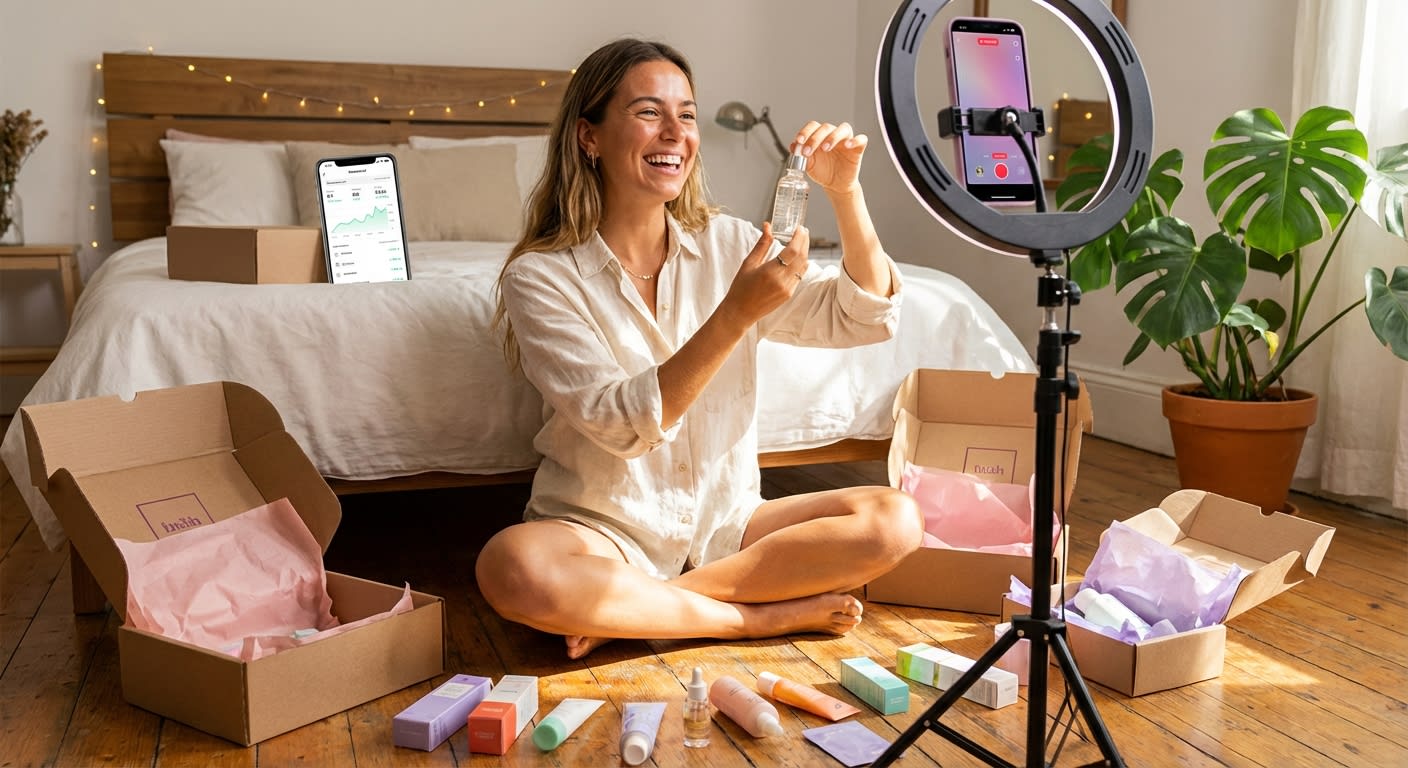
If you're a brand manager who came up through Instagram, Amazon, or DTC e-commerce, your instinct is to create a 15-page brand guide with exact color codes, approved language, mandatory disclaimers, and shot-by-shot storyboards.
On TikTok Shop, that instinct will kill your program.
Here's what the data shows: TikTok's internal research found that UGC-style content outperforms polished branded content by 2.2x in engagement and 1.7x in conversion rate on Shop listings. The algorithm rewards authenticity signals — shaky cameras, natural lighting, conversational tone, genuine reactions. The moment a video feels scripted, watch time drops, the algorithm depresses distribution, and your cost-per-acquisition inflates.
But the opposite extreme is equally dangerous. Brands that hand creators a product and say "just be yourself" are playing Russian roulette with:
- FTC compliance (undisclosed partnerships, unsubstantiated claims)
- TikTok Shop policy violations (restricted claims, prohibited content categories)
- Brand reputation (off-brand messaging, controversial contexts)
- Legal exposure (IP infringement, competitor defamation) creator contracts to protect your brand
- Ad account health (flagged Spark Ads, restricted whitelisting) ad account structure for multi-product brands
A beauty brand we've studied went from $85K/month in affiliate GMV to having their entire Shop suspended for 14 days because three creators independently made "FDA-approved" claims about a skincare serum. Fourteen days of zero revenue. Thousands in lost momentum. All because their TikTok Shop creator content guidelines were a single paragraph in a Google Doc.
The Scale Problem Nobody Talks About
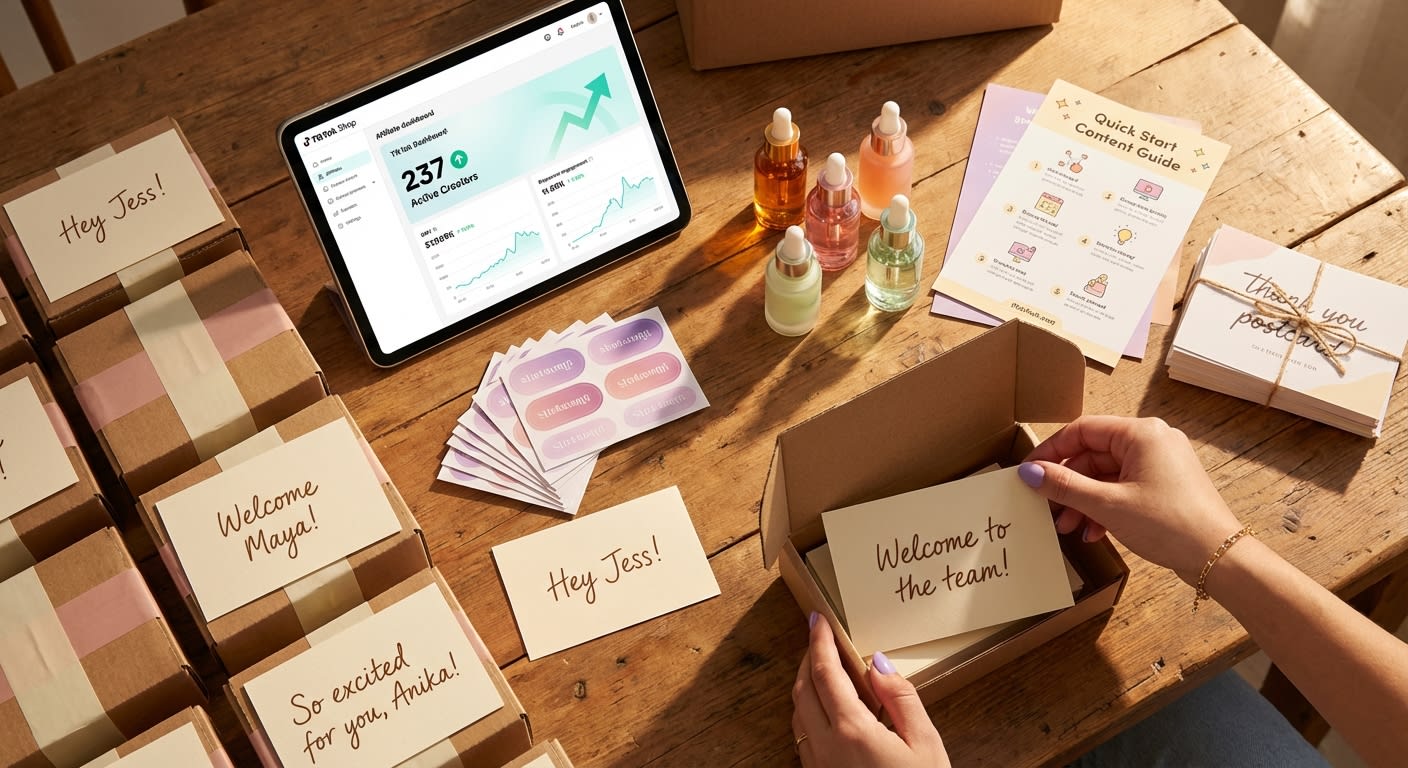
Here's the dirty secret about managing TikTok Shop creator content guidelines at scale: it's not a content problem. It's an operations problem.
When you're working with 10 creators, you can personally review every video before it goes live. At 50 creators, you need a team. At 200+, you need a system.
Most brands hit a wall between 30 and 75 active creators.Content quality becomes inconsistent. Compliance review becomes a bottleneck. Your team spends more time policing content than optimizing for performance. Creator response times slow down because they're waiting for approvals. The best creators — the ones driving real GMV — get frustrated and jump to competitors with faster, simpler processes.
This is exactly the scaling pain point where MomentIQ transforms the game. As TikTok Shop Partner of the Year, MomentIQ has built proprietary systems that manage content guidelines across hundreds of creators simultaneously — using algorithmic creator matching that pre-qualifies creators for brand safety before a single product ships. More on that later.
First, let's build the framework.
The Three-Tier TikTok Shop UGC Guidelines Framework
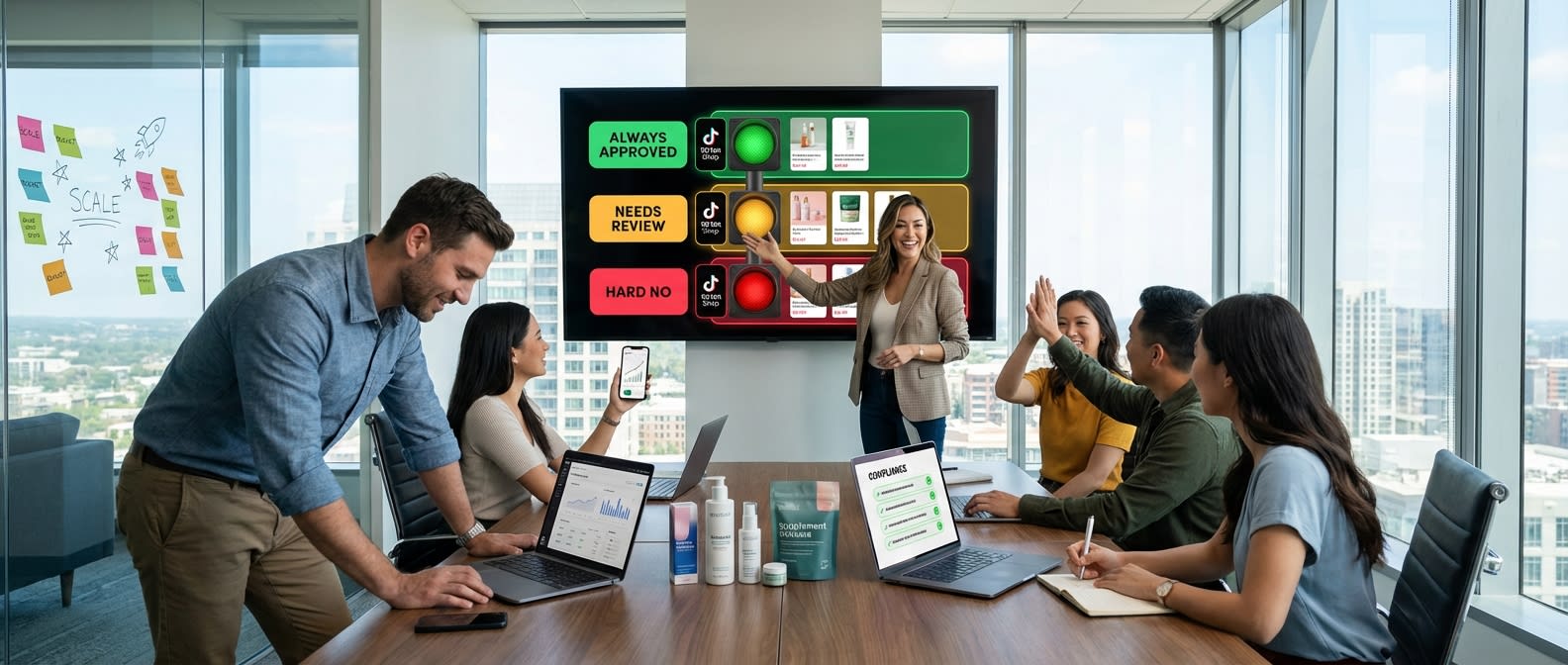
The most effective TikTok Shop brand safety creator content system isn't a single document. It's a three-tier architecture that gives creators clarity on what's non-negotiable, what's encouraged, and where they have complete creative freedom.
Think of it like traffic lights:
- 🔴 Red Zone: Non-Negotiable Brand Safety Rules — Break these and the partnership ends
- 🟡 Yellow Zone: Encouraged Creative Directions — Strategic guidance that improves performance
- 🟢 Green Zone: Creator Freedom Zone — Complete creative autonomy within the guardrails
This tiered approach solves the fundamental tension. Creators get the freedom they need to make authentic content. Brands get the protection they need to scale without fear. And the system works whether you have 15 creators or 1,500.
Tier 1 (Red Zone): Non-Negotiable Brand Safety Rules

What Belongs in the Red Zone
These are your hard lines. No exceptions, no creative interpretation, no "but the video went viral" justifications. Red Zone violations result in immediate content removal and potential partnership termination.
The Red Zone should be short, specific, and unmistakable. If a creator has to interpret whether something violates a Red Zone rule, the rule isn't clear enough.
Here's what every TikTok Shop brand's Red Zone should include:
Regulatory & Legal Compliance:
- No unsubstantiated health, medical, or efficacy claims ("cures," "treats," "FDA-approved" unless actually FDA-approved)
- No before/after imagery that implies guaranteed results (especially for supplements, skincare, weight loss)
- Mandatory FTC disclosure compliance — #ad, #sponsored, or TikTok's built-in paid partnership label
- No claims about competitors that could constitute defamation or false advertising
TikTok Shop Platform Policy:
- No content depicting minors using age-restricted products
- No pricing claims that contradict the listed Shop price
- No screenshots or references to other platform pricing (Amazon, Walmart)
- No use of copyrighted music in content intended for Spark Ads amplification
- No content that violates TikTok's community guidelines (violence, hate speech, dangerous activities)
Brand Protection:
- No filming with visible competitor products (even in background)
- No altering the product, packaging, or labels
- No political, religious, or divisive social commentary while featuring the product
- No content filmed in unsafe, illegal, or inappropriate settings
- Product name and key claims must be stated accurately (provide exact approved language)
How to Communicate Red Zone Rules

Keep it to one page. Seriously. If your Red Zone document is longer than one page, you've put Yellow Zone items in the wrong tier.
Format it as a simple checklist with yes/no clarity. Every rule should pass the "would a creator with zero brand knowledge understand this in 30 seconds?" test.
Pro tip: Record a 90-second video of yourself walking through the Red Zone rules. According to a 2024 CreatorIQ survey, creators are 3.4x more likely to fully absorb guidelines delivered via video than text documents. Attach it to your onboarding flow alongside the written checklist.
Tier 2 (Yellow Zone): Encouraged Creative Directions

Strategic Guidance That Lifts Performance Without Killing Authenticity

The Yellow Zone is where most brands either over-prescribe or under-deliver. This tier shouldn't tell creators what to say — it should tell them what tends to work and let them adapt it to their voice.
Think of Yellow Zone guidelines as coaching, not scripting. You're sharing performance data and creative intelligence so creators can make better decisions on their own.
Content Structure Recommendations:
- Hook formats that drive watch time: "I was skeptical about [product] until..." or "Nobody's talking about this [category] hack" or unboxing-first-reaction format
- Ideal video length: 30-90 seconds for affiliate content, 15-30 seconds for trending sound integration
- Call-to-action placement: Verbal CTA in the last 5 seconds + on-screen text pointing to the Shop link
- Product demonstration timing: Show the product in use within the first 7 seconds (TikTok's 2024 data shows videos that show product use in the first 7 seconds convert 38% higher than those that delay)
Messaging Priorities (Not Scripts):
- Top 3 product benefits to emphasize (ranked by conversion data)
- Key differentiators vs. category alternatives (without naming competitors)
- Common customer pain points the product solves (provide real customer language from reviews)
- Approved claims with specific wording (e.g., "clinically tested" not "clinically proven" if that's the accurate distinction)
Content Formats That Convert:
- "Day in my life" integration (product appears naturally)
- Problem → solution narrative
- "Things I wish I knew sooner" listicle
- Side-by-side comparison (your product vs. generic alternative, never named competitor)
- GRWM / routine integration for beauty, wellness, fashion
Visual & Audio Guidance:
- Natural lighting preferred over ring lights
- Front-facing camera for testimonial-style content
- Trending sounds encouraged (provide a weekly updated list of brand-safe trending sounds)
- Captions/subtitles recommended (85% of TikTok videos are watched without sound initially, per Statista 2024)
The Critical Difference: Suggestions, Not Mandates
Bold this and tattoo it on your content operations team's foreheads: Yellow Zone items are recommendations, not requirements.
The moment you make every Yellow Zone suggestion mandatory, you've turned your creator program into a production house. Creators will produce compliant but lifeless content. The algorithm will punish it. Your CPMs will spike. Your affiliate acceptance rates will crater because word spreads fast in creator communities — "that brand micromanages everything."
Instead, frame Yellow Zone guidance as insider intel: "Here's what's working for our top-performing creators right now." Creators are competitive. Show them that the hook format you're recommending drove 2.3x higher GMV for other creators in your program, and they'll adopt it voluntarily.
Tier 3 (Green Zone): The Creator Freedom Zone

Where Authenticity Lives and the Algorithm Rewards

This is the tier that separates brands crushing it on TikTok Shop from brands struggling to break $50K/month.
The Green Zone is everything not covered by Red or Yellow. It's the explicit permission slip that tells creators: within the guardrails we've set, you have complete creative freedom.
That means creators choose:
- Their filming location
- Their outfit, setting, and aesthetic
- Their personal storytelling angle
- Their tone (funny, serious, educational, chaotic)
- Their posting schedule
- Whether to integrate the product into existing content series or create standalone
- Their own captions and hashtag strategy (beyond required disclosures)
- How they respond to comments on their content
Why the Green Zone Is Non-Negotiable for Scale

Here's the data that should convince even the most control-oriented brand manager:
Brands that give creators explicit creative freedom zones see 67% higher content output per creator and 41% higher average engagement rates compared to brands that prescribe every element, according to a 2024 Aspire creator economy benchmark study.
The math compounds fast. If you have 200 creators each producing 3 pieces of content per month with a Green Zone framework, you're generating 600 pieces of authentic, diverse, algorithm-friendly content. The same 200 creators under heavy restrictions? They'll produce maybe 1.5 pieces each (because half will ghost you after the first round of revision requests), giving you 300 pieces of content that all look and sound the same — which the algorithm penalizes as repetitive.
One supplement brand working with MomentIQ scaled from $18K to $420K/month in 90 days by implementing this exact three-tier framework across 300+ creators. The key insight? They had only 11 Red Zone rules, 8 Yellow Zone suggestions, and everything else was Green Zone. Their creator retention rate hit 78% — nearly double the industry average of 41%.
How to Build Your TikTok Shop Brand Safety Creator Content System Step by Step

Step 1: Audit Your Current Risk Exposure
Before writing a single guideline, audit your last 90 days of creator content for violations you didn't catch. You'll likely find:
- Unsubstantiated claims hiding in video captions or verbal statements
- Missing FTC disclosures (the #1 compliance gap — eMarketer reports that 62% of sponsored TikTok content in 2024 lacked proper disclosure)
- Copyrighted audio in content you've boosted or plan to whitelist
- Off-brand messaging that contradicts your positioning
This audit tells you where your Red Zone needs to be strongest.
Step 2: Separate the Tiers Ruthlessly
The most common mistake? Putting Yellow Zone items in the Red Zone. If you make "must use natural lighting" a non-negotiable rule, you'll lose creators who film at night, in studios, or in aesthetically dark spaces. That's a preference, not a safety issue. Keep it Yellow.
A good litmus test for each rule:
- Could this get us sued, suspended, or publicly embarrassed? → Red Zone
- Does this improve performance based on data? → Yellow Zone
- Is this just our personal creative preference? → Don't include it at all
Step 3: Create Tiered Documentation
Your final guidelines package should include:
- Red Zone One-Pager (PDF + 90-second video walkthrough)
- Yellow Zone Creative Brief (2-3 pages, updated monthly with performance data)
- Green Zone Statement (a single paragraph explicitly granting creative freedom)
- Quick-Reference Card (a visual summary creators can screenshot and save to their camera roll)
Step 4: Build Compliance Into Onboarding, Not Review

Here's where most brands waste enormous time and money: reviewing every piece of content before it goes live.
At scale, pre-publication review is a bottleneck that destroys velocity. Instead, invest heavily in onboarding. Make creators demonstrate understanding of Red Zone rules before they receive product. Use a simple quiz, a signed acknowledgment, or a brief video call.
Then shift to spot-check monitoring rather than full review. Sample 15-20% of content weekly, flag violations, and address them immediately. This approach lets you manage 500+ creators with the same team that previously struggled with 50.
This is exactly the operational infrastructure that MomentIQ builds for brands. Our proprietary systems automate compliance monitoring across creator networks, flagging potential Red Zone violations before they become problems. Combined with our algorithmic creator matching — which pre-screens creators for brand safety signals, content quality, and category relevance — brands can scale to hundreds of creators with confidence.
Want to see how this works for your specific category? Talk to a Strategist and get a custom brand safety framework built for your creator program.
Advanced TikTok Shop UGC Guidelines: Handling Edge Cases at Scale

What to Do When Creators Push Boundaries

Every brand scaling on TikTok Shop will encounter these scenarios. Plan for them now:
The "Viral But Violating" Video:
A creator posts content that violates a Yellow Zone suggestion but generates massive views and sales. Do you pull it? No — if it doesn't violate Red Zone rules, let it ride. This is exactly why the tier system exists. Use the data from that video to update your Yellow Zone guidance. Maybe the creator discovered something your team didn't.
The "Technically Compliant But Off-Brand" Post:
A creator follows every rule but films your luxury skincare product in a messy bathroom with poor lighting. This is Green Zone territory. Resist the urge to intervene. The algorithm often rewards "real" environments over aspirational ones. TikTok's 2024 Shopping Trends Report found that content filmed in "everyday" settings drove 23% higher add-to-cart rates than content in styled environments.
The "Competitor Mention" Situation:
A creator says "this is way better than [Competitor Name]." This is a Red Zone violation (naming competitors). Address it immediately but diplomatically. Provide the creator with approved comparison language: "I've tried a lot of [category] products, and this is the best I've found." Same sentiment, zero legal exposure.
The "Claim Creep" Problem:
Creators gradually escalate claims over time. A skincare creator starts with "my skin feels smoother" (fine) and by month three is saying "this cleared my cystic acne" (potentially problematic). Build quarterly claim audits into your process. Review your most active creators' recent content specifically for claim escalation.
Category-Specific Red Zone Additions

Your Red Zone should include category-specific rules beyond the universal ones:
Supplements & Wellness:
- No disease treatment or cure claims
- No references to specific medical conditions
- Required disclaimer language ("not intended to diagnose, treat, cure, or prevent any disease")
- No before/after body transformation imagery
Beauty & Skincare:
- No "dermatologist-approved" unless documented
- No permanent results claims for topical products
- No claims about replacing medical treatments
Food & Beverage:
- Accurate nutritional claims only
- No allergy-safe claims unless certified
- Age-appropriate consumption guidelines
Baby & Kids Products:
- No unsupervised child usage in content
- Age-appropriateness clearly stated
- Safety certifications mentioned accurately
Why DIY Guidelines Fail at Scale (And What to Do Instead)
The In-House Limitation
Let's address the elephant in the room. You might be reading this thinking: "Great framework. I'll build this myself and save the agency fee."
Here's the reality check.
Building the framework is 20% of the work. Operationalizing it across hundreds of creators — onboarding, monitoring, enforcing, updating, and optimizing — is the other 80%.
A typical in-house team managing 100+ creators needs:
- 1-2 full-time creator coordinators ($50-70K salary each)
- A compliance/legal review process (fractional legal counsel: $5-15K/month)
- Content monitoring tools ($500-2,000/month)
- Ongoing guideline updates based on platform policy changes (TikTok updated Shop policies 17 times in 2024 alone)
That's $150-250K/year in fully loaded costs to manage what a specialized partner handles as part of a comprehensive growth system.
The ROI math gets even more compelling when you factor in opportunity cost. Every hour your team spends reviewing creator content for compliance is an hour not spent on product development, pricing strategy, or scaling what's already working.
Brands that have tried generic influencer agencies often fare worse. Traditional agencies understand Instagram collaborations and YouTube sponsorships, but TikTok Shop has fundamentally different mechanics — affiliate commission structures, Shop policy compliance, algorithm-driven distribution, live commerce integration. An agency that doesn't live and breathe TikTok Shop will apply the wrong playbook to the wrong platform.
This is why MomentIQ exists as a TikTok-native growth partner. As a TikTok Marketing Partner and TikTok Shop Partner of the Year, MomentIQ doesn't adapt generic influencer strategies to TikTok — we build systems specifically engineered for TikTok Shop's unique ecosystem. Our algorithmic creator matching through the Reacher platform pre-qualifies creators for brand safety, content quality, and category conversion potential before they ever receive a product.
One home goods brand came to MomentIQ after burning through two generic agencies that couldn't maintain content quality above 50 creators. Within 60 days, MomentIQ scaled their program to 275 active creators with a 94% Red Zone compliance rate and a 3.2x increase in affiliate GMV.
Measuring the Impact of Your TikTok Shop Creator Content Guidelines

The Metrics That Matter
A guidelines framework is only as good as its measurable impact. Track these KPIs monthly:
Compliance Metrics:
- Red Zone violation rate (target: <2% of total content)
- FTC disclosure compliance rate (target: 100%)
- Content takedown requests (should decrease month-over-month)
- Platform policy warnings or strikes (target: zero)
Performance Metrics:
- Average creator content output (pieces per creator per month)
- Creator retention rate (month-over-month)
- Affiliate acceptance rate (creators who accept your collaboration requests)
- Content-to-conversion rate by tier adherence
- GMV per creator (should increase as guidelines improve content quality)
Operational Metrics:
- Time from product ship to content publication
- Guideline-related creator support tickets
- Onboarding completion rate
- Spot-check review coverage rate
Here's the benchmark that matters most: brands with structured three-tier guidelines see 52% higher GMV per creator compared to brands with unstructured or no guidelines, based on aggregated performance data from TikTok Shop programs managing 100+ creators.
The Window Is Closing: Why Building This System Now Matters
TikTok Shop is projected to reach $17.5 billion in U.S. GMV by the end of 2025, according to Statista's latest forecast. The platform is still in its growth phase, which means:
- Creator acquisition costs are still low. Top creators haven't been locked into exclusive deals yet.
- The algorithm still rewards volume. Brands producing 500+ pieces of monthly content have a compounding distribution advantage.
- Compliance standards are tightening. TikTok is actively increasing enforcement of Shop policies. Brands that build compliant systems now avoid the crackdown that's coming.
The brands building scalable content guidelines systems today will own the creator relationships, algorithmic advantages, and operational infrastructure that latecomers simply cannot replicate.
Your competitors are already scaling. A 2024 TikTok Commerce survey found that 73% of top-performing Shop sellers now work with 50+ creators, up from 31% in 2023. The brands that figure out how to do this safely and authentically will dominate their categories for years.
Waiting six months to "figure it out internally" means six months of lost GMV, creator relationships captured by competitors, and algorithmic momentum you'll never recover.
Your TikTok Shop UGC Guidelines Action Plan
Here's your immediate next-step roadmap:
- This week: Audit your last 90 days of creator content for undiscovered violations
- Next week: Draft your Red Zone one-pager (11 rules or fewer)
- Week three: Build your Yellow Zone creative brief with current performance data
- Week four: Write your Green Zone freedom statement and assemble the complete package
- Ongoing: Implement spot-check monitoring and monthly guideline updates
Or skip the months of trial-and-error and get a proven system built by the team that's scaled hundreds of brands on TikTok Shop.
Talk to a Strategist. Our strategists will assess your current creator content risk, build a custom three-tier guidelines framework for your category, and show you exactly how our algorithmic creator matching and compliance monitoring systems can scale your program to 500+ creators — without a single brand safety incident keeping you up at night.
The brands that scale smart on TikTok Shop don't choose between authenticity and safety. They build systems that deliver both. That's exactly what this framework — and MomentIQ — is designed to do.
MomentIQ is the leading TikTok Shop growth agency and TikTok Shop Partner of the Year. We help brands scale through algorithmic creator matching, managed product seeding, live commerce strategy, and proprietary data analytics. Learn more at bemomentiq.com.