TikTok Shop Influencer Exclusivity
Learn when to use TikTok Shop influencer exclusivity clauses, ideal contract lengths, and the exact language to protect your brand from competitor crossover.

You found a creator who moves product like nothing you've ever seen. Their TikTok Shop affiliate content consistently drives 4X your average conversion rate. Their audience trusts them. Their content style is a perfect brand fit. And then — three weeks later — they're holding up your competitor's product in a new video, using the exact same energy, the exact same hooks, and the exact same credibility your brand helped build.
- Reserve hard exclusivity for your top 5% of creators generating $15K+ monthly revenue, as they drive 4X average conversion rates.
- Recognize that TikTok Shop exclusivity means asking creators to forgo entire affiliate revenue streams, not just one sponsored post — price accordingly.
- Use category-specific soft exclusivity for mid-tier creators earning $2K-$15K monthly to protect your niche without overpaying.
- Skip exclusivity agreements entirely for the bottom 80% of creators earning under $2K monthly — the cost isn't justified.
- Factor in that 67% of consumers lose trust when creators promote competing products, making exclusivity a brand equity protection tool.
It stings. And it's entirely preventable.
Welcome to the high-stakes world of TikTok Shop influencer exclusivity agreements — the single most underutilized (and most misunderstood) tool in your creator partnership arsenal. Done right, exclusivity clauses protect your brand equity, lock in your best-performing talent, and create a competitive moat that rivals can't easily breach.Done wrong, they scare away top creators, blow up your budget, and land you in legal gray areas that no one wants to navigate.
This guide is your definitive playbook. We're going deep on when exclusivity is worth paying for, how to price it without overpaying, how long your exclusivity windows should actually be, and the exact creator exclusivity clause contract language that keeps talent happy while keeping competitors out.
Let's get into it.
Why TikTok Shop Influencer Exclusivity Is Different From Traditional Influencer Deals
Before we talk strategy, let's establish why TikTok Shop changes the exclusivity calculus entirely.
In traditional influencer marketing, a creator posts a sponsored video, it gets views for 48 hours, and the relationship is largely transactional. Exclusivity in that world is about preventing awkward optics — you don't want your brand ambassador showing up in a competitor's Instagram Story the next day.
TikTok Shop is fundamentally different. Here's why:
The Affiliate Revenue Factor
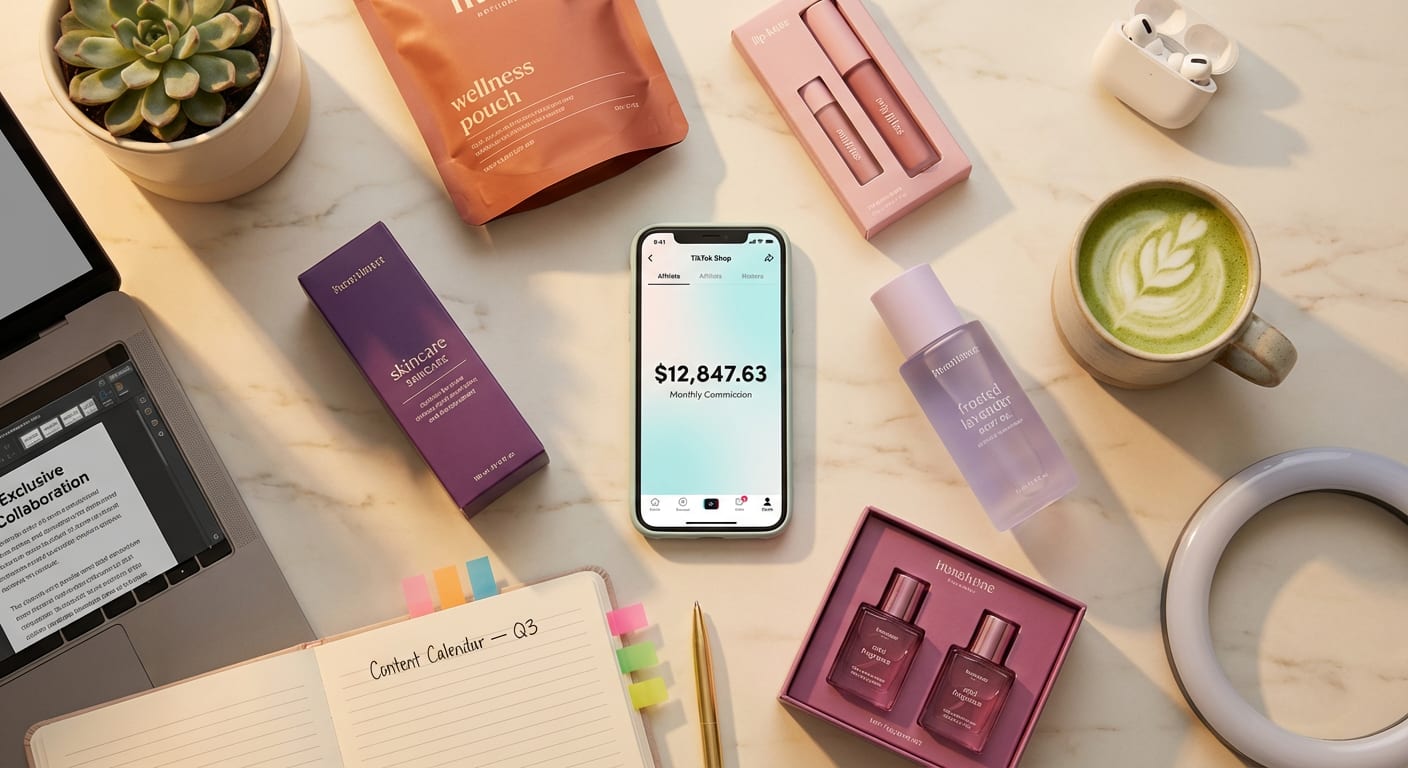
TikTok Shop creators earn ongoing commissions — often 10-20% — on every sale their content drives. According to TikTok's own creator economy reports, top-performing affiliates can earn $5,000-$50,000+ per month from a single brand relationship.When you ask a creator to go exclusive, you're not just asking them to skip one sponsored post. You're asking them to forgo an entire revenue stream from competing products.
That's a fundamentally different negotiation.
The Algorithmic Amplification Loop
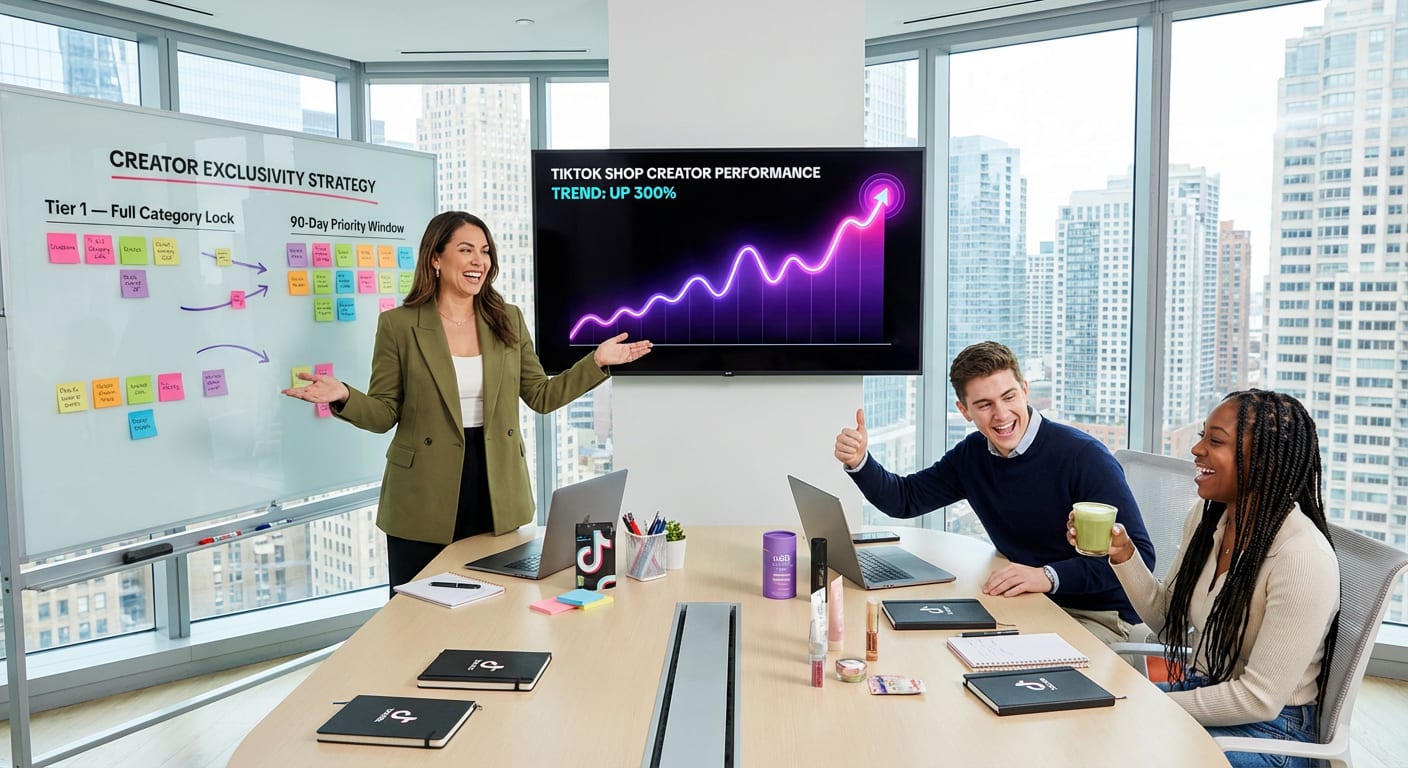
TikTok's recommendation algorithm rewards creators who post consistently in a niche. A creator who talks about skincare every day builds algorithmic authority in that category. Their content gets pushed to skincare-interested audiences more aggressively over time. When that creator promotes your competitor's serum alongside yours, they're not just splitting their audience attention — they're diluting the algorithmic signal that makes their content so effective for your brand.
This is why exclusivity on TikTok Shop isn't just a brand protection play. It's a performance optimization strategy.
The Trust Erosion Problem
Research from the Digital Marketing Institute shows that 67% of consumers say they'd lose trust in an influencer who promoted competing products within the same category in a short timeframe. On TikTok Shop, where the purchase happens inside the app and the creator's recommendation is the primary conversion driver, that trust erosion hits your bottom line immediately.
When a TikTok Shop Influencer Exclusivity Agreement Is Actually Worth It
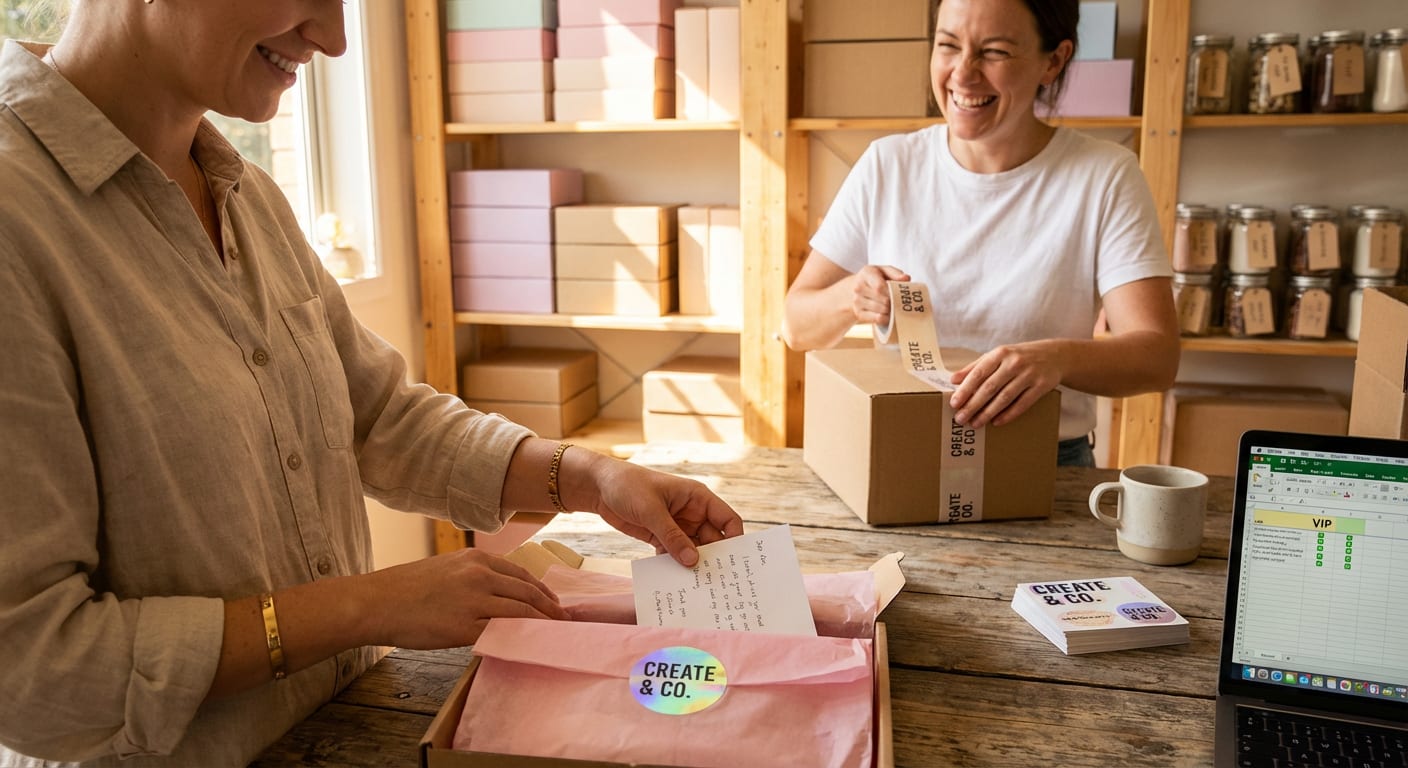
Not every creator deserves an exclusivity clause. In fact, most don't. Here's the framework for deciding when to invest.
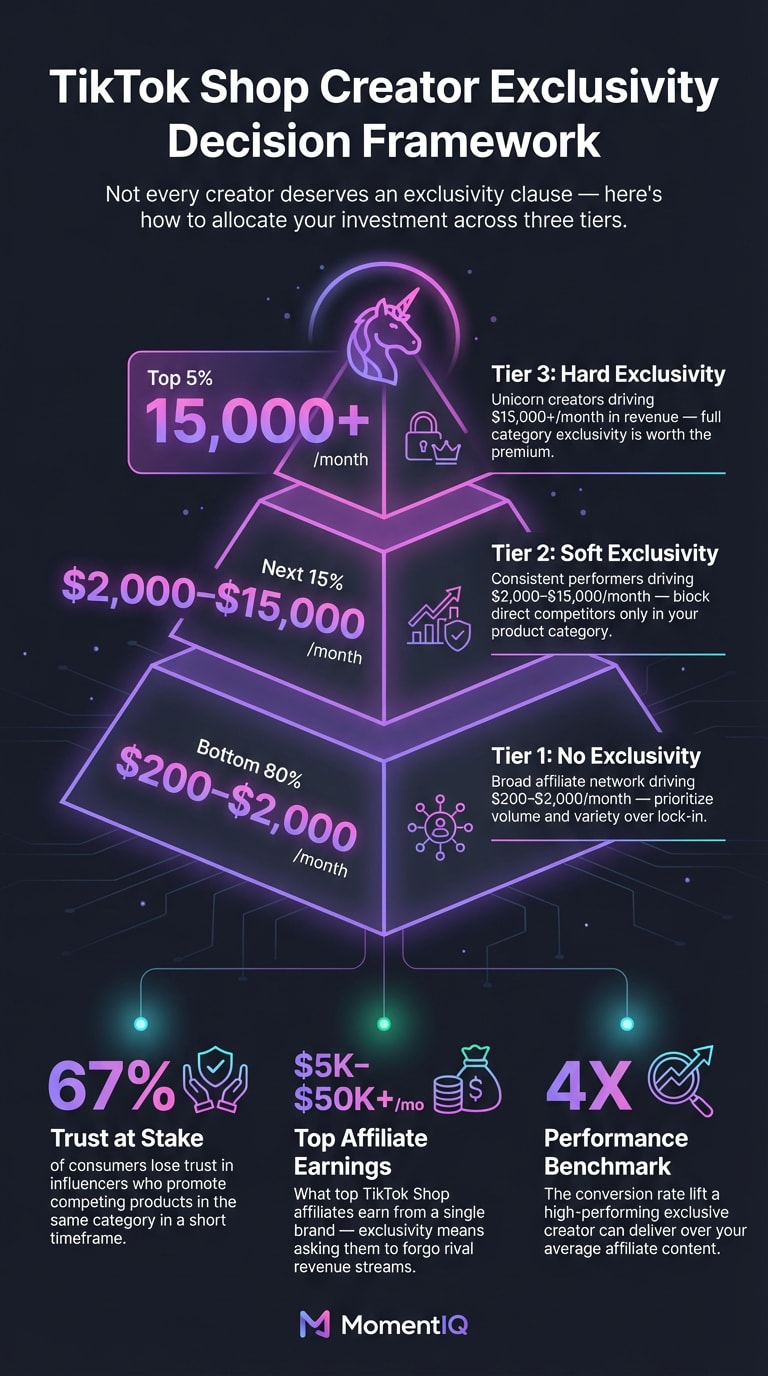
The 3-Tier Creator Exclusivity Decision Framework

Tier 1: No Exclusivity Needed (80% of your creators)
These are your broad affiliate network — creators doing product seeding content, one-off reviews, or low-volume affiliate sales. They might drive $200-$2,000/month in revenue.Exclusivity here is overkill.You want volume and variety at this tier, not lock-in.
Tier 2: Soft Exclusivity (15% of your creators)
These are your consistent performers — creators driving $2,000-$15,000/month in attributable TikTok Shop revenue.They post about your products regularly and have built genuine affinity with your brand. For these creators, you want category-specific soft exclusivity: they can promote other brands, just not direct competitors in your specific product category.
Tier 3: Hard Exclusivity (5% of your creators)
These are your unicorns. They drive $15,000+ per month in revenue, their content consistently goes viral with your products, and their audience deeply associates them with your brand. For these creators, full category exclusivity is worth paying a premium for — and they'll expect significant compensation in return.
At MomentIQ, we help brands identify which creators fall into each tier using performance data, audience overlap analysis, and competitive intelligence — so you're investing exclusivity dollars where they'll actually generate ROI, not spreading them across creators who don't move the needle.
The 5 Signals That a Creator Is Worth Locking Down

- Repeat conversion performance: They've driven sales across 3+ pieces of content, not just one viral hit
- Audience-brand alignment: Their follower demographics match your ideal customer profile (age, location, interests)
- Competitor vulnerability: You've seen competitors reaching out to them, or they've mentioned other brand offers
- Content scalability: They can produce high-quality content consistently, not just one great video
- Live commerce potential: They're willing and able to do TikTok Shop lives, which represent the highest-value creator relationship
If a creator hits 4 out of 5 of these signals, it's time to have the exclusivity conversation.
How to Price TikTok Shop Creator Exclusivity: The Compensation Framework
Here's where most brands get it wrong. They either lowball the exclusivity premium (and lose the creator) or overpay dramatically (and destroy their unit economics). Let's build a rational pricing model.
The Exclusivity Premium Formula
The baseline principle: exclusivity compensation should cover the creator's realistic opportunity cost, plus a premium for the commitment.
Here's how to calculate it:
Step 1: Estimate the creator's category earnings potential
Look at what competing brands in your category typically pay affiliates. If a creator could reasonably earn $3,000/month promoting a competing product, that's your baseline opportunity cost.
Step 2: Apply the exclusivity multiplier
- Soft category exclusivity (can promote non-competing products): 1.2X-1.5X the opportunity cost
- Hard category exclusivity (no competing products at all): 1.5X-2.5X the opportunity cost
- Full platform exclusivity (only promotes your brand on TikTok): 3X-5X the opportunity cost (rarely worth it)
Step 3: Choose your compensation structure
| Structure | Best For | Example |
|---|---|---|
| Flat monthly retainer | Predictable budgeting | $5,000/month exclusive retainer |
| Enhanced commission rate | Performance alignment | 25% commission vs. standard 15% |
| Retainer + enhanced commission | Top-tier creators | $3,000/month + 20% commission |
| Retainer + bonuses | Incentivizing volume | $2,500/month + $500 per viral video |
What the Data Says About Exclusivity Pricing
According to a 2024 CreatorIQ benchmark report, the average exclusivity premium in the beauty and wellness category is 40-60% above standard creator compensation. In highly competitive categories like supplements and fitness equipment, that premium can reach 80-100%.
The key insight: exclusivity premiums are rising fast. As more brands compete for top TikTok Shop creators, the cost of locking down talent increases. Brands that establish exclusive relationships early — before a creator blows up — pay significantly less than those who try to lock down established stars.
How Long Should a TikTok Shop Influencer Exclusivity Clause Last?
Duration is where most exclusivity negotiations either succeed or fall apart. Go too short and you don't get meaningful protection. Go too long and creators feel trapped — or demand astronomical premiums.
The Duration Sweet Spots by Creator Tier
Tier 2 (Soft Exclusivity) Creators:
- Ideal duration: 60-90 days
- Maximum recommended: 120 days
- Renewal structure: Auto-renew with 30-day opt-out notice from either party
Tier 3 (Hard Exclusivity) Creators:
- Ideal duration: 90-180 days
- Maximum recommended: 12 months
- Renewal structure: Mutual opt-in renewal with renegotiated terms every cycle
Why 90 Days Is the TikTok Shop Sweet Spot
Here's the strategic logic behind the 90-day window:
It aligns with TikTok's content lifecycle: Most TikTok Shop content drives 80% of its total revenue within the first 30 days, with a long tail extending to 60-90 days. A 90-day exclusivity window covers the full revenue lifecycle of content created during the partnership.
It's psychologically comfortable for creators: Industry surveys consistently show that creators are 3X more likely to accept exclusivity terms under 6 months than over 6 months. The 90-day mark sits in the "commitment without claustrophobia" zone.
It allows for performance evaluation: 90 days gives you enough data to determine if the exclusivity investment is generating positive ROI before you commit to renewal.
The Post-Term Exclusivity Trap
One critical element many brands overlook: the post-term exclusivity period. This is the window after the contract ends during which the creator still can't promote competitors.
Our recommendation: keep post-term exclusivity to 30 days maximum for Tier 2 creators and 60 days maximum for Tier 3 creators. Anything longer and you're effectively extending the exclusivity period without paying for it — which breeds resentment and damages the relationship.
The Exact Creator Exclusivity Clause Contract Language That Works
Now for the part you've been waiting for: the actual contract language. We're providing template clauses you can adapt with your legal counsel. These are starting points, not legal advice — always have an attorney review your final agreements.
Clause 1: Category-Specific Exclusivity Definition
During the Term of this Agreement, Creator agrees not to create, publish, or distribute promotional content (including but not limited to organic posts, affiliate content, live streams, and paid advertisements) for any Competing Product on TikTok or TikTok Shop. "Competing Product" is defined as [specific product category, e.g., "facial serums, moisturizers, and skincare treatment products"] sold by any brand other than [Brand Name]. For the avoidance of doubt, this exclusivity does not extend to [list of non-competing categories, e.g., "makeup, haircare, or body care products"].
Why this works: It's specific enough to protect your competitive position but narrow enough that the creator doesn't feel boxed out of their entire content niche. The "for the avoidance of doubt" clause is critical — it explicitly tells the creator what they can do, which reduces anxiety and increases acceptance rates.
Clause 2: Compensation and Payment Terms
In consideration of Creator's exclusivity commitment, Brand shall pay Creator an Exclusivity Premium of $[amount] per month, payable on the [1st/15th] of each month during the Term. This Exclusivity Premium is in addition to any affiliate commissions, content creation fees, or performance bonuses earned under this Agreement. The Exclusivity Premium shall be prorated for any partial months.
Why this works: Separating the exclusivity premium from other compensation makes the value of the exclusivity commitment crystal clear to the creator. They can see exactly what they're being paid for the restriction — which makes the arrangement feel fair and transparent.
Clause 3: The Escape Valve (Creator-Friendly Termination)
Either party may terminate the exclusivity provisions of this Agreement (while maintaining the underlying content partnership) by providing [30/60] days' written notice. Upon termination of exclusivity, the Exclusivity Premium shall cease, and Creator shall be free to promote Competing Products after a [30]-day post-termination cooling period. All other terms of this Agreement shall remain in effect.
Why this works: This is the clause that separates good exclusivity agreements from ones that scare creators away. By allowing the creator to exit the exclusivity without killing the entire partnership, you reduce the perceived risk dramatically. Creators are far more likely to sign exclusivity when they know there's a reasonable exit path.
Clause 4: The Breach and Remedy Provision
In the event Creator breaches the exclusivity provisions of this Agreement, Brand shall provide written notice of the breach. Creator shall have [7] business days to cure the breach (e.g., by removing competing content). If the breach is not cured within the cure period, Brand may (a) terminate the exclusivity provisions and cease Exclusivity Premium payments, and/or (b) offset documented damages against future commission payments, up to a maximum of [amount equal to 2 months of Exclusivity Premium]. Brand shall not seek damages exceeding the total Exclusivity Premium paid during the Term.
Why this works: The cure period shows good faith. The damages cap prevents the creator from feeling like they're signing a document that could financially ruin them. Both of these elements dramatically increase signing rates while still giving you meaningful protection.
Clause 5: Content Ownership and Usage Rights During Exclusivity
During the Term of exclusivity, Brand shall have the right to amplify Creator's content through TikTok Spark Ads and whitelisted advertising, subject to the content approval and usage terms outlined in Section [X] of this Agreement. Creator grants Brand a non-exclusive license to use exclusivity-period content in paid media for a period of [90] days following the end of the Term.
Why this works: This connects your exclusivity investment to your paid media strategy. If you're paying a premium for exclusive content, you should be able to amplify it through Spark Ads and whitelisting — which compounds the ROI of your exclusivity spend.
7 Negotiation Strategies for Getting Creators to Say Yes to Exclusivity
Having the right contract language is only half the battle. You also need to sell the exclusivity arrangement to the creator. Here's how:
1. Lead With the Upside, Not the Restriction
Don't open with "we want you to stop promoting competitors." Open with "we want to invest more heavily in you as our primary creator partner, which includes a dedicated monthly retainer, priority access to new product launches, and enhanced commission rates."
2. Show Them the Math
Creators are business people. Show them that the exclusivity premium plus enhanced commissions will likely exceed what they'd earn by splitting their content across multiple competing brands. When you can demonstrate that going exclusive is actually more profitable, resistance evaporates.
3. Offer a Trial Period
Propose a 30-day exclusivity trial at a reduced premium. This lets the creator experience the benefits (guaranteed income, deeper brand partnership) without the anxiety of a long-term commitment. After the trial, conversion to full-term exclusivity rates are significantly higher.
4. Include Non-Monetary Perks
Exclusivity sweeteners that creators love:
- Early access to new products (before other affiliates)
- Co-creation opportunities (input on product development)
- Feature placement on your brand's TikTok Shop page
- Invitation to brand events or retreats
- Custom affiliate landing pages or discount codes
5. Use Graduated Exclusivity
Start with soft category exclusivity and offer to upgrade to hard exclusivity (with increased compensation) after 60 days of proven performance. This builds trust incrementally.
6. Make It a Two-Way Street
Offer the creator some form of brand exclusivity in return. For example: "During the exclusivity period, you'll be our only creator partner in the skincare category with over 100K followers." This makes the creator feel valued and reduces the power imbalance.
7. Automate the Outreach, Personalize the Close
When you're managing exclusivity conversations across dozens of high-performing creators can help automate initial outreach and follow-up sequences. But the exclusivity conversation itself should always be personal — a video call, a voice note, a genuine human conversation about the partnership vision.
Common TikTok Shop Exclusivity Mistakes That Cost Brands Thousands
Mistake 1: Demanding Exclusivity Without Data
Never ask for exclusivity before you have at least 30-60 days of performance data with a creator. You need to know their actual revenue impact before you can price exclusivity correctly — and the creator needs to see that your brand is worth committing to.
Mistake 2: Making Exclusivity All-or-Nothing
The biggest deal-killer is presenting exclusivity as a binary: "Sign this or we part ways." Always position exclusivity as an upgrade to an existing successful partnership, not an ultimatum.
Mistake 3: Forgetting About Existing Commitments
Always ask creators about their current brand partnerships before proposing exclusivity. If they have existing contracts with competitors, you'll need to either wait for those to expire or negotiate a start date that respects their existing obligations. Ignoring this creates legal liability for both parties.
Mistake 4: Not Monitoring Compliance
An exclusivity clause is only as good as your ability to monitor it. Set up competitor mention alerts, regularly review the creator's content, and have a system for flagging potential violations early — before they become relationship-destroying confrontations.
Mistake 5: Overpaying for Platform-Wide Exclusivity
Unless a creator is generating $50K+ per month in attributable revenue, full platform exclusivity (where they can't promote any other brand on TikTok) is almost never worth the cost. Stick to category-specific exclusivity for 95% of your creator relationships.
How Exclusivity Fits Into Your Broader TikTok Shop Creator Strategy
Exclusivity doesn't exist in a vacuum. It's one piece of a comprehensive creator partnership ecosystem that includes recruitment, onboarding, content briefing, performance optimization, and long-term relationship management.
The brands that win on TikTok Shop in 2025 aren't just signing exclusive deals — they're building creator ecosystems where exclusivity is the natural next step in a deepening partnership. The progression looks like this:
- Product seeding → Creator tries your product organically
- Affiliate activation → Creator joins your TikTok Shop affiliate program
- Performance validation → You track 60-90 days of conversion data
- Ambassador upgrade → Top performers get enhanced terms and brand partnership status
- Exclusivity lock-in → Your best 5% get exclusive deals with premium compensation
- Co-creation partnership → Exclusive creators become true brand partners with input on products, campaigns, and strategy
This is exactly the progression that MomentIQ builds for brands — from initial creator discovery and algorithmic matching all the way through to exclusive partnership management. Our platform identifies which creators are ready for each stage of this journey based on real performance data, not guesswork.
The Bottom Line: Exclusivity Is a Competitive Weapon — If You Wield It Correctly
In a TikTok Shop landscape where the same top creators are being courted by dozens of competing brands, exclusivity is your competitive moat. It protects your investment in creator relationships, prevents competitors from drafting off your brand-building efforts, and creates the kind of deep, authentic creator partnerships that drive sustainable revenue growth.
But exclusivity only works when it's:
- Strategically targeted at your highest-impact creators (not spread thin)
- Fairly compensated with premiums that reflect the creator's real opportunity cost
- Reasonably scoped in duration and category definition
- Clearly documented with contract language that protects both parties
- Positioned as an upgrade, not a restriction
Get these elements right, and your exclusivity strategy becomes one of the most powerful levers in your TikTok Shop growth engine.
Ready to Build an Exclusivity Strategy That Actually Works?
Managing exclusivity across a growing roster of TikTok Shop creators is complex — from identifying which creators deserve exclusive deals, to pricing those deals correctly, to monitoring compliance and managing renewals. It's a full-time job on top of everything else you're doing to scale your TikTok Shop business.

That's where MomentIQ comes in. We help brands build and manage comprehensive creator partnership programs — including exclusivity strategy — powered by data-driven creator matching, performance analytics, and hands-on partnership management.
Whether you're looking to lock down your first exclusive creator or scale an existing ambassador program with strategic exclusivity tiers, our team has the frameworks, the relationships, and the platform to make it happen.
Talk to a Strategist and let's build an exclusivity strategy that protects your brand, retains your best creators, and gives your competitors zero room to poach your talent.
Your best creators are your biggest asset. It's time to protect them.