23 TikTok Shop Influencer Fraud Stats
Discover 23 alarming TikTok Shop influencer fraud stats for 2025—from bot followers to fake engagement—and learn how much money brands are losing to scams.
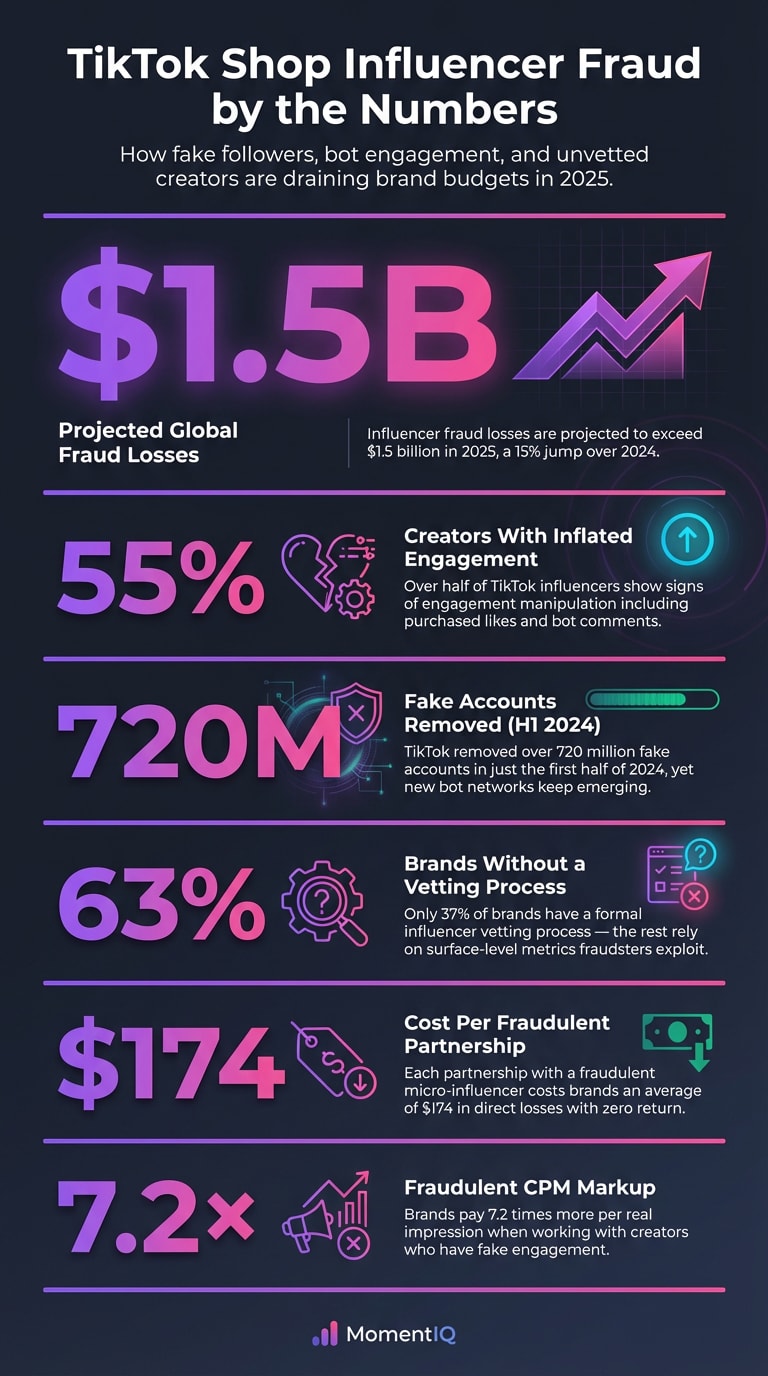
Here's a number that should make every TikTok Shop brand owner sit up straight: an estimated $1.3 billion was lost to influencer fraud globally in 2024, and that number is projected to climb even higher in 2025.
- Vet every TikTok creator deeply — 55% of influencers show signs of artificial engagement inflation, meaning surface-level metrics will mislead you.
- Budget for fraud losses: with $1.5 billion projected lost to influencer fraud in 2025, allocate resources for creator verification tools like HypeAuditor or Modash. track creator performance effectively
- Scrutinize mega-influencers most carefully, as fake follower rates reach up to 25% for larger accounts versus 10% for micro-influencers.
- Build a formal creator vetting process now — 63% of brands lack one, leaving your TikTok Shop affiliate spend dangerously exposed.
- Calculate true CPM before partnering: fraudulent creators drive 7.2x higher CPMs, so verify engagement authenticity to protect your ROAS.
Let that sink in.
While TikTok Shop is the single most exciting commerce channel of the decade most exciting commerce channel of the decade — brands are scaling from zero to seven figures in months, creators are building empires overnight, and the algorithm is rewarding authentic content like never before — there's a shadow economy thriving underneath the surface.Fake followers. Bot engagement. Fabricated metrics. Creators who look like goldmines on paper but deliver absolutely nothing in the cart.
And the worst part?Most brands don't even know they've been hit until the damage is done.
This post is your wake-up call.We've compiled 23 alarming data points on TikTok influencer fraud in 2025 — drawn from industry research, platform reports, and fraud detection analyses — to show you exactly how big this problem is, how much money is bleeding out of brand budgets, and what you can do to protect every dollar you invest in creator partnerships.
Let's get into it.
The State of TikTok Influencer Fraud in 2025: The Big Picture

Influencer fraud isn't new. But TikTok Shop has created a unique breeding ground for it. The platform's explosive growth, combined with its affiliate commission model and the sheer volume of creators entering the ecosystem, has made vetting harder and the stakes higher than ever.
Here are the macro-level statistics every brand needs to understand.
1. Global Influencer Fraud Losses Are Projected to Exceed $1.5 Billion in 2025
According to research from Statista and the Association of National Advertisers (ANA), influencer marketing fraud losses have grown year-over-year since 2020. The 2025 projection of $1.5 billion represents a 15% increase over 2024's estimated $1.3 billion — driven largely by the expansion of social commerce platforms like TikTok Shop where creator partnerships directly impact revenue.
2. An Estimated 55% of TikTok Influencers Have Engaged in Some Form of Artificial Engagement Inflation
A 2024 study by HypeAuditor analyzing millions of social media accounts found that over half of TikTok influencers showed signs of engagement manipulation — including purchased likes, comments from bot networks, and follow-for-follow schemes. This doesn't mean all of these creators are intentionally malicious, but it means the majority of creator profiles require deeper scrutiny before partnership.
3. Fake Follower Rates on TikTok Are Between 10-25% Across All Account Sizes
Research from fraud detection platforms like Modash and HypeAuditor consistently shows that TikTok accounts carry a fake follower rate ranging from 10% for micro-influencers to as high as 25% for mega-influencers. That means for every 100,000 followers a creator claims, up to 25,000 may be completely fabricated.
4. TikTok Removed Over 720 Million Fake Accounts in the First Half of 2024 Alone
TikTok's own Transparency Reports confirm the platform is aggressively fighting fake accounts, removing hundreds of millions every quarter. But the sheer volume tells a story: the supply of fake accounts is relentless, and new bot networks spin up faster than the platform can shut them down.
5. Only 37% of Brands Report Having a Formal Influencer Vetting Process

According to a 2024 Influencer Marketing Hub survey, nearly two-thirds of brands partnering with influencers do not have a systematic, data-driven vetting process.They rely on surface-level metrics — follower counts, view counts, and vibes — which is exactly what fraudulent creators exploit.
Fake Followers on TikTok Shop: The Financial Damage
Fake followers aren't just a vanity problem. On TikTok Shop, where creator partnerships are tied directly to product sales, commissions, and product seeding costs, fake followers translate to real financial losses.
6. Brands Lose an Average of $174 Per Fraudulent Micro-Influencer Partnership
When you factor in product seeding costs (shipping free product), commission structures, and internal team time spent managing the relationship, a partnership with a fraudulent micro-influencer costs brands an average of $174 in direct losses — with zero return. For brands running large-scale seeding campaigns with hundreds of creators, this adds up to tens of thousands of dollars in waste.
7. Product Seeding Waste From Unvetted Creators Costs Mid-Size Brands $8,000-$25,000 Per Quarter
A mid-size brand running a TikTok Shop affiliate program might seed 200-500 creators per quarter. Industry estimates suggest that without proper fraud detection, 15-30% of those creators will never post, have artificially inflated metrics, or generate zero meaningful engagement. At an average product cost of $20-$50 per unit (plus shipping), that's $8,000-$25,000 in product literally thrown away every 90 days.
8. 49% of Brands Say They've Unknowingly Paid for Fake Engagement
A 2024 survey by CreatorIQ found that nearly half of all brands admitted to discovering — after the fact — that they had compensated creators whose engagement metrics were artificially inflated. The discovery typically came when campaign performance data revealed catastrophically low conversion rates despite seemingly strong engagement numbers.
9. The Average CPM for Fraudulent Creator Content Is 7.2X Higher Than Legitimate Creator Content
When you calculate the true cost-per-thousand-impressions of content from creators with fake engagement, the CPM skyrockets. Research from WARC and various fraud detection platforms shows that brands effectively pay 7.2 times more per real impression when working with fraudulent creators — because the majority of their "impressions" are bot-generated and commercially worthless.
10. Brands Running Unvetted TikTok Shop Affiliate Programs See 34% Lower ROAS Than Those With Fraud Detection Protocols
This stat comes from aggregate industry benchmarking data: brands that implement systematic creator vetting and fraud detection consistently outperform those that don't by a significant margin. A 34% ROAS gap is the difference between a profitable TikTok Shop operation and one that's hemorrhaging money. (For more on what strong ROAS actually looks like, check out our guide on TikTok Shop ROAS Benchmarks by Industry 2025.)
Bot Engagement and Fake Comments: How Fraudulent TikTok Creators Game the System
Fake followers are just the tip of the iceberg. The more sophisticated — and more damaging — form of TikTok influencer fraud is engagement manipulation.
11. Bot Comment Networks Can Generate 10,000+ Fake Comments for Under $50
The barrier to entry for engagement fraud is shockingly low. Underground services sell bulk comment packages — complete with varied phrasing to mimic organic conversation — for pennies per comment. A creator can make a mediocre video look like a viral sensation for less than the cost of a dinner.
12. 68% of Fraudulent Engagement on TikTok Occurs Within the First 30 Minutes of Posting
Fraud detection research shows that bot engagement tends to spike immediately after content goes live, creating an artificial signal that tricks TikTok's algorithm into boosting the content further. Brands looking at a creator's content and seeing rapid early engagement may mistake bot activity for genuine virality.
13. Engagement Pods — Groups of Creators Who Artificially Boost Each Other's Content — Involve an Estimated 12% of Active TikTok Creators
Engagement pods are organized groups where creators agree to like, comment on, and share each other's content to inflate metrics. While not technically "bots," these pods create artificially inflated engagement rates that mislead brands about a creator's true audience responsiveness. An estimated 12% of active TikTok creators participate in some form of pod activity.
14. Videos With Bot-Inflated Engagement Convert at 83% Lower Rates Than Organically Viral Content
This is the stat that matters most for TikTok Shop brands. Bot engagement doesn't buy products. When a video's likes and comments are artificially inflated, the conversion rate to actual product clicks, add-to-carts, and purchases plummets. Research from e-commerce analytics platforms shows an 83% conversion gap — meaning bot-boosted content is essentially worthless for driving sales.
15. TikTok's Algorithm Now Penalizes Detected Bot Engagement With Up to 90% Reach Suppression
TikTok has been investing heavily in algorithmic fraud detection. When the platform detects bot engagement patterns on a piece of content, it can suppress that content's reach by up to 90%. This means that even if a fraudulent creator's video initially looks like it's performing, the algorithm will throttle it — and your brand's product goes unseen.
TikTok Shop-Specific Fraud: The Affiliate and Commission Problem
TikTok Shop's affiliate model introduces a unique layer of fraud risk that doesn't exist on other platforms. When creators earn commissions on sales, the incentive structure creates new avenues for manipulation.
16. An Estimated 18% of TikTok Shop Affiliate Applications Come From Accounts With Significant Fraud Indicators
Brands running open affiliate programs on TikTok Shop — where any creator can apply to promote their products — report that a significant portion of applications come from accounts showing red flags: sudden follower spikes, engagement-to-follower ratio anomalies, and content patterns consistent with bot networks.
17. Commission Fraud Through Fake Purchases Costs TikTok Shop Brands an Estimated $2,800/Month on Average
Some fraudulent creators use self-purchasing schemes — buying products through their own affiliate links (often with stolen payment methods or through coordinated networks) to collect commissions. While TikTok has implemented safeguards, this form of fraud still costs the average affected brand nearly $3,000 per month.
18. Brands With More Than 500 Affiliates Are 3.4X More Likely to Experience Creator Fraud Than Those With Fewer Than 50
Scale creates vulnerability. The more creators you onboard without systematic vetting, the higher your exposure to fraud. This is why scaling from 10 to 1,000 affiliates — as we discuss in our bulk creator recruitment playbook — requires fraud detection infrastructure, not just outreach volume.
19. 62% of TikTok Shop Sellers Do Not Audit Their Affiliate Creator Performance Data for Fraud Indicators
The majority of TikTok Shop sellers look at top-line affiliate metrics — total sales, total clicks, total commissions paid — without digging into the patterns that reveal fraud. Anomalous return rates, geographically concentrated purchases, and engagement-to-conversion ratio outliers are all detectable signals that most brands simply aren't monitoring.
The Hidden Costs: Brand Reputation and Algorithm Damage
The financial losses from influencer fraud are quantifiable. But there are hidden costs that can be even more devastating.
20. 41% of Consumers Say They Would Lose Trust in a Brand Promoted by an Obviously Inauthentic Influencer
A 2024 consumer survey by Edelman found that brand association with visibly fraudulent or inauthentic creators damages consumer trust. On TikTok, where authenticity is the currency of the algorithm, this trust erosion can cascade — affecting not just the fraudulent partnership but the brand's entire presence on the platform.
21. Brands Associated With Fraudulent Creator Networks See a 22% Decline in Organic Content Performance Over 90 Days
When TikTok's algorithm detects patterns of bot engagement connected to a brand's products, it can negatively impact the brand's broader content ecosystem. Legitimate creators promoting the same products may see reduced reach, and the brand's own organic content can suffer algorithmic suppression.
22. Recovering From a Major Fraud-Related Algorithm Penalty Takes an Average of 45-60 Days
Once TikTok's algorithm flags a brand's content ecosystem for fraud-associated activity, the recovery period is significant. Brands report needing 45-60 days of clean, high-quality creator partnerships and organic engagement to restore their algorithmic standing — that's two months of suppressed growth.
23. Only 14% of Brands Have a Fraud Response Plan in Place for Their Influencer Programs
Perhaps the most alarming statistic of all: the vast majority of brands have no playbook for what to do when fraud is detected. No process for auditing affected campaigns, no protocol for removing fraudulent creators, and no strategy for mitigating algorithmic damage. They're flying blind — and when fraud hits, they scramble.
How to Protect Your TikTok Shop Brand From Influencer Fraud: A 5-Step Framework
The data is clear. Influencer fraud on TikTok Shop is pervasive, expensive, and growing. But it's also preventable — if you build the right systems.
Here's the framework that separates brands losing thousands to fraud from brands running clean, high-converting creator programs.
Step 1: Implement Multi-Layer Creator Vetting Before Any Partnership
Never partner with a creator based on follower count and engagement rate alone. Your vetting process should include:
- Audience authenticity analysis: Use fraud detection tools to assess the percentage of real vs. fake followers
- Engagement pattern analysis: Look for bot engagement signatures — sudden spikes, generic comments, engagement concentrated in the first few minutes
- Content quality review: Watch their last 20 pieces of content. Does the engagement match the content quality? Are comments relevant and specific?
- Historical performance data: Review their track record of actual product sales if they've been a TikTok Shop affiliate before
- Audience demographic verification: Ensure their audience demographics align with your target customer
Step 2: Use Algorithmic Matching, Not Manual Scrolling
Manual creator discovery is where fraud thrives. When you're scrolling TikTok looking for creators and evaluating them based on what you see on the surface, you're seeing exactly what fraudulent creators want you to see.
This is where MomentIQ fundamentally changes the game. MomentIQ's algorithmic creator matching technology analyzes creators across multiple data dimensions — not just the vanity metrics that are easy to fake, but deep performance signals, audience quality indicators, and content-to-commerce conversion patterns. The platform identifies creators who actually drive sales, not just creators who look good on paper.
When you're vetting creators at scale, automation can also help streamline outreach to pre-vetted creator lists, ensuring you're only spending time and product on creators who've passed your fraud filters.
Step 3: Start With Small Test Campaigns Before Scaling
Never go all-in on an unproven creator. Structure your partnerships in phases:
- Phase 1 (Test): Seed product to 10-20 vetted creators. Track not just views and engagement, but actual product clicks, add-to-carts, and conversions.
- Phase 2 (Validate): Identify the top 20% of performers based on real commerce metrics. Look for any fraud indicators in the bottom performers.
- Phase 3 (Scale): Double down on validated creators. Expand to similar creator profiles using data-driven matching.
This phased approach limits your fraud exposure while building a clean, high-performing affiliate roster.
Step 4: Monitor Ongoing Performance for Fraud Signals
Fraud detection isn't a one-time event. Creators who pass initial vetting can still engage in fraud later. Build ongoing monitoring into your operations:
- Weekly engagement audits: Flag any creators whose engagement patterns change dramatically
- Return rate monitoring: Unusually high return rates from a specific creator's sales can indicate commission fraud
- Conversion rate benchmarking: Compare each creator's view-to-sale conversion rate against your program average. Significant outliers (in either direction) warrant investigation
- Comment sentiment analysis: Bot comments tend to be generic ("love this!", "amazing!", fire emojis). Real engagement includes specific questions, personal stories, and product-related discussion
Step 5: Build Relationships With Verified, High-Performing Creators
The best defense against fraud is a strong offense: build a core roster of verified, trusted creators who consistently deliver real results. Our guide on building a TikTok Shop creator ambassador program walks through how to turn your best affiliates into long-term brand partners who are invested in your success — not just chasing commissions.
When your creator program is anchored by authentic, high-performing partners, the impact of any individual fraudulent creator is minimized.
Why Fraud Detection Is Now a Non-Negotiable for TikTok Shop Growth
Let's zoom out for a moment.
TikTok Shop is projected to facilitate over $17.5 billion in U.S. e-commerce transactions in 2025. The brands that win on this platform will be the ones that scale creator partnerships aggressively — but intelligently.
Every dollar you lose to a fraudulent creator is a dollar you could have invested in a real creator who drives real sales. Every product you seed to a bot-inflated account is a product that could have been in the hands of an authentic advocate who creates content that converts.
The math is simple: fraud detection isn't a cost center. It's a profit multiplier.
Brands that implement systematic fraud detection and creator vetting consistently see:
- 30-40% improvement in creator program ROI by eliminating wasted spend on fraudulent partnerships
- Higher average conversion rates because their creator roster is composed of authentic voices with real, engaged audiences
- Stronger algorithmic performance because their content ecosystem is clean and signals genuine engagement to TikTok's algorithm
- Better creator relationships because high-quality creators want to work with brands that take partnerships seriously
How MomentIQ Eliminates Fraud Risk From Your TikTok Shop Creator Program
At MomentIQ, fraud detection isn't an add-on feature — it's built into the foundation of how we match brands with creators.
Here's what that looks like in practice:
- Algorithmic creator matching that evaluates creators on commerce performance data, not just surface-level metrics that are easy to manipulate
- Product seeding strategy designed to minimize waste by targeting creators with verified engagement quality and proven conversion potential
- Full-funnel commerce support that tracks creator performance from first impression to final purchase, making fraud patterns immediately visible
- Live commerce strategy that connects brands with vetted live hosts who drive real-time sales — the hardest format for fraudulent creators to fake
- Scalable creator programs built on data integrity, so you can grow from 50 to 500 to 5,000 affiliates without proportionally increasing your fraud exposure
We've seen it over and over: brands come to us after burning tens of thousands of dollars on unvetted creator partnerships. They've seeded hundreds of products to creators who never posted. They've paid commissions on sales that were returned within 48 hours. They've watched their TikTok Shop performance plateau because their content ecosystem was polluted with bot-inflated engagement.
And then they implement a data-driven approach — and everything changes.
The Bottom Line: 23 Statistics That Should Change How You Run Your Creator Program
Let's recap the numbers:
- $1.5 billion projected global influencer fraud losses in 2025
- 55% of TikTok influencers show signs of engagement manipulation
- 10-25% fake follower rates across all account sizes
- 720 million+ fake accounts removed by TikTok in H1 2024
- Only 37% of brands have formal vetting processes
- $174 average loss per fraudulent micro-influencer partnership
- $8,000-$25,000 quarterly product seeding waste for mid-size brands
- 49% of brands have unknowingly paid for fake engagement
- 7.2X higher CPM for fraudulent creator content
- 34% lower ROAS for unvetted affiliate programs
- 10,000+ fake comments available for under $50
- 68% of bot engagement occurs in the first 30 minutes
- 12% of active creators participate in engagement pods
- 83% lower conversion rates for bot-inflated content
- Up to 90% reach suppression for detected bot engagement
- 18% of affiliate applications show significant fraud indicators
- $2,800/month average commission fraud cost
- 3.4X higher fraud risk for programs with 500+ affiliates
- 62% of sellers don't audit for fraud indicators
- 41% of consumers lose trust in brands promoted by inauthentic creators
- 22% decline in organic performance from fraud association
- 45-60 day recovery period from algorithm penalties
- Only 14% of brands have a fraud response plan
These aren't abstract numbers. They represent real money leaving real brands' bank accounts. They represent months of growth lost to algorithmic penalties. They represent the difference between a TikTok Shop operation that scales profitably and one that bleeds out slowly.
Ready to Build a Fraud-Proof TikTok Shop Creator Program?
You've seen the data. You know the risks. Now it's time to do something about it.
Talk to a Strategist and discover how our algorithmic creator matching, performance-driven seeding strategy, and full-funnel commerce support can help you scale your TikTok Shop creator program — without losing a single dollar to fraud.
We'll audit your current creator program, identify your fraud exposure, and build a roadmap to a cleaner, more profitable, and massively scalable influencer operation.
The brands winning on TikTok Shop in 2025 aren't the ones spending the most on creators. They're the ones spending the smartest.
Let's make sure you're one of them. Book your free call now →