TikTok Shop Live Host Training Program
Master the 30-day TikTok Shop live host training curriculum that builds world-class selling teams. Boost viewer retention, click-through rates & conversions.
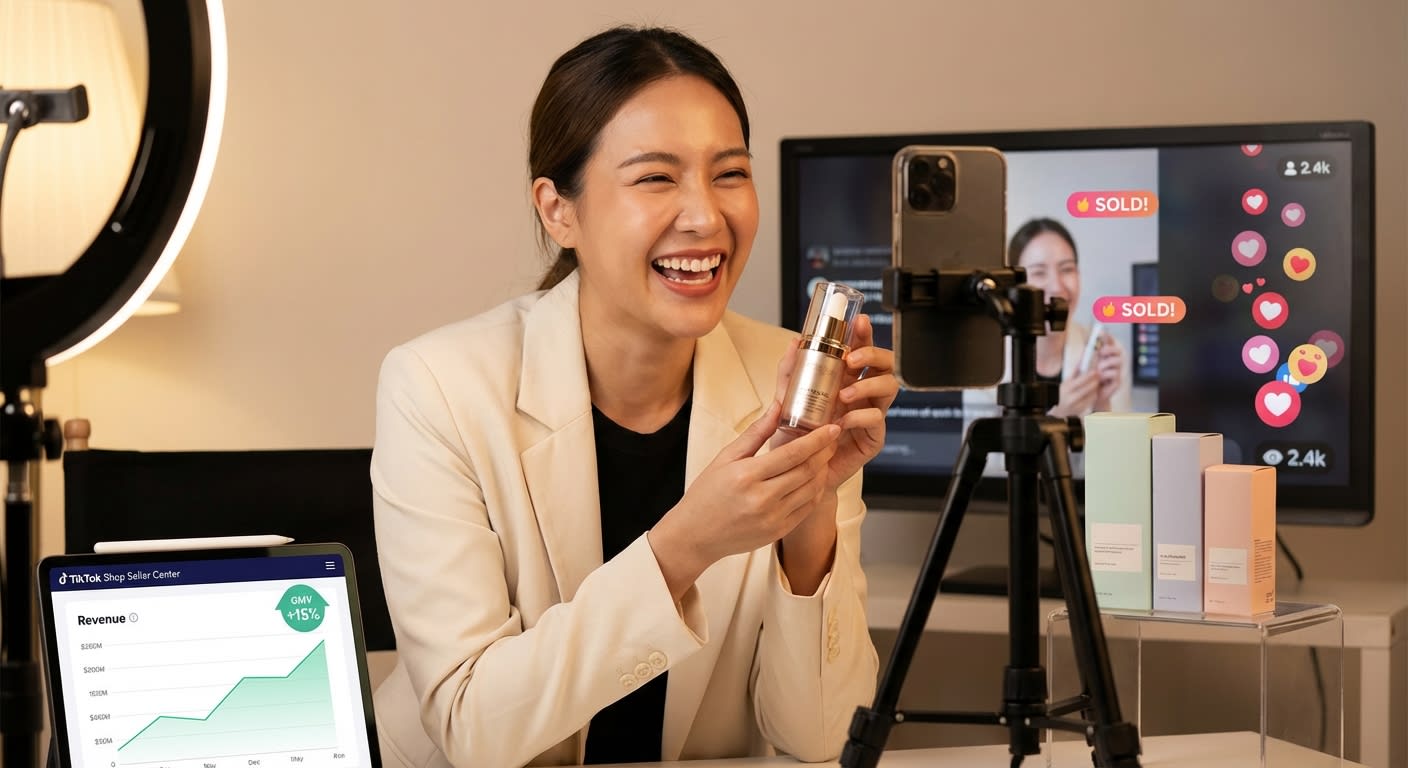
Here's the uncomfortable truth most TikTok Shop sellers won't admit: your live streams aren't underperforming because of the algorithm, your product, or your pricing. They're underperforming because your hosts aren't trained.
- Invest in structured 30-day host training programs, since the top 10% of live rooms generate 74% of total live commerce revenue.
- Build performance scorecards with clear benchmarks to create feedback loops and stop repeating the same live stream mistakes nightly.
- Train hosts on value propositions, objection handling, and urgency creation — the three pillars of live conversion — not just product features.
- Implement energy management systems to prevent mid-stream burnout, since untrained hosts typically crash after just 45 minutes.
- Treat live selling as a hybrid of sales, entertainment, and real-time audience psychology — not just on-camera charisma.
You've probably felt it.You hire someone with "on-camera energy," throw them into a live room, and watch the metrics flatline — low viewer retention, anemic click-through rates, and a GPM (gross per mille) that makes you question why you're doing live commerce at all.Meanwhile, your competitors are running 6- and 8-hour streams with hosts who convert at 3–5x your rate, and you can't figure out what they know that you don't.
What they know is this: world-class TikTok live sellers aren't born — they're built through systematic, structured training. And the brands investing in a real TikTok Shop live host training program right now are locking in a compounding advantage that latecomers simply won't be able to replicate.
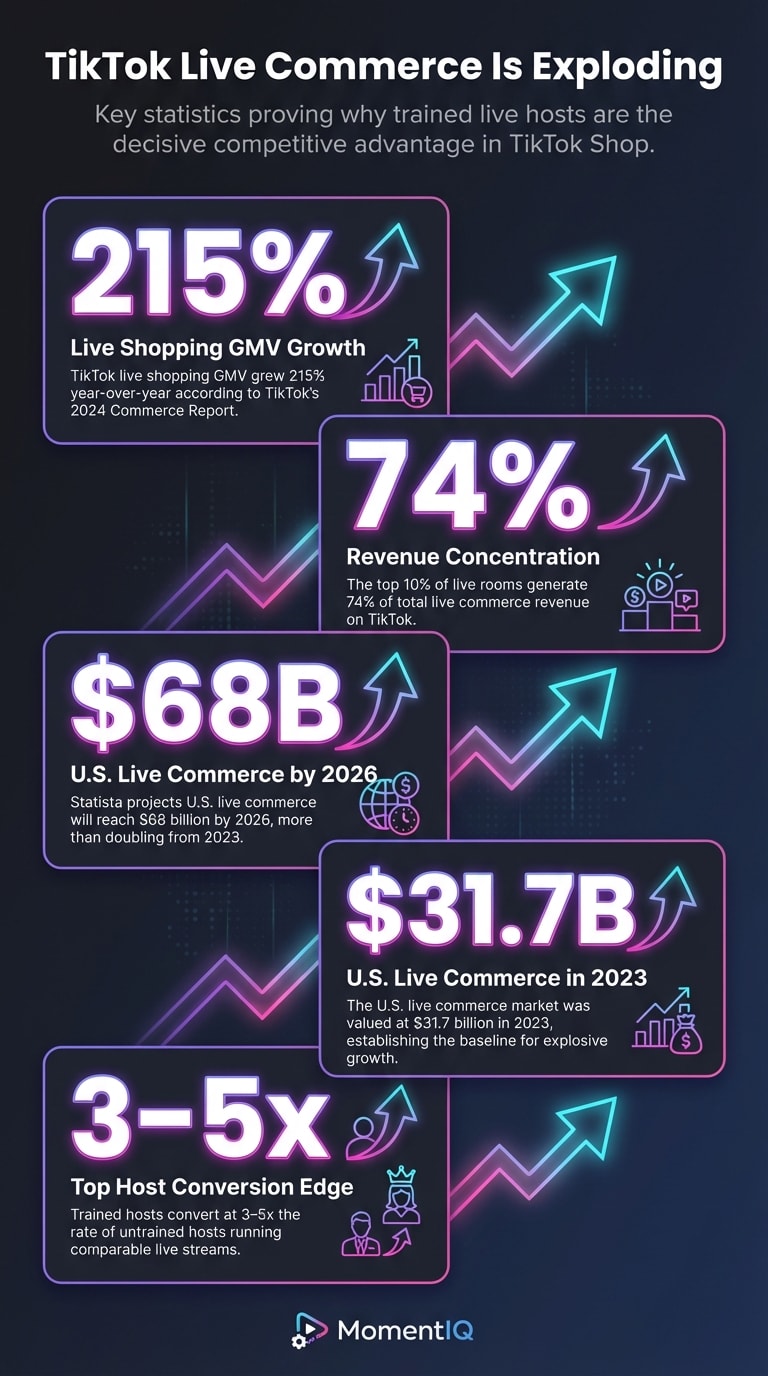
According to TikTok's 2024 Commerce Report, live shopping GMV on the platform grew 215% year-over-year, with the top 10% of live rooms generating 74% of total live commerce revenue.The gap between trained hosts and untrained hosts isn't marginal — it's exponential.
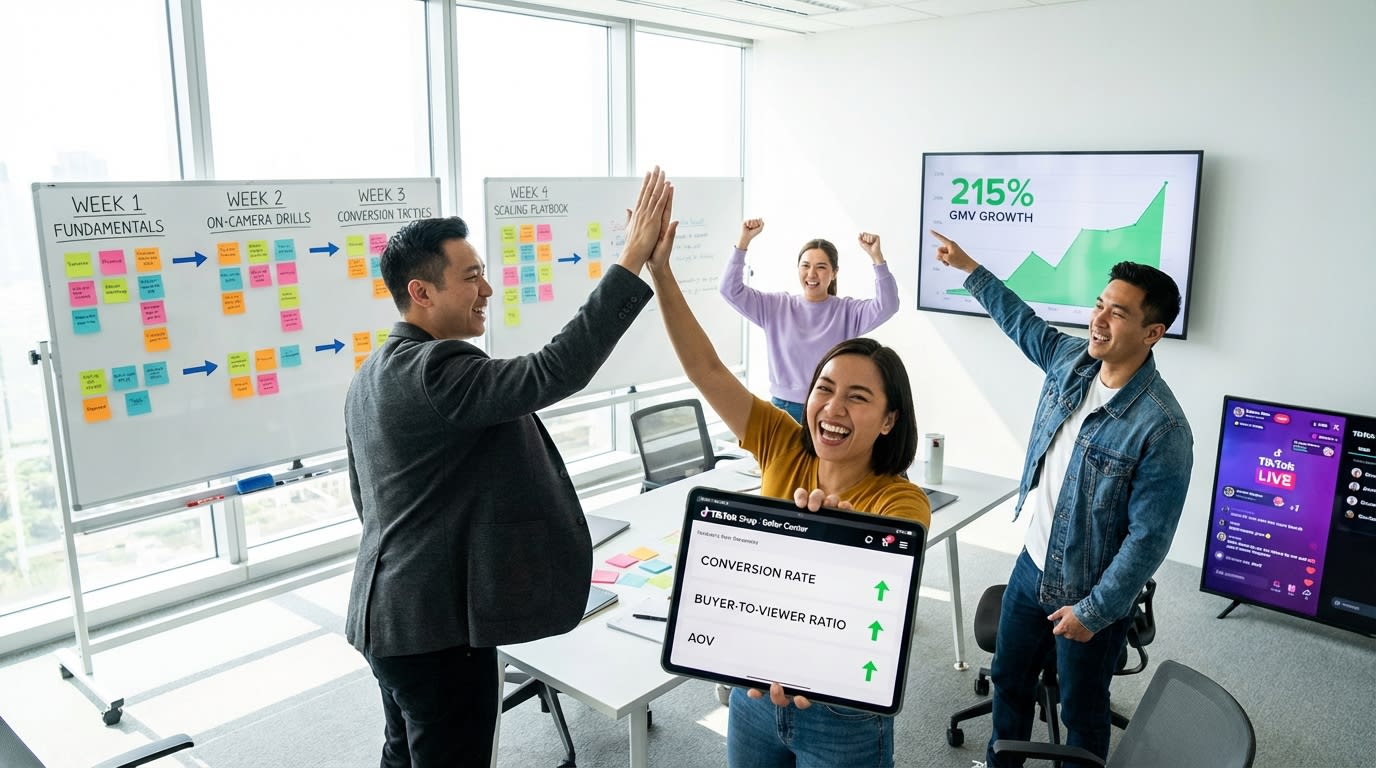
This guide gives you the complete 30-day curriculum to train TikTok live sellers who don't just show up on camera — they sell. We'll cover audition criteria, on-camera coaching frameworks, product knowledge drills, energy management systems, and the performance scorecards that separate hobbyists from revenue machines.
And if you'd rather skip the 90-day learning curve and deploy a battle-tested live commerce team immediately, Talk to a Strategist. As TikTok Shop Partner of the Year, MomentIQ has built and trained live selling teams that have generated millions in GMV — and the playbook below is drawn from that same operational DNA.
Why Most TikTok Shop Live Hosts Fail (And Why Training Is the Fix)
Let's diagnose the problem before we prescribe the solution.
Most brands approach live host hiring the way they'd cast a commercial: find someone attractive, articulate, and energetic, then hope for the best. But TikTok live selling is not acting — it's a hybrid of sales, entertainment, and real-time audience psychology that requires an entirely different skill set.
Here's what typically goes wrong:
- No structured onboarding. Hosts are handed a product list and told to "be authentic." They wing it, and the numbers reflect it.
- Zero performance benchmarks. Without scorecards, there's no way to identify what's working, what's broken, or who needs coaching.- Energy crashes mid-stream. Untrained hosts burn out after 45 minutes, and viewer counts crater with their energy.- Product knowledge is surface-level. Hosts can describe features but can't articulate value propositions, handle objections, or create urgency — the three pillars of live conversion.- No feedback loops. Streams happen, data is ignored, and the same mistakes repeat nightly.
A Statista report from early 2025 projects that U.S. live commerce will reach $68 billion by 2026, up from $31.7 billion in 2023. The brands capturing that growth aren't doing it with untrained talent. They're running structured TikTok Shop live host training programs that turn raw potential into predictable revenue essential live streaming equipment.
The Audition: How to Identify High-Potential TikTok Live Presenters Before You Invest in Training
Training can sharpen skills, but it can't manufacture core traits. Your 30-day curriculum starts before Day 1 — with a rigorous audition process designed to filter for the raw materials that great TikTok live presenter skills are built on.
The 5 Non-Negotiable Audition Criteria
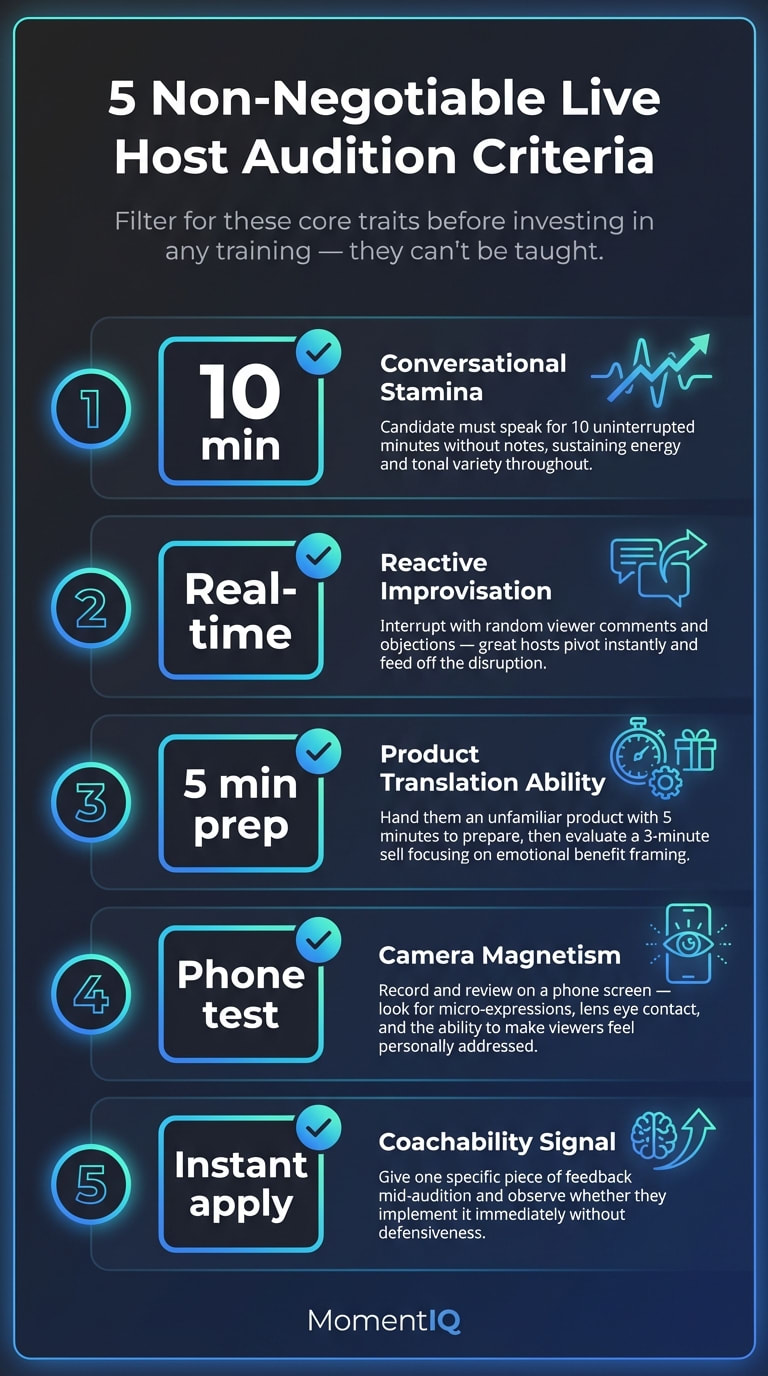
1. Conversational Stamina
Ask candidates to speak for 10 uninterrupted minutes about any topic they're passionate about — without notes. You're not evaluating expertise. You're evaluating whether they can sustain energy, vary their tone, and hold attention without a script. If they run out of steam at minute 4, they'll crater at minute 40 in a live room.
2. Reactive Improvisation
During the audition, interrupt them with random "viewer comments" (questions, objections, jokes). Great live hosts don't just tolerate interruptions — they feed off them.Watch for how quickly they pivot, acknowledge the comment, and return to their point without losing momentum.
3. Product Translation Ability
Give them a product they've never seen — a random skincare serum, a kitchen gadget, anything — and 5 minutes to prepare. Then ask them to sell it for 3 minutes. You're testing their ability to translate features into emotional benefits on the fly. This is the single most predictive trait of live selling success.
4. Camera Magnetism (Not Just Attractiveness)
Record the audition and watch it back on a phone screen. Some people who are magnetic in person become flat on camera. Others who seem quiet in a room come alive through a lens. Camera magnetism is about micro-expressions, eye contact with the lens, and the ability to make a viewer feel personally addressed. It's distinct from traditional charisma.
5. Coachability Signal
Give them one specific piece of feedback mid-audition ("Try holding the product closer to the camera" or "Slow down when you say the price") and see if they implement it immediately. The fastest-developing hosts aren't the most talented — they're the most coachable.
Red Flags That No Amount of Training Will Fix
- Monotone delivery that doesn't vary despite prompting
- Inability to make eye contact with the camera lens
- Defensiveness when given feedback
- Reliance on filler words that persist even when pointed out
- Discomfort with repetition (live selling requires saying the same CTA dozens of times per stream without it feeling stale)
Pro tip: Run auditions as mock 15-minute live streams using TikTok's actual interface. The candidates who intuitively understand the vertical format, pinned comments, and product card placement are already ahead.
The 30-Day TikTok Shop Live Host Training Curriculum
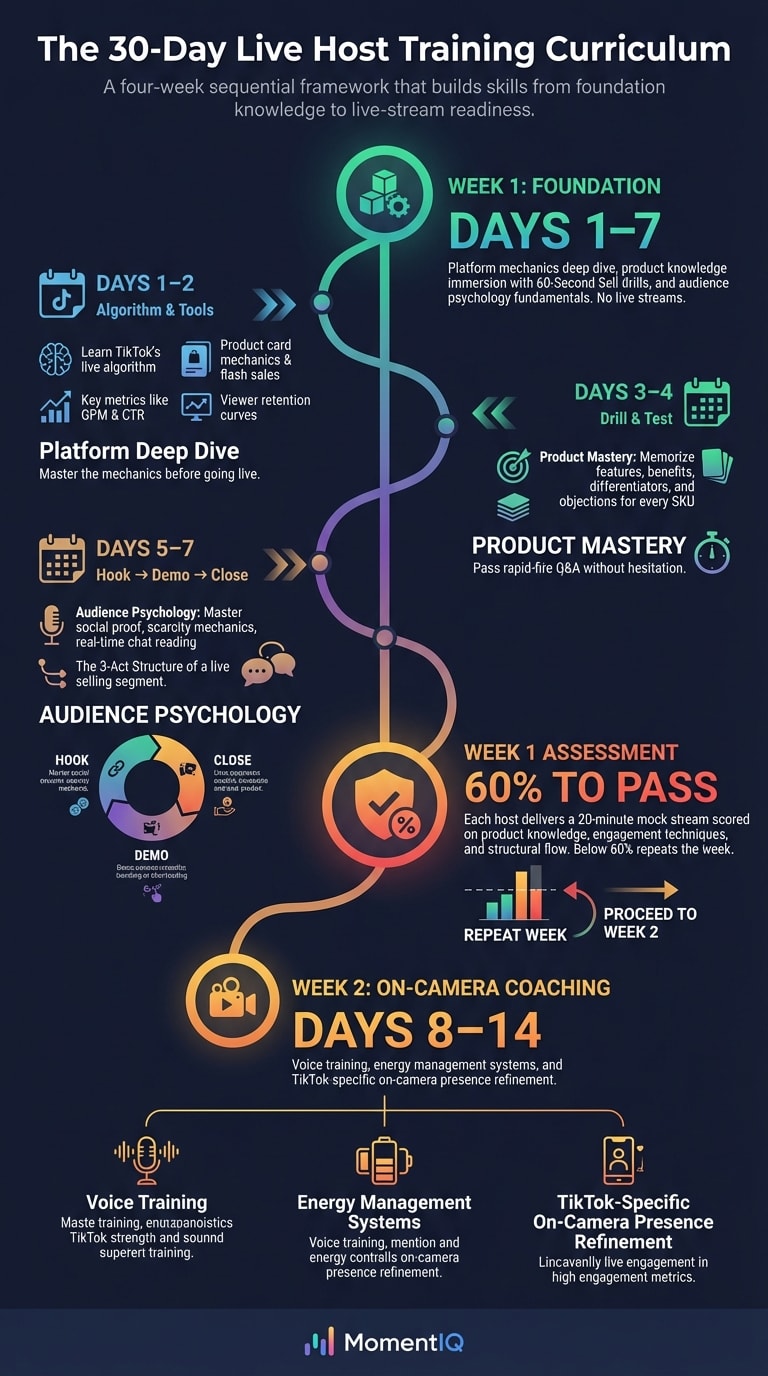
This is the framework. Four weeks, each with a distinct focus, building skills sequentially so that by Day 30, your hosts can run high-converting streams with confidence and consistency.
Week 1 (Days 1–7): Foundation — Platform Mechanics, Product Mastery, and Audience Psychology
The first week is about building the knowledge base that everything else sits on. No one goes live during Week 1. This is classroom time.
Days 1–2: Platform Deep Dive
- How TikTok's live algorithm distributes viewers (and what triggers it to pull viewers away)
- The mechanics of the product card, pinned comments, flash sales, and coupon drops
- Understanding GPM, CTR, viewer retention curves, and average watch time
- Watching and annotating 10+ competitor live streams, noting specific techniques
Days 3–4: Product Knowledge Immersion
- Hosts must be able to recite every product's features, benefits, differentiators, and common objections from memory
- Drill format: "60-Second Sell" — host picks a random product card and delivers a complete pitch in under 60 seconds
- Create a "Product Bible" document for each SKU with talk tracks, comparison points, and FAQ responses
- Test with rapid-fire Q&A where a trainer fires viewer-style questions and the host must answer without hesitation
Days 5–7: Audience Psychology Fundamentals
- The psychology of social proof in real-time ("327 people just added this to cart")
- Scarcity and urgency mechanics that feel authentic, not manipulative
- How to read chat sentiment and adjust tone in real time
- The "3-Act Structure" of a live selling segment: Hook (why should I care?) → Demo (prove it) → Close (buy now because…)
Week 1 Assessment: Each host delivers a 20-minute mock stream to the training team. Score on product knowledge accuracy, engagement techniques, and structural flow. Hosts who score below 60% repeat the week.
Week 2 (Days 8–14): On-Camera Coaching — Voice, Energy, and TikTok Live Presenter Skills
This is where raw potential starts becoming polished skill. Week 2 is about the craft of performing on camera — and it's where most DIY training programs fall apart because brands don't know what to coach.
If you're realizing that building this training infrastructure internally feels overwhelming, you're not alone. Most brands we talk to at MomentIQ have tried to train hosts in-house and hit a ceiling within weeks. Our live commerce strategists have developed proprietary coaching frameworks that compress months of trial-and-error into days. Talk to a Strategist to see how we can build or train your live selling team.
Days 8–9: Voice and Delivery Training
- Pacing drills: Practice delivering the same pitch at three speeds — normal, 20% faster (for urgency moments), and 20% slower (for price reveals and key benefits)
- Tonal variation exercises: Record a 5-minute segment in monotone, then re-record with exaggerated tonal shifts. The sweet spot is between the two.
- The "Radio Test": Play back audio-only of a host's stream. If it's compelling without video, the voice work is solid. Most untrained hosts fail this test completely.
- Volume dynamics: Practice the "whisper-to-shout" technique — dropping volume to pull viewers in, then surging for excitement moments
Days 10–11: Physical Presence and Camera Work
- Hand gesture vocabulary: 5 go-to gestures that emphasize points without being distracting
- Product handling drills: How to hold, demonstrate, and transition between products smoothly
- The "Triangle" technique: Alternating eye contact between lens, product, and chat to create a sense of dynamic engagement
- Wardrobe and background coaching specific to your brand aesthetic
Days 12–14: Energy Management Systems
This is the skill that separates hosts who can do 1-hour streams from hosts who can dominate 4–8 hour marathons.
- The 20-Minute Energy Cycle: Teach hosts to think in 20-minute blocks. Each block has an energy arc — start at 7/10, build to 9/10 for the product push, then reset to 6/10 during transitions. This prevents the catastrophic energy crash that kills most streams after 30–45 minutes.
- Physical energy techniques: Standing vs. sitting rotations, micro-stretches during product transitions, hydration and snack schedules
- Mental energy techniques: Pre-stream visualization routines, mid-stream "reset phrases" that re-center focus, and post-stream cooldown protocols
- The Tag-Team Framework: For multi-host setups, train seamless handoff techniques where energy transfers between hosts without viewer drop-off
Week 2 Assessment: Each host runs a 45-minute mock stream. Score on vocal variety (1–10), energy consistency (1–10), camera presence (1–10), and product demonstration quality (1–10). Minimum passing score: 7 average across all categories.
Week 3 (Days 15–21): Live Selling Mechanics — Conversion Techniques, Objection Handling, and Real-Time Adaptation
Weeks 1 and 2 built the foundation and the performance skills. Week 3 is where we turn presenters into sellers.
Days 15–16: The Conversion Framework
Teach the "SPIN-to-SELL" live selling structure:
- Story: Open every product segment with a 30-second story (personal use, customer testimonial, problem scenario)
- Proof: Demonstrate the product live — texture, function, before/after, comparison
- Incentive: Present the live-exclusive offer, bundle, or limited-time price
- Nudge: Direct CTA — "Tap the orange button right now, there are only 47 left at this price"
Drill this sequence until it's muscle memory. Hosts should be able to run through SPIN-to-SELL for any product in under 3 minutes.
Days 17–18: Real-Time Objection Handling
The most common viewer objections in TikTok live rooms:
- "Is this legit?" → Social proof response + show order count
- "It's too expensive" → Value reframe + per-use cost breakdown
- "Does it actually work?" → Live demonstration + satisfaction guarantee mention
- "I'll buy it later" → Scarcity trigger + live-only pricing emphasis
- "Is shipping fast?" → Specific delivery timeline + TikTok Shop buyer protection
Run "objection gauntlet" drills where trainers rapid-fire objections via chat and hosts must respond naturally within 5 seconds. According to eMarketer's 2024 social commerce study, live streams where hosts actively address viewer objections see 38% higher conversion rates than those where objections are ignored.
Days 19–21: Reading the Room and Adapting
- How to interpret real-time metrics: If viewer count drops, what do you change? If CTR spikes but orders don't, what's the disconnect?
- The "Pivot Protocol": A decision tree for common scenarios:
- Viewer count dropping → Switch to a hero product, run a flash giveaway, or increase energy
- High engagement but low sales → Strengthen the CTA, add urgency, or address an unspoken objection
- Chat going negative → Acknowledge, redirect, and refocus on value
- Practice streams with intentional disruptions (trainer kills the music, changes the product order, floods chat with tough questions)
Week 3 Assessment: A 90-minute live stream on the brand's actual TikTok account (low-traffic time slot). Evaluate real metrics: viewer retention, CTR on product cards, and actual conversion rate. This is the first real-world test.
Week 4 (Days 22–30): Performance Optimization — Scorecards, Feedback Loops, and Scaling
The final week transforms trained hosts into self-optimizing performers who improve with every stream.
Days 22–24: The Performance Scorecard System
Every stream gets scored across 8 dimensions. Here's the scorecard framework:
| Metric | Weight | Target (Trained Host) |
|---|---|---|
| Average Watch Time | 15% | 3+ minutes |
| Product Card CTR | 15% | 8%+ |
| Conversion Rate (card click → purchase) | 20% | 12%+ |
| GPM (Gross Per Mille) | 15% | $150+ |
| Viewer Retention at 30 min | 10% | 40%+ of peak |
| Chat Engagement Rate | 10% | 5%+ of viewers |
| Energy Consistency Score (peer-rated) | 10% | 7/10+ |
| Objection Handling Quality (reviewed) | 5% | 8/10+ |
These benchmarks aren't arbitrary. They're based on aggregate performance data from top-performing TikTok Shop live rooms. Hosts who consistently hit these targets typically generate $2,000–$8,000+ in GMV per stream hour, depending on product price point and audience size.
Days 25–27: Film Review and Coaching Sessions
Borrow from professional sports: watch the tape.
- Review recordings of each host's streams with timestamp annotations
- Identify the exact moments where viewers dropped off and diagnose why
- Celebrate specific wins ("At 14:32, you handled that pricing objection perfectly — here's why it worked")
- Create individualized improvement plans with 2–3 focus areas per host
Days 28–30: Graduation Streams and Ongoing Development Planning
- Each host runs a full-length stream (2–4 hours) during a prime traffic window
- Score against the performance scorecard with real data
- Hosts who meet benchmarks are "graduated" to the regular streaming rotation
- Create a 90-day development roadmap for each host with progressive targets
The brands that dominate TikTok live commerce don't stop training after 30 days. They build continuous improvement into their operations — weekly film reviews, monthly skill workshops, and quarterly scorecard recalibrations.
The Hidden Cost of Not Training Your TikTok Live Hosts
Let's talk about what happens when you skip this process — because "we'll figure it out as we go" is the most expensive strategy in live commerce.
The math is brutal:
- An untrained host averaging $800/hour in GMV across a 4-hour stream generates $3,200
- A trained host averaging $3,500/hour generates $14,000 from the same stream
- Over 20 streams per month, that's the difference between $64,000 and $280,000 in monthly GMV
- The training investment pays for itself in the first week
One supplement brand that partnered with MomentIQ scaled from $18K to $420K/month in 90 days — and a significant portion of that growth came from deploying properly trained live hosts who converted at 3.4x the rate of their previous untrained presenters.
A home goods brand saw their average stream GPM jump from $47 to $312 within 45 days of implementing a structured training program through MomentIQ's live commerce division. That's not a marginal improvement — it's a category shift.
"We Can Train Hosts Ourselves" — Why DIY Training Hits a Ceiling
Here's an objection we hear constantly: "We don't need an agency for training. We'll build the program internally."
And honestly? You can get 60–70% of the way there with the framework in this article. But here's where DIY training consistently breaks down:
1. You don't have benchmark data.
Without access to performance data across hundreds of live rooms and thousands of streams, you're guessing at what "good" looks like. MomentIQ's proprietary analytics, built from managing live commerce for brands across dozens of categories, provide the benchmarks that make training measurable. You're not coaching in the dark.
2. You can't coach what you haven't mastered.
Most brand managers have never sold live on TikTok themselves. They can identify that something feels "off" about a host's performance but can't diagnose the specific technical issue — whether it's pacing, tonal flatness, weak transitions, or poor product staging. Expert coaching requires expert coaches.
3. Scale breaks everything.
Training one host is manageable. Training a rotation of 4–8 hosts across multiple time zones, with consistent quality and standardized scorecards? That's an operational challenge that requires dedicated infrastructure. According to a 2024 McKinsey report on live commerce operations, brands that professionalize their live selling teams see 2.8x higher revenue per stream than those running ad-hoc operations.
4. The opportunity cost is massive.
Every week you spend building a training program from scratch is a week your competitors are streaming with trained hosts and capturing market share. TikTok's live commerce algorithm rewards consistency and performance — the brands building trained teams now are earning algorithmic advantages that compound over time.
This is exactly why brands partner with MomentIQ. We don't just recruit creators and manage affiliate programs — we build and train complete live commerce operations, from host auditions to performance scorecards, using frameworks proven across millions in managed GMV.
Advanced Training Modules: Beyond the 30-Day Foundation
Once your hosts graduate the core curriculum, these advanced modules separate good live sellers from great ones.
Multi-Product Transition Mastery
The #1 moment viewers leave a live stream is during product transitions. Train hosts to use "bridge phrases" that connect one product to the next:
- "Now, if you loved that serum, wait until you see what we pair it with..."
- "I know a lot of you in chat are asking about [next product] — let's get into it RIGHT NOW"
- "Before I show you the next item, let me tell you why these two products together are a game-changer"
Drill transitions until they're seamless. The best hosts make a 15-product stream feel like one continuous conversation, not 15 separate pitches.
Flash Sale and Event Execution
TikTok Shop's promotional tools — flash sales, limited-time coupons, bundle offers — require specific hosting techniques:
- Countdown energy management: Building anticipation without peaking too early
- Stock-level narration: "We started with 500 units, we're down to 127 — I'm watching the number drop in real time"
- Post-sale momentum: How to maintain energy and viewer count after a flash sale ends (this is where most hosts lose 40%+ of their audience)
Audience Segmentation in Real Time
Advanced hosts learn to identify and address different viewer segments simultaneously:
- New viewers: "If you're just joining, here's what you missed and why you need to stay"
- Repeat buyers: "My regulars already know this is our best-seller — tell the new people in chat!"
- Skeptics: "I see some questions about whether this really works — let me show you right now"
This technique, when executed well, can increase average watch time by 40–60% according to TikTok's own creator education materials.
The Performance Scorecard: Measuring What Matters
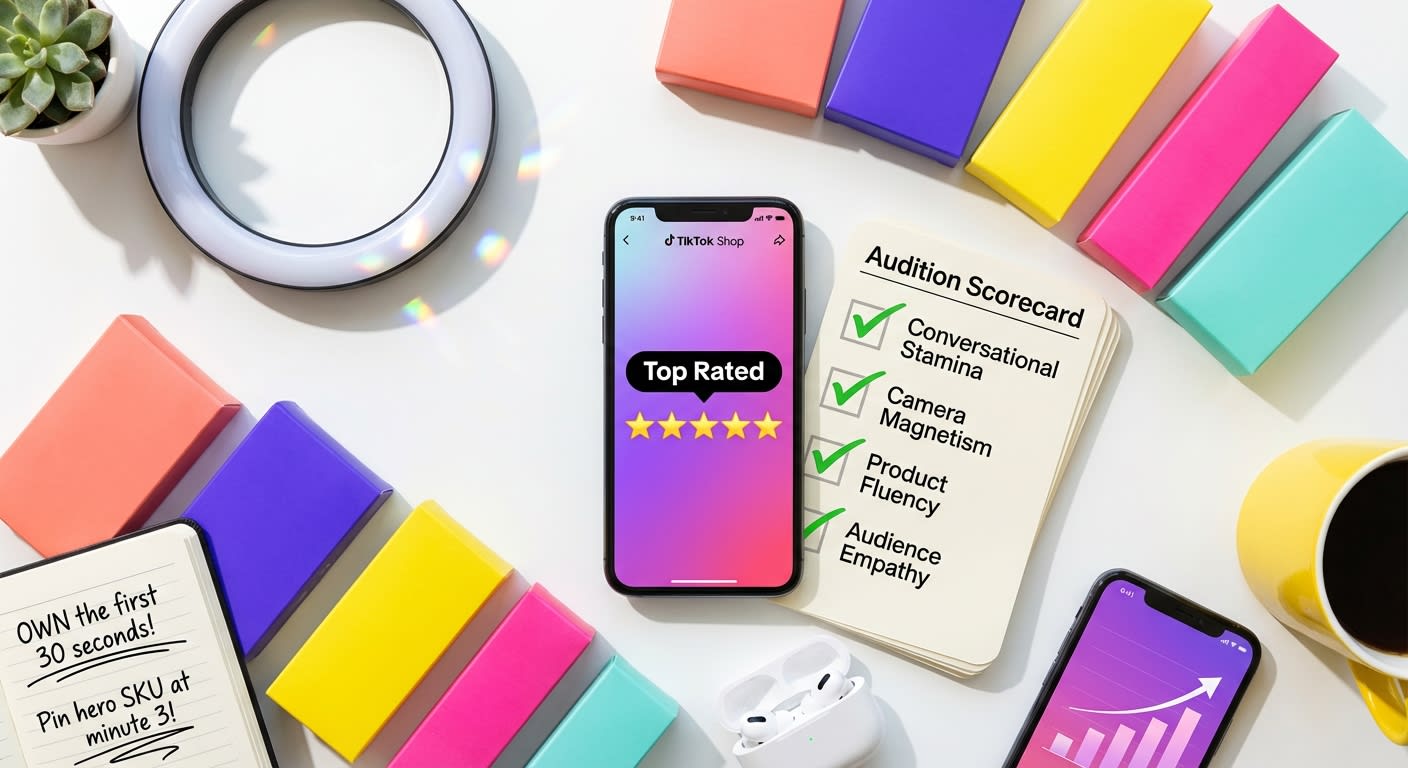
You can't improve what you don't measure. The performance scorecard is the single most important tool in your TikTok Shop live host training program — and it's where most brands completely drop the ball.
Here's how to implement it:
Daily Metrics (Tracked After Every Stream)
- Total GMV
- GPM (gross per mille — revenue per 1,000 viewers)
- Average watch time
- Peak concurrent viewers
- Product card CTR
- Conversion rate
- Items sold per hour
Weekly Coaching Metrics (Reviewed in 1:1s)
- Energy consistency across stream duration (rated 1–10 by reviewer)
- Objection handling quality (sampled from stream recordings)
- Product knowledge accuracy (spot-checked)
- Chat engagement quality (not just quantity — are responses driving sales?)
- Transition smoothness between products
Monthly Development Metrics
- Trend in GPM over 30 days (should be consistently rising)
- Viewer return rate (are the same viewers coming back for this host?)
- Cross-sell effectiveness (does this host successfully sell complementary products?)
- Stress test performance (how do metrics hold during 4+ hour streams?)
Set clear thresholds: Hosts consistently below benchmarks after 60 days need either intensive remedial coaching or replacement. Hosts exceeding benchmarks should be rewarded — higher commission rates, prime time slots, and feature opportunities.
Why the Window for Building a Trained Live Team Is Closing
Let's talk about timing — because this matters more than most brands realize.
TikTok Shop's live commerce ecosystem in the U.S. is still in its growth phase. According to Insider Intelligence, TikTok's share of U.S. social commerce sales is projected to reach 20.3% by 2026, up from an estimated 13.7% in 2024. The platform is actively investing in live commerce infrastructure, creator incentives, and buyer acquisition.
But here's what's happening beneath the surface:
- The supply of skilled live hosts is tightening as more brands enter the space
- Top-performing hosts are being locked into exclusivity deals (we covered this in our creator exclusivity guide)
- TikTok's algorithm increasingly rewards live rooms with strong historical performance metrics — meaning the brands training hosts NOW are building algorithmic equity that compounds
- Viewer expectations are rising rapidly; the tolerance for amateur-hour streams is dropping every quarter
The brands that will dominate TikTok live commerce in 2026 are the ones building their trained host teams in 2025. Full stop.
A beauty brand working with MomentIQ built a 6-person trained host rotation in Q1 2025 and saw their live commerce revenue grow from $45K/month to $380K/month by the end of Q2 — not because they found magical products, but because they invested in the people selling those products.
When to Build In-House vs. When to Partner with Experts
Let's be honest about when a DIY approach makes sense and when it doesn't:
Build in-house if:
- You have 1–2 products and plan to stream less than 10 hours/week
- You have a team member with genuine live selling experience (not just "good on camera")
- You're comfortable with a 3–6 month ramp to profitability
- Your monthly live commerce GMV target is under $50K
Partner with MomentIQ if:
- You need to scale to 20+ streaming hours per week across multiple hosts
- You want trained hosts generating revenue within weeks, not months
- Your GMV targets require professional-grade conversion rates from Day 1
- You've tried building internally and hit a performance ceiling
- You need the full stack — host training, creator affiliate programs, product seeding, and analytics — working as an integrated system
MomentIQ isn't a generic influencer agency that bolted on "live commerce" as a service line. As TikTok Shop Partner of the Year and a TikTok Marketing Partner, MomentIQ's live commerce division was built from the ground up for TikTok Shop's unique mechanics — from algorithmic creator matching through our Reacher platform (reacherapp.com) to end-to-end live stream operations and host development.
The difference between a generic agency and MomentIQ is the difference between an untrained host and a trained one: it shows up in every metric, every stream, every month.
Your 30-Day Training Checklist (Quick Reference)
Week 1: Foundation
- Platform mechanics deep dive
- Product Bible creation for all SKUs
- 60-Second Sell drills (daily)
- Audience psychology workshop
- 20-minute mock stream assessment
Week 2: On-Camera Skills
- Voice and pacing drills
- Radio Test recordings
- Physical presence coaching
- Energy management system training
- 45-minute mock stream assessment
Week 3: Selling Mechanics
- SPIN-to-SELL framework mastery
- Objection gauntlet drills
- Pivot Protocol training
- 90-minute live stream on actual account
Week 4: Performance Optimization
- Scorecard system implementation
- Film review sessions
- Individualized coaching plans
- Graduation stream (2–4 hours, prime slot)
- 90-day development roadmap creation
Stop Hoping Your Hosts Figure It Out. Start Building a System.
The difference between a $50K/month live commerce operation and a $500K/month one almost never comes down to product or price. It comes down to the people on camera and the system that trained them.
Every day you run live streams with untrained hosts is a day you're leaving money on the table — and handing it to competitors who invested in training. The 30-day curriculum above gives you the blueprint. But a blueprint without execution is just a document.
Ready to build a world-class live selling team — or scale the one you have? Talk to a Strategist. Our live commerce strategists will assess your current operation, identify the highest-leverage improvements, and show you exactly how brands in your category are scaling to six- and seven-figure monthly GMV through trained, optimized live commerce teams.
The window is open. The playbook exists. The only question is whether you'll build the team — or watch someone else in your category do it first.