
TikTok Shop to Reels & Shorts: Cross-Platform Funnel
Master the 2025 cross-platform social commerce funnel from TikTok Shop to Instagram Reels to YouTube Shorts. Capture buyers everywhere they scroll.
Here's the uncomfortable truth most TikTok Shop sellers don't want to hear: your customers aren't loyal to one platform. They're scrolling TikTok at lunch, browsing Instagram Reels on their commute, and watching YouTube Shorts before bed.And if you're only showing up in one of those places, you're leaving an enormous amount of revenue on the table.
- Treat each platform as a distinct funnel stage with tailored content, not a lazy repost of the same TikTok video everywhere.
- Target multi-channel shoppers who spend 250% more by showing up on TikTok, Instagram Reels, and YouTube Shorts simultaneously.
- Design every piece of cross-platform content to ultimately drive traffic back to your TikTok Shop checkout as the single conversion point.
- Leverage YouTube Shorts' 70 billion daily views and new shoppable features to build trust and consideration before purchase.
- Recognize that 73% of consumers follow brands on multiple platforms before buying, so orchestrate a deliberate multi-platform presence now.

This isn't about content repurposing. (We already covered how to turn one video into 15 assets how to turn one video into 15 assets in a separate guide.) This is about something far more strategic: building a deliberate cross-platform commerce funnel where each platform plays a specific role in the buyer journey — and every single road leads back to TikTok Shop checkout.
According to a 2024 McKinsey report, consumers who engage with a brand across three or more channels spend 250% more than single-channel shoppers.Meanwhile, Sprout Social's 2025 data shows that 73% of consumers follow brands on multiple social platforms before making a purchase.The brands winning in social commerce right now aren't just creating great TikTok content — they're orchestrating a multi-platform symphony that surrounds buyers with the right message at the right time on the right platform.
Let's break down exactly how to build this funnel, platform by platform, with specific optimization tactics for each leg of the journey.
Why a Cross-Platform Social Commerce Strategy Is Non-Negotiable in 2025
Before we dive into the tactical framework, let's ground this in reality. The social commerce landscape has fundamentally shifted.
The numbers tell the story:
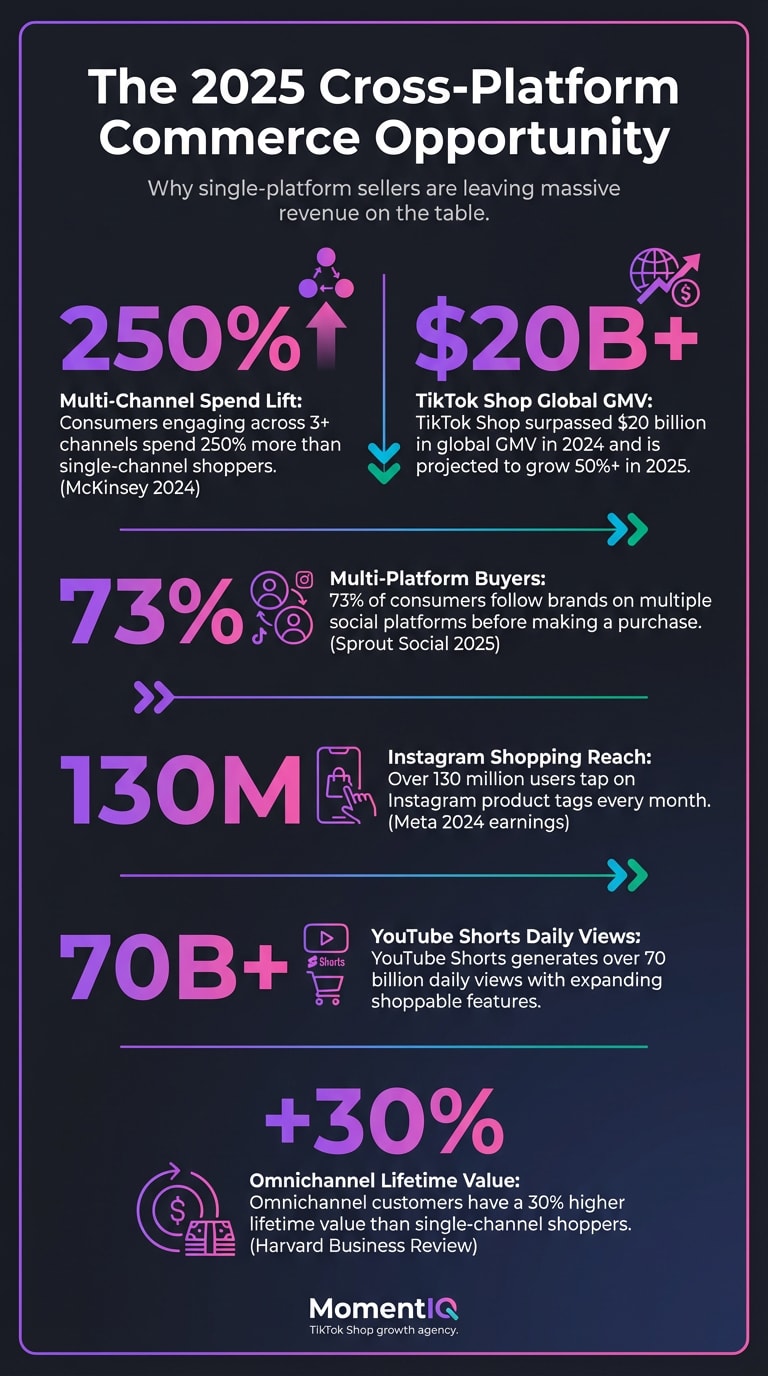
- TikTok Shop surpassed $20 billion in global GMV in 2024, according to internal TikTok for Business reports — and is projected to grow another 50%+ in 2025.- Instagram Shopping features reach over 130 million users monthly who tap on product tags, per Meta's 2024 earnings data.
- YouTube Shorts now generates over 70 billion daily views, and Google has been aggressively rolling out shoppable features throughout 2024-2025.
- A Harvard Business Review study found that omnichannel customers have a 30% higher lifetime value than those who shop through a single channel.
The old playbook — post on TikTok, pray for virality, hope people buy — is a single-point-of-failure strategy.The new playbook uses each platform's unique strengths to move buyers through discovery, consideration, trust-building, and conversion.
The Core Problem With "Just Repurpose" Thinking
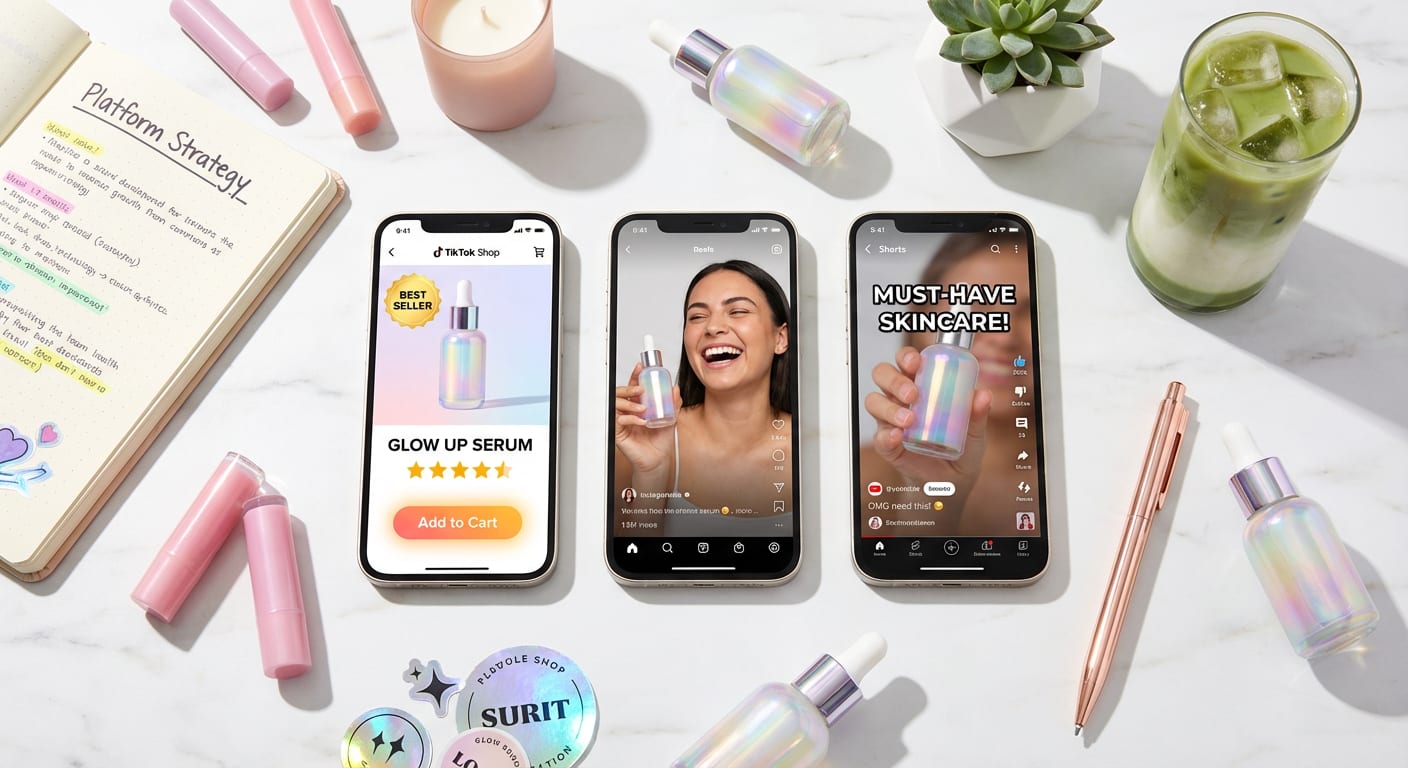
Most brands hear "cross-platform" and think: post the same video everywhere. That's not a funnel. That's laziness disguised as strategy.
Each platform has different algorithms, different user intent, different content formats that perform, and different roles in the purchase decision. A TikTok video that drives millions of views might completely flop on Instagram Reels — not because the content is bad, but because the platform context is different.
What you need is a platform-specific optimization strategy where content is adapted (not just resized) for each channel's unique psychology.
The Cross-Platform Social Commerce Funnel Framework

Here's the framework that the most sophisticated social commerce brands are using in 2025:
| Platform | Funnel Role | Primary Objective | Content Style |
|---|---|---|---|
| TikTok | Discovery + Conversion | Viral reach + direct checkout | Raw, fast, trend-driven |
| Instagram Reels | Consideration + Social Proof | Brand credibility + desire building | Polished, aspirational, lifestyle |
| YouTube Shorts | Trust + Education | Deep product understanding + authority | Informative, review-style, detailed |
| TikTok Shop | Conversion Hub | Final purchase destination | Seamless checkout experience |
Let's break down each leg.
TikTok: The Discovery Engine That Fills Your Funnel

TikTok is where stran

gers become aware your product exists. Its algorithm is the most democratic discovery engine in social media history — a brand-new account with zero followers can reach millions of people if the content hits.
Platform-Specific Optimization for TikTok Discovery

Algorithm priorities: Watch time, completion rate, shares, and saves. TikTok's algorithm in 2025 heavily weights "search intent signals" — meaning your content needs to match what people are actively searching for on the platform.
Content that wins at the discovery stage:
- Problem-agitation hooks: "Nobody talks about why your [product category] isn't working..." (See our hook writing masterclass for 37 proven formulas.)
- Trend-jacking with product integration: Ride trending sounds and formats, but make your product the star.
- "Found it on TikTok" content: Lean into the platform's identity as a product discovery engine. According to TikTok's own research, 67% of TikTok users say the platform inspires them to shop even when they weren't planning to.
- Creator-driven content: Authentic creator videos outperform branded content by 2-3x on TikTok. This is where having a robust affiliate and creator seeding program becomes crit

ical.
The TikTok-specific conversion play: Unlike other platforms, TikTok lets you close the sale right there through TikTok Shop. Your discovery content should always include product links, shopping tags, or live shopping CTAs that let impulse buyers convert immediately.
Pro tip: Your best-performing organic TikTok content should be amplified with Spark Ads to extend its reach while maintaining the authentic feel that drives engagement.
How to Seed Cross-Platform Intent From TikTok
Here's where most brands miss the opportunity. Not everyone who discovers your product on TikTok will buy immediately. Research from Google shows that the average consumer needs 7-13 touchpoints before making a purchase decision. Your TikTok content should plant seeds that drive cross-platform engagement:
- Mention your Instagram handle for "behind-the-scenes" content
- Reference YouTube reviews or tutorials for deeper product education
- Use language like "check out the full review on our YouTube" to create platform bridges
- Include branded hashtags that are searchable across all platforms
Instagram Reels: The Consideration Engine That Builds Desire
If TikTok is where people discover your product, Instagram is where they decide they want it. Instagram's user base skews slightly older and more affluent — Meta reports that 83% of Instagram users discover new products on the platform, and the platform's visual-first, lifestyle-oriented environment is perfect for building brand desire.
Platform-Specific Optimization for Instagram Reels
Algorithm priorities: Instagram's 2025 algorithm for Reels heavily weights shares (sends via DM), saves, and engagement from non-followers. The platform has publicly stated it's prioritizing "original content" over reposts.
Content that wins at the consideration stage:
- Lifestyle integration content: Show the product in aspirational real-life contexts. A home decor brand shouldn't just show the product — they should show the life the product creates.
- Social proof compilations: Stitch together UGC clips, customer testimonials, and review highlights into polished Reels that build credibility.
- "Day in my life" featuring the product: Instagram users respond to aspirational content that makes them envision the product in their life.
- Before/after transformations: Especially powerful for beauty, fitness, home, and fashion brands. According to Later's 2025 Social Media Trends Report, before/after Reels generate 45% more saves than standard product showcases.
- Carousel Reels (new in 2025): Instagram's multi-slide Reels format lets you combine video and static images — perfect for showing multiple product angles, benefits, and social proof in a single piece of content.
Instagram-Specific Optimization Tactics
Hashtag strategy: Unlike TikTok where hashtags are secondary to the algorithm, Instagram hashtags still matter for discoverability. Use a mix of:
- Broad category hashtags (500K-5M posts)
- Niche-specific hashtags (10K-500K posts)
- Branded hashtags (your own)
Caption strategy: Instagram captions can be up to 2,200 characters — use them. Write mini-stories, include product details, and always end with a CTA that bridges to TikTok Shop: "Link in bio to shop, or find us on TikTok Shop for exclusive bundles."
Stories integration: Use Instagram Stories to create urgency around TikTok Shop promotions, flash sales, and live events. Stories' 24-hour disappearing format creates natural FOMO.
The Instagram-to-TikTok Shop bridge: Instagram doesn't have native commerce integration with TikTok Shop, so you need creative bridging tactics:
- Link-in-bio tools that direct to your TikTok Shop storefront
- QR codes in Stories pointing to specific TikTok Shop product pages
- "Shop this on TikTok" callouts that leverage TikTok Shop's exclusive deals or bundles
YouTube Shorts: The Trust Engine That Eliminates Objections
YouTube Shorts is the most underutilized platform in the social commerce funnel — and that's exactly why it's such a massive opportunity. While brands fight for attention on TikTok and Instagram, YouTube Shorts offers less competition and a fundamentally different user psychology.
The key insight: YouTube users are in research mode. Google's own data shows that over 90% of consumers say they discover new brands and products on YouTube, and viewers are 2x more likely to buy something they saw on YouTube compared to other platforms. YouTube isn't where people scroll mindlessly — it's where they go to make informed decisions.
Platform-Specific Optimization for YouTube Shorts
Algorithm priorities: YouTube Shorts' algorithm in 2025 prioritizes click-through rate on the thumbnail/title, average view duration, and subscriber conversion. Unlike TikTok, YouTube also factors in your channel's overall authority and content consistency.
Content that wins at the trust-building stage:
- Mini product reviews (under 60 seconds): Dense, information-rich reviews that address specific concerns. "Is [product type] worth $49? Here's my honest take after 30 days."
- Comparison content: "[Product type] A vs. B — which one actually works?" This captures high-intent search traffic.
- FAQ-style content: Address the top 3-5 objections buyers have about your product category. Every objection you eliminate in a Short is a barrier removed from the purchase path.
- How-to and tutorial content: Show the product in action solving a real problem. A kitchen gadget brand should show the gadget making an actual meal, not just sitting on a counter looking pretty.
- "Myth-busting" content: "3 things nobody tells you about [product category]" — this format builds authority and trust simultaneously.
YouTube-Specific Optimization Tactics
Title optimization: YouTube is a search engine. Your Shorts titles should include keywords people are actively searching for. Use tools like TubeBuddy or vidIQ to identify search volume for product-related queries.
Description links: YouTube Shorts descriptions can include clickable links — direct these to your TikTok Shop storefront or specific product pages. This is your most direct bridge from trust-building to conversion.
Pinned comments: Pin a comment on every Short with a clear CTA: "Grab this on TikTok Shop — link in description. They're running [promotion] right now."
Long-form to Shorts pipeline: One of YouTube's unique advantages is the ability to create both Shorts AND long-form content on the same channel. Your Shorts can tease longer, more detailed reviews that further build trust and authority.
Building the Cross-Platform Commerce Funnel: The Step-by-Step Playbook
Now let's put it all together into an actionable system.
Step 1: Create Your Content Pillar Map
For each product or product line, identify:
- 3 discovery angles (for TikTok): trend-driven, problem-aware, curiosity hooks
- 3 consideration angles (for Instagram): lifestyle, social proof, aspiration
- 3 trust angles (for YouTube): reviews, comparisons, tutorials
This gives you 9 unique content angles per product — each optimized for the platform where it will perform best.
Step 2: Build Platform-Specific Creator Strategies
This is where most brands need serious infrastructure. You don't just need TikTok creators — you need creators on each platform who understand that platform's audience and content style.
For TikTok: High-volume creator seeding through your affiliate program. The goal is maximum reach and discovery. You want dozens (or hundreds) of creators posting about your product to trigger algorithmic distribution.
For Instagram: Fewer, more curated creators with strong aesthetic alignment. Instagram creators should have engaged followings and a visual style that matches your brand identity.
For YouTube: Subject matter experts and reviewers in your product category. YouTube audiences trust expertise — a creator with 50K subscribers who's known for honest reviews in your niche is worth more than a creator with 500K followers who posts about everything.
MomentIQ specializes in building these multi-platform creator networks for brands. Their algorithmic creator matching technology identifies the right creators not just on TikTok, but across platforms — ensuring your cross-platform funnel has authentic voices at every stage. Combined with for streamlined outreach automation, brands can efficiently recruit and manage creator relationships across TikTok, Instagram, and YouTube simultaneously.
Step 3: Implement Cross-Platform Tracking and Attribution
You can't optimize what you can't measure. Here's how to track your cross-platform funnel:

- UTM parameters on every link: Use unique UTMs for Instagram bio links, YouTube description links, and TikTok Shop URLs so you can see exactly where traffic originates.
- Platform-specific promo codes: Give each platform a unique discount code (e.g., INSTA10, YT10, TIKTOK10). This creates a simple attribution system that shows which platform drives the most conversions.
- Branded search tracking: Monitor branded search volume on Google and TikTok. Cross-platform exposure should increase branded searches — a leading indicator that your funnel is working.
- TikTok Shop analytics: Track which traffic sources are driving the most TikTok Shop checkouts. (Our guide on TikTok Shop content analytics goes deeper on reading your data.)
Step 4: Create Cross-Platform Content Bridges
The magic of this funnel is in the bridges — the intentional moments where you guide viewers from one platform to the next.
TikTok → Instagram bridges:
- "Follow us on IG for exclusive behind-the-scenes content"
- "We posted the full routine on Instagram — link in bio"
- Cross-promote Instagram-exclusive giveaways on TikTok
TikTok → YouTube bridges:
- "Full honest review on our YouTube — link in bio"
- "We tested this for 30 days. Full results on YouTube."
- Tease YouTube-exclusive comparison content
Instagram → TikTok Shop bridges:
- "Shop this exclusively on TikTok Shop — prices you won't find anywhere else"
- Instagram Stories with "Swipe up to shop on TikTok" (using link stickers)
- Highlight TikTok Shop bundles and flash sales
YouTube → TikTok Shop bridges:
- Description links directly to TikTok Shop product pages
- End-screen CTAs: "If this review helped, grab it on TikTok Shop — link below"
- Pinned comments with TikTok Shop links and promo codes
Step 5: Optimize Your Posting Cadence for Maximum Funnel Velocity
Timing matters. Here's a recommended weekly content cadence for a brand running a full cross-platform funnel:
| Platform | Weekly Posts | Content Type | Best Posting Times (2025 Data) |
|---|---|---|---|
| TikTok | 5-7 | Discovery + conversion | 7-9 AM, 12-2 PM, 7-10 PM |
| Instagram Reels | 3-5 | Consideration + desire | 11 AM-1 PM, 7-9 PM |
| YouTube Shorts | 3-4 | Trust + education | 2-4 PM, 6-8 PM |
These times are based on aggregate data from Hootsuite's 2025 Best Times to Post report and should be refined based on your specific audience analytics.
Advanced Cross-Platform Tactics for TikTok Shop Multi-Platform Selling
Tactic 1: The "Platform Exclusive" Strategy
Create platform-specific exclusives that give people a reason to follow you everywhere:
- TikTok: Exclusive flash sales and live shopping events
- Instagram: Exclusive early access to new product drops
- YouTube: Exclusive in-depth reviews and comparison content
This turns passive followers into active cross-platform community members.
Tactic 2: The "Social Proof Cascade"
Capture UGC and social proof on one platform, then deploy it strategically on others:
- A creator posts an authentic TikTok review that goes viral
- Screenshot the view count and comments → use as social proof in Instagram Reels ("This video got 2M views — here's why everyone's obsessed")
- Create a YouTube Short that compiles the "best TikTok reactions" to your product
- All three pieces of content link back to TikTok Shop for purchase
This creates a self-reinforcing cycle where each platform's content amplifies the others.
Tactic 3: The "Retargeting Bridge"
Use paid advertising to create cross-platform retargeting sequences:
- Someone watches your TikTok but doesn't buy → retarget them with an Instagram Reel ad showing social proof
- Someone engages with your Instagram content → retarget them with a YouTube ad showing a detailed review
- Someone watches your YouTube review → retarget them with a TikTok Shopping Ad with a direct checkout CTA
This requires Meta Ads Manager and Google Ads accounts, plus pixel implementation across your properties — but the ROI is substantial. Brands running cross-platform retargeting sequences report 35-50% lower cost per acquisition compared to single-platform campaigns, according to Smartly.io's 2024 benchmark data.
Common Mistakes in Cross-Platform Social Commerce Strategy
Avoid these pitfalls that derail most brands' multi-platform efforts:
Mistake #1: Identical content across all platforms. Each platform has different aspect ratio preferences, content length sweet spots, and audience expectations. A raw, unfiltered TikTok might crush on TikTok but feel out of place on Instagram's more curated feed.
Mistake #2: No clear conversion path. Every piece of content on every platform should have a clear next step that ultimately leads to TikTok Shop checkout. If someone watches your YouTube Short and there's no link to buy, you've wasted their purchase intent.
Mistake #3: Spreading too thin without systems. Running three platforms effectively requires serious content production infrastructure. This is where working with a partner like MomentIQ becomes a force multiplier — their team helps brands build the creator networks, content systems, and commerce strategies needed to execute across platforms without burning out internal teams.
Mistake #4: Ignoring platform-specific analytics. What works on TikTok won't necessarily work on YouTube. Track performance on each platform independently and optimize based on platform-specific KPIs.
Mistake #5: Treating this as a content strategy instead of a commerce strategy. Views and likes are vanity metrics. The only metric that matters is revenue driven through TikTok Shop. Every cross-platform decision should be evaluated through the lens of: does this drive more checkouts?
The Revenue Impact: What a Cross-Platform Social Commerce Funnel Actually Delivers
Let's put this in perspective with a realistic scenario.
Imagine a supplements brand doing $80K/month on TikTok Shop with a TikTok-only strategy. They implement the cross-platform funnel:
- Instagram Reels start driving an additional 15-20% of traffic to their TikTok Shop storefront through bio links and Stories
- YouTube Shorts capture high-intent buyers who need more information before purchasing, converting at 2-3x the rate of cold TikTok traffic
- Cross-platform retargeting reduces their overall CAC by 30%
- Multi-platform creator content increases total branded impressions by 300%, driving more organic branded search and direct TikTok Shop visits
The result? That $80K/month brand is now doing $150-200K/month — not because they created more content, but because they created the right content on the right platforms with clear conversion paths back to TikTok Shop.
This is the power of a true TikTok Shop cross-platform strategy. You're not just reaching more people — you're reaching the same people multiple times across multiple platforms, building the familiarity and trust that turns browsers into buyers.
Your Cross-Platform Social Commerce Action Plan
Here's your immediate next-step checklist:
- Audit your current presence on Instagram and YouTube — are you even showing up where your buyers are scrolling?
- Create your content pillar map with platform-specific angles for your top 3 products
- Set up UTM tracking and platform-specific promo codes for attribution
- Identify 10 creators on each platform who align with your brand and product category
- Build your first cross-platform content bridge sequence (TikTok discovery → Instagram consideration → YouTube trust → TikTok Shop conversion)
- Implement cross-platform retargeting campaigns
- Measure, optimize, and scale what works
Ready to Build Your Cross-Platform Commerce Funnel?
Building a multi-platform social commerce strategy that actually drives TikTok Shop revenue isn't simple — it requires the right creators, the right content systems, and the right commerce infrastructure across every platform.
That's exactly what MomentIQ builds for brands every single day. From algorithmic creator matching across TikTok, Instagram, and YouTube to full-funnel commerce strategy and product seeding at scale, MomentIQ gives you the infrastructure to capture buyers everywhere they scroll — and convert them where it matters most.
Stop leaving revenue on platforms you're ignoring. Start building the cross-platform funnel that turns scrollers into buyers.
👉 Talk to a Strategist and let's map out your cross-platform social commerce growth plan today.