Run a Self-Funding TikTok Shop Influencer Affiliate Program
Learn how to build a self-funding TikTok Shop affiliate program with smart commission structures, tracking setup, and creator incentives that only cost you when
Here's the dirty secret most TikTok Shop brands learn the hard way: paying creators $500 flat fees for a single video is a terrible business model.
- Replace flat-fee creator deals with affiliate-first commissions to eliminate upfront risk and make your TikTok Shop program self-funding from day one.
- Structure hero product commissions at 15-25% to attract quality creators while maintaining predictable, scalable unit economics.
- Leverage TikTok Shop's native affiliate infrastructure instead of external tools to make commission-based creator partnerships seamless and trackable.
- Prioritize creator volume and consistency over single posts, since TikTok's algorithm rewards frequent content and videos can go viral weeks later.
- Stop buying lottery tickets — 67% of brands struggle to measure influencer ROI with flat fees, so align creator pay directly with sales performance.
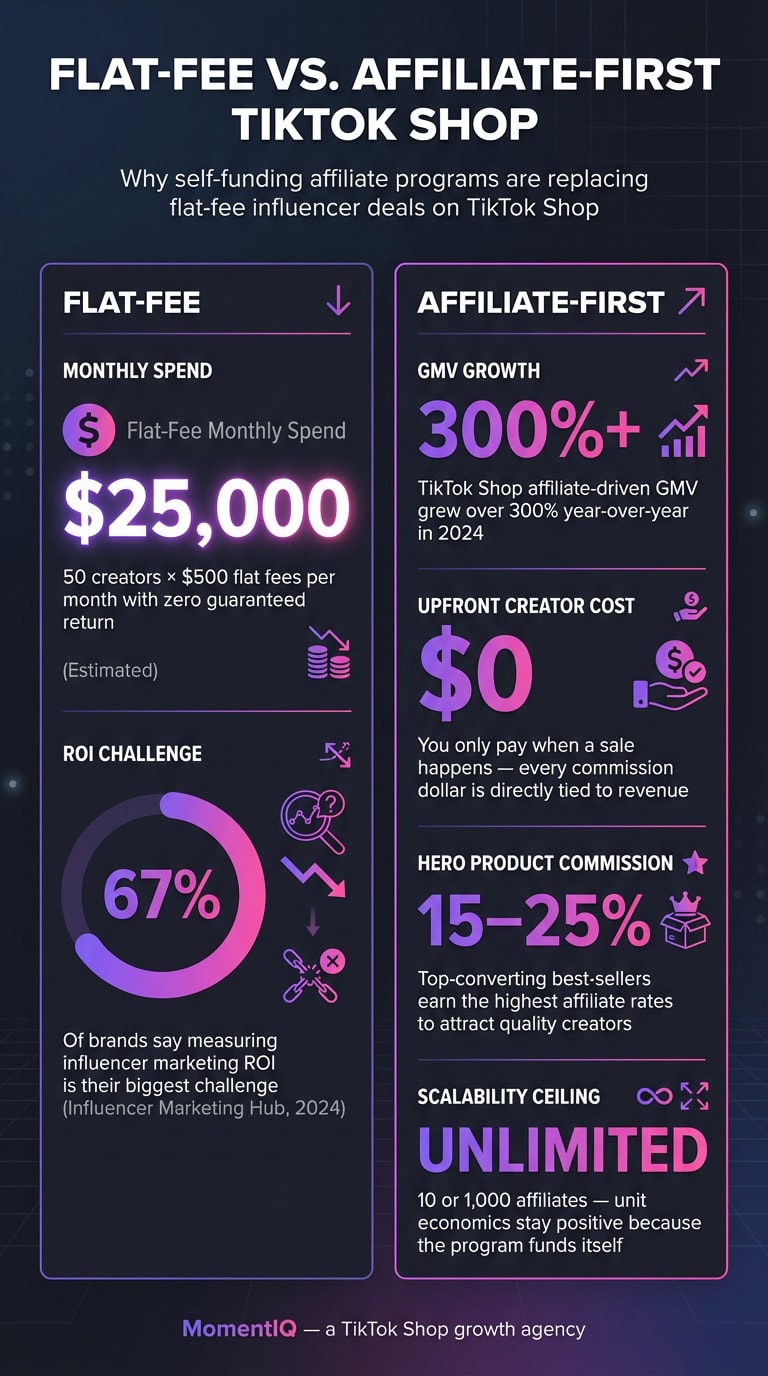
You pay upfront.You pray the content performs. And when it doesn't — when that $500 video gets 2,000 views and generates exactly zero sales — you eat the loss and move on to the next creator.
Now multiply that by 50 creators a month. That's $25,000 in flat fees with absolutely no guarantee of return.
There's a better way. A radically better way.
It's called an affiliate-first influencer program ambassador vs affiliate partnership model — and it's how the fastest-growing TikTok Shop brands are scaling to seven and eight figures with zero upfront creator costs, predictable unit economics, and campaigns that literally pay for themselves from day one.
In this guide, you'll learn the exact commission structure, tracking setup, and creator incentive system you need to build a self-funding TikTok Shop affiliate program. No theory. No fluff. Just the operational blueprint that's driving real revenue on the platform right now.
Let's build it.
Why an Affiliate-First Model Beats Flat-Fee Influencer Deals on TikTok Shop

Before we dive into the how, let's lock in the why — because understanding the economics is what separates brands that scale from brands that stall.
The Flat-Fee Problem

Traditional influencer marketing operates on a simple (and flawed) premise: pay a creator a fixed amount, receive content, hope for sales.
The problem? According to a 2024 Influencer Marketing Hub report, 67% of brands say measuring ROI is their biggest influencer marketing challenge. With flat fees, you're essentially buying lottery tickets. Some hit. Most don't. And you have zero mechanism to align creator incentives with actual sales performance.
On TikTok Shop specifically, this model breaks even faster because:
- Content shelf life is unpredictable. A TikTok video can go viral three weeks after posting — long after your flat-fee contract has expired.
- **Volume matters more than individual posts.**One video from one creator rarely moves the needle.
- The platform was literally built for affiliate commerce. TikTok Shop's native affiliate infrastructure makes commission-based partnerships seamless.
The Affiliate Advantage

An affiliate-first TikTok Shop creator strategy flips the model entirely:
- You only pay when a sale happens. Zero upfront risk. Every dollar spent on creator commissions is directly tied to revenue.
- Creators are incentivized to optimize. When their income depends on performance, creators test hooks, iterate on content, and post more frequently.
- You can scale infinitely. There's no budget ceiling because the program funds itself.Whether you have 10 affiliates or 1,000, the unit economics stay positive.
TikTok's own data backs this up: TikTok Shop affiliate-driven GMV grew over 300% year-over-year in 2024, making it the fastest-growing commerce channel on the platform.Brands that build robust affiliate programs aren't just saving money — they're tapping into the single most powerful growth lever TikTok Shop offers.
How to Set Up Your TikTok Shop Affiliate Program: The Foundation

Before you recruit a single creator, you need your infrastructure locked down. A sloppy setup leads to tracking errors, commission disputes, and creator churn. Here's how to build it right.
Step 1: Activate TikTok Shop's Native Affiliate Tools

TikTok Shop has three built-in affiliate collaboration models:
- Open Plan: You set a commission rate and any approved creator can promote your products. This is your top-of-funnel recruitment engine.
- Targeted Plan: You invite specific creators to promote products at a custom commission rate. This is your mid-tier engagement tool.
- Shop Plan: You set a baseline commission for your entire store. This is your always-on passive recruitment layer.
The winning move: Run all three simultaneously. Set a competitive Shop Plan rate to attract organic affiliates, use Open Plans for hero products you want to push aggressively, and deploy Targeted Plans for high-value creators you want to lock in with premium rates.
Step 2: Configure Your Product Catalog for Affiliate Success

Not every product in your catalog should be affiliate-enabled at the same rate. Here's the framework:
- Hero Products (highest commission): Your best-sellers with proven conversion rates. These are the products creators will want to promote because they convert. Set your highest commission rates here — typically 15-25%.
- Discovery Products (mid commission): New launches or products you want to test. Set moderate rates (10-15%) and use these to gather data on what resonates.
- Accessory/Upsell Products (lower commission): Lower-margin items that typically sell as add-ons. Set baseline rates (5-10%).
This tiered approach ensures your affiliate spend is concentrated where it drives the most revenue while maintaining healthy margins across your catalog.
Step 3: Set Up Attribution and Tracking

TikTok Shop's affiliate tracking is built into the platform, but you need to understand how it works to avoid costly misunderstandings:
- Attribution window: TikTok Shop uses a click-based attribution model where the last affiliate link clicked before purchase receives the commission.
- Cookie duration: The standard attribution window is 7 days from click to purchase.
- Live shopping attribution: Sales generated during a creator's live session are attributed to that creator automatically.
Critical setup step: Enable the TikTok Shop affiliate dashboard and configure your reporting views to track by creator, by product, and by content type. You need to know not just who is driving sales, but what kind of content is driving sales — because that data informs your entire optimization strategy.
For brands managing large affiliate programs, this is where working with a specialized partner like Talk to a Strategist becomes a force multiplier. MomentIQ's platform provides algorithmic creator matching and performance tracking that goes far beyond TikTok's native tools, giving you granular visibility into which creators, content formats, and commission structures are actually driving profitable growth.
The Influencer Affiliate Commission Structure That Drives Maximum Performance on TikTok Shop
Your commission structure is the single most important variable in your affiliate program. Set it too low and creators won't bother. Set it too high and you'll erode your margins. Here's the framework for getting it exactly right.
Baseline Commission Benchmarks by Category
Based on aggregated industry data from TikTok Shop's top-performing affiliate programs in 2025:
| Product Category | Average Commission Rate | Top-Performer Rate |
|---|---|---|
| Beauty & Skincare | 15-20% | 25-30% |
| Health & Wellness | 12-18% | 20-25% |
| Fashion & Apparel | 12-15% | 18-22% |
| Home & Kitchen | 10-15% | 18-20% |
| Electronics & Tech | 8-12% | 15-18% |
| Food & Beverage | 15-20% | 22-28% |
These ranges account for TikTok Shop's platform fees (typically around 2-8% depending on category and seller tier) and standard fulfillment costs. Your target: maintain at least 20-30% gross margin after commissions, platform fees, COGS, and shipping.
The Tiered Commission Escalator Model
Flat commission rates are fine for getting started. But the brands crushing it on TikTok Shop use a tiered escalator model that rewards top performers with progressively higher rates:
Tier 1 — Starter (0-50 units/month): Base commission rate (e.g., 15%)
Tier 2 — Performer (51-200 units/month): Base + 3-5% bonus (e.g., 18-20%)
Tier 3 — Elite (201+ units/month): Base + 7-10% bonus (e.g., 22-25%)
This structure does three powerful things:
- Attracts high-volume creators who see the earning potential and self-select into your program.
- Incentivizes consistent posting because creators need sustained volume to hit higher tiers.
- Naturally filters out low-performers who cost you nothing but never graduate past Tier 1.
A supplement brand using this exact model reported that their Tier 3 creators (just 8% of their total affiliate roster) drove 62% of total affiliate revenue. The tiered model identified and rewarded those power performers automatically.
Bonus Structures That Accelerate Results
Beyond base commissions, strategic bonuses create urgency and drive specific behaviors:
- Launch Bonus: Offer an extra 5-10% commission during the first 7 days of a new product launch. This concentrates creator content around your launch window and triggers TikTok's algorithm to boost the product's visibility.
- Volume Bonus: Pay a flat cash bonus ($50-$200) when a creator hits a monthly sales milestone. This gamifies the experience.
- Content Quality Bonus: Reward creators who produce content that exceeds a specific engagement threshold (e.g., 100K+ views) with a one-time bonus. This incentivizes quality, not just quantity.
- Exclusivity Bonus: Offer premium rates to creators who agree not to promote competing products for a defined period.
Recruiting Creators for Your TikTok Shop Affiliate Program at Scale
Your commission structure is only as good as the creators promoting your products. Here's how to build a pipeline of motivated affiliates.
The 3-Channel Recruitment Framework
Channel 1: TikTok Shop's Creator Marketplace
TikTok's built-in marketplace lets you browse creators by category, follower count, engagement rate, and past affiliate performance. Set up your Open Plan with competitive rates and let creators discover you organically. According to TikTok, brands with Open Plans active receive 4X more creator applications than those relying on Targeted Plans alone.
Channel 2: Proactive Outreach
Don't wait for creators to find you. Build a systematic outreach operation that identifies high-potential creators and pitches them directly. Look for creators with:
- 10K-500K followers (the sweet spot for affiliate conversion rates)
- High comment-to-view ratios (indicates engaged audiences)
- Previous experience with TikTok Shop product links
- Content style that matches your brand aesthetic
For scaling outreach efficiently can automate the identification and initial contact process, allowing you to reach hundreds of potential affiliates per week without manual effort. Combined with the proven outreach templates we've covered in our guide on TikTok Shop Creator Outreach Templates, this creates a recruitment engine that runs on autopilot.
Channel 3: Product Seeding
Send free products to targeted creators with a simple ask: try it, and if you love it, post about it with your affiliate link. No obligation. No contract.
This approach works exceptionally well because it:
- Removes all friction from the creator's decision
- Results in more authentic content (they're genuinely trying the product)
- Creates a natural filter (only creators who actually like the product will post)
A home goods brand running a product seeding program reported that 35% of seeded creators posted affiliate content within 14 days, and those posts converted at 2.3X the rate of contracted content.
The Numbers Game: How Many Affiliates You Actually Need
Here's the reality most brands don't want to hear: the majority of your affiliates will generate minimal sales. This isn't a failure — it's the nature of affiliate programs.
The typical distribution looks like this:
- Top 5% of creators: Drive 50-60% of total affiliate revenue
- Next 15% of creators: Drive 25-30% of revenue
- Remaining 80% of creators: Drive 10-20% of revenue
This means you need volume in your affiliate roster to find your top performers. If you want 10 elite creators driving serious revenue, you need roughly 200 active affiliates in your program.
This is exactly why Talk to a Strategist built its algorithmic creator matching system — to help brands identify the creators most likely to become top performers before they join your program, dramatically improving the hit rate and reducing the time from recruitment to revenue. Instead of sifting through thousands of creators manually, MomentIQ's technology matches your products with creators whose audience demographics, content style, and engagement patterns predict high affiliate performance.
Building the Creator Incentive System That Keeps Affiliates Posting
Recruiting creators is step one. Retaining them is where the real money is made. The average TikTok Shop affiliate posts 2-3 times and then goes silent — unless you build a system that keeps them engaged.
The Affiliate Engagement Loop
Week 1: Onboarding & First Post
Send a comprehensive creator brief (check out our guide on How to Build a TikTok Shop Creator Brief That Actually Gets Great Content for templates). Include product samples, key talking points, and examples of top-performing content. Your goal: get their first post live within 48 hours of joining.
Week 2-4: Performance Feedback
Share their sales data weekly. Creators are obsessed with metrics. When they see that their video generated 47 sales and $XX in commissions, they're motivated to post again. When they see that a specific hook or format outperformed others, they iterate and improve.
Month 2+: Tier Advancement & Recognition
Notify creators when they're close to hitting the next commission tier. Send personalized messages celebrating milestones. Feature top performers in your brand's community channels. Recognition is a powerful motivator — sometimes even more powerful than money.
The Creator Leaderboard Strategy
Implement a monthly leaderboard that ranks your top affiliates by sales volume. Share it with your entire affiliate community. This creates:
- Social proof: Mid-tier creators see what's possible and push harder.
- Healthy competition: Creators compete for top spots, driving more content and more sales.
- Identification of rising stars: You'll spot breakout creators early and can invest in deeper relationships with them.
Brands running creator leaderboards report 40-60% higher content output from their affiliate rosters compared to brands without them.
Exclusive Perks for Top Performers
Your best affiliates should feel like VIPs. Offer:
- Early access to new products (they get to post before anyone else, gaining a first-mover advantage in the algorithm)
- Higher commission rates (via Targeted Plans)
- Co-creation opportunities (let them collaborate on product development or limited-edition items)
- Paid amplification of their content via Spark Ads (you boost their best-performing videos, driving more views and more commissions for them — a true win-win)
This last point is especially powerful. When you take a creator's organic affiliate video and amplify it with paid spend through Spark Ads, you're essentially saying: "Your content is so good, we're investing our own money to get it seen by more people — and you'll earn commissions on every sale." That's a loyalty-building move that flat-fee deals can never replicate.
Tracking and Optimizing Your Self-Funding TikTok Shop Affiliate Program
A self-funding program requires obsessive tracking. Here are the metrics that matter and how to use them.
The 6 KPIs That Define Affiliate Program Health
- Affiliate Revenue as % of Total GMV: What percentage of your TikTok Shop revenue comes from affiliates? Top-performing brands aim for 40-70%.
- Cost Per Acquisition (CPA) via Affiliates: Total commissions paid ÷ total units sold through affiliates. This should be lower than your CPA through paid ads.
- Active Creator Rate: What percentage of your total affiliate roster posted content in the last 30 days? Healthy programs maintain 25-35% active rates.
- Revenue Per Creator (RPC): Total affiliate revenue ÷ number of active creators. Track this monthly to identify trends.
- Content-to-Sale Conversion Rate: What percentage of affiliate videos generate at least one sale? Benchmark: 15-25% for well-optimized programs.
- Creator Retention Rate: What percentage of creators who posted in Month 1 are still posting in Month 3? Target: 40%+.
The Weekly Optimization Cadence
Every Monday: Review the previous week's affiliate performance. Identify top-performing content and analyze why it worked (hook, format, product angle, posting time).
Every Wednesday: Share performance insights with your creator community. Send "what's working" updates that help all affiliates improve their content.
Every Friday: Adjust commission rates, bonuses, and product focus based on the week's data. If a specific product is converting exceptionally well through affiliates, increase its commission rate to drive more creator attention.
This cadence creates a continuous optimization loop where your program gets more efficient every single week. After 90 days, you'll have enough data to predict revenue with startling accuracy — and to know exactly which levers to pull to accelerate growth.
When to Layer in Paid Amplification
The beauty of an affiliate-first model is that it generates organic data you can use to de-risk your paid strategy. Here's the rule:
Only amplify affiliate content that has already proven itself organically.
If a creator's video generates 50+ sales organically, it's a validated winner. Boost it with Spark Ads and watch it scale. This approach consistently delivers 3-5X ROAS because you're amplifying content that the algorithm and the market have already validated.
This is the bridge between your affiliate program and your paid strategy — and it's how the most sophisticated TikTok Shop brands turn a self-funding affiliate program into a full-scale growth engine.
Common TikTok Shop Affiliate Program Mistakes (and How to Avoid Them)
Even well-intentioned programs fail when brands make these critical errors:
Mistake 1: Setting Commission Rates Too Low
If your rates are below category averages, top creators will promote your competitors instead. Remember: creators have options. A beauty creator with 200K followers might receive 50+ affiliate invitations per month. Your commission rate is your first impression — make it competitive.
Mistake 2: Ignoring Creator Communication
Silence kills affiliate programs. If creators post content and hear nothing from you — no performance data, no feedback, no encouragement — they'll move on. Build a communication rhythm and stick to it.
Mistake 3: Not Providing Creative Direction
Affiliate doesn't mean "figure it out yourself." Provide creators with briefs, product angles, proven hooks, and examples of top-performing content. The more guidance you give, the better their content will be. (Our guide on TikTok Shop Hook Writing Masterclass is a great resource to share with your affiliates.)
Mistake 4: Treating All Creators Equally
Your top 5% of creators deserve 50% of your attention. Invest disproportionately in your best performers through higher rates, exclusive access, and dedicated relationship management.
Mistake 5: Not Tracking Unit Economics
A self-funding program requires that you know your numbers cold. If you don't know your all-in cost per unit sold through affiliates (including commissions, platform fees, COGS, and shipping), you can't optimize. Build a simple P&L model for your affiliate channel and update it weekly.
The Self-Funding Flywheel: How It All Comes Together
When you execute this system correctly, something remarkable happens: your affiliate program becomes a self-reinforcing flywheel.
- Competitive commissions attract quality creators.
- Quality creators produce high-converting content.
- High-converting content generates sales and commissions.
- Sales data reveals top performers and winning content formats.
- You amplify winning content with Spark Ads, driving even more sales.
- Higher sales attract more creators who see the earning potential.
- The cycle accelerates.
This is how brands go from $10K/month to $100K/month to $1M/month on TikTok Shop — not through massive upfront media buys, but through a self-funding affiliate engine that compounds over time.
The math is elegant: if your average commission rate is 18% and your blended gross margin after COGS and shipping is 55%, you're keeping 37% gross margin on every affiliate-driven sale — with zero customer acquisition cost paid upfront. Compare that to paid ads where you're spending money before you know if it will convert.
Let MomentIQ Build Your Self-Funding TikTok Shop Affiliate Engine
Building a high-performance TikTok Shop affiliate program requires three things most brands don't have in-house: algorithmic creator matching at scale, deep platform expertise, and the operational infrastructure to manage hundreds of creator relationships simultaneously.
That's exactly what Talk to a Strategist was built to deliver.
MomentIQ helps brands launch and scale affiliate-first influencer programs on TikTok Shop by matching your products with the creators most likely to drive sales, optimizing commission structures for maximum profitability, and managing the entire creator lifecycle — from recruitment and onboarding to performance tracking and tier advancement.
The result? Self-funding campaigns that generate revenue from day one, a growing roster of motivated affiliates who sell for you around the clock, and a scalable growth engine that compounds month after month.

Stop paying flat fees and praying for results. Start building an affiliate program that pays for itself.
👉 Book your free TikTok Shop strategy call with MomentIQ today and discover exactly how to structure a self-funding affiliate program for your brand. Your competitors are already building theirs.