TikTok Shop Pricing Strategy
Discover 9 proven TikTok Shop pricing tactics for 2025 that protect your margins while boosting conversions. Stop racing to the bottom and start scaling profita
Here's the pricing trap that kills most TikTok Shop sellers before they ever hit scale:
- Use anchor pricing and bundle psychology instead of flat discounts to protect margins on TikTok Shop's discovery-driven platform.
- Leverage creator-driven perceived value to charge 20–35% more than marketplace averages by aligning pricing and creator strategies.
- Price for impulse-buy psychology since 67% of TikTok Shop purchases are impulse-driven with decisions made in under 60 seconds.
- Set higher margins to fund higher affiliate commissions, attracting better creators who increase perceived value and willingness to pay.
- Build TikTok-specific pricing architectures rather than using the same price across all channels, accounting for platform fees and return rates.
They see competitors slashing prices, panic, and race to the bottom — only to discover that a $9.99 price tag with 8% affiliate commissions, platform fees, and COGS leaves them with margins thinner than a TikTok transition effect.
Or they go the other direction. They price at full retail, ignore the impulse-buy psychology that drives 67% of TikTok Shop purchases (according to TikTok's own 2024 Commerce Insights report), and wonder why their add-to-cart rate flatlines at 0.3%.
The brands winning on TikTok Shop in 2025 aren't doing either. They're deploying sophisticated pricing frameworks — anchor pricing, bundle psychology, creator-exclusive drops, dynamic discounting — that protect margins while converting at rates that make traditional e-commerce look broken.
And here's the insight most sellers miss entirely: creator-driven perceived value lets brands charge 20–35% more than marketplace averages when the pricing strategy and creator strategy work in concert.
This guide breaks down the 9 pricing tactics top TikTok Shop sellers are using right now to maximize profit margins without sacrificing the conversion velocity the algorithm rewards.
If you're tired of guessing on price and watching your margins erode, Talk to a Strategist — we'll show you exactly where your pricing is leaking revenue.
Why Traditional Pricing Strategies Fail on TikTok Shop
Before we get into what works, let's talk about why your current TikTok Shop pricing strategy is probably costing you money.

TikTok Shop is not Amazon.It's not even Instagram Shopping. The purchase psychology is fundamentally different:
- Discovery-driven, not search-driven. Buyers aren't comparison-shopping. They're scrolling, encountering a product through a creator's content, and making a decision in under 60 seconds.
- Emotion-first, logic-second. Statista's 2024 social commerce survey found that 78% of TikTok Shop buyers cited "seeing the product in action" as their primary purchase trigger — not price.
- Algorithm-rewarded velocity. TikTok's algorithm favors shops with high conversion rates and fast sell-through. Price too high and your conversion rate tanks, which tanks your visibility.Price too low and you can't afford the affiliate commissions that drive creator content, which tanks your visibility.
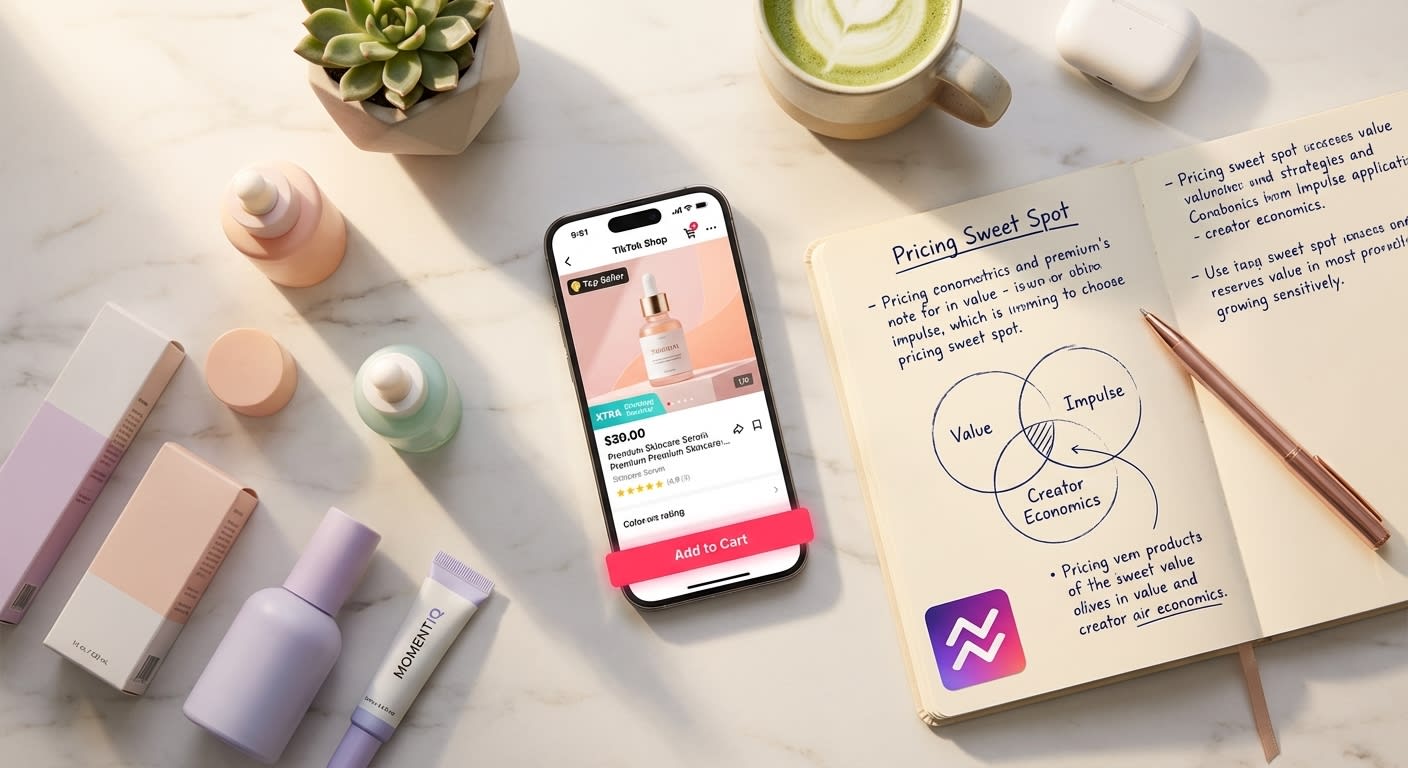
The pricing sweet spot on TikTok Shop exists at the intersection of perceived value, impulse-buy thresholds, and creator economics. Miss any one of these three, and you're leaving money on the table — or burning it.
Most sellers we talk to at MomentIQ are making at least two of these critical pricing mistakes: Setting prices based on competitor benchmarking
- Setting prices based on competitor benchmarking without accounting for creator-driven value perception
- Offering flat discounts TikTok Shop coupon and discount frameworks instead of psychologically-optimized discount structures
- Ignoring the relationship between commission rates and content quality (higher margins = higher commissions = better creators = higher perceived value = higher willingness to pay creator compensation and commission structures)
- Using the same price across all channels instead of TikTok-specific pricing architectures
- Failing to account for platform fees, shipping subsidies, and return rates in their margin calculations
Let's fix all of that.
Tactic 1: Anchor Pricing That Exploits the Discovery Mindset
How to Price Products on TikTok Shop Using Psychological Anchors
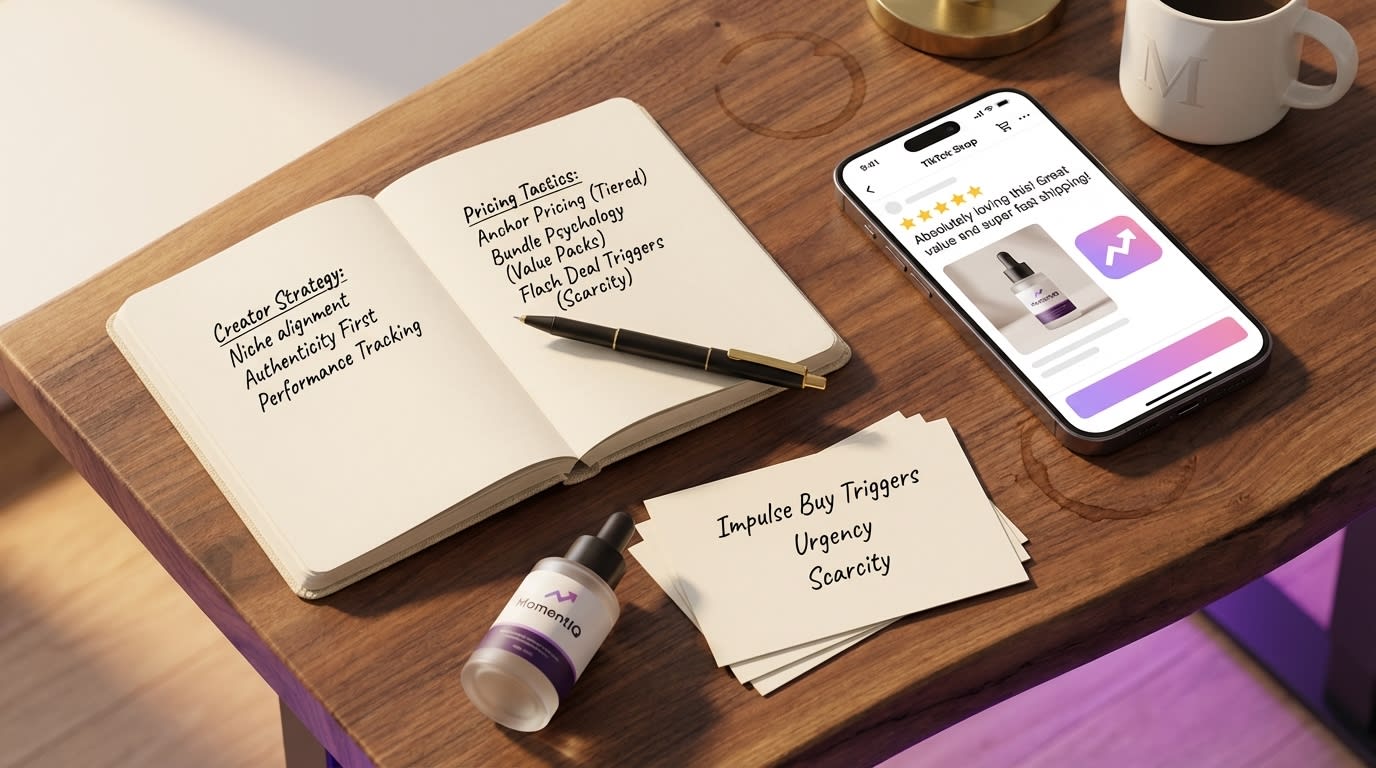
On Amazon, anchor pricing is table stakes — every seller shows a "was/now" price. On TikTok Shop, anchor pricing is an art form because the anchor isn't just a crossed-out number. It's the entire content narrative.
Here's how top sellers deploy it:
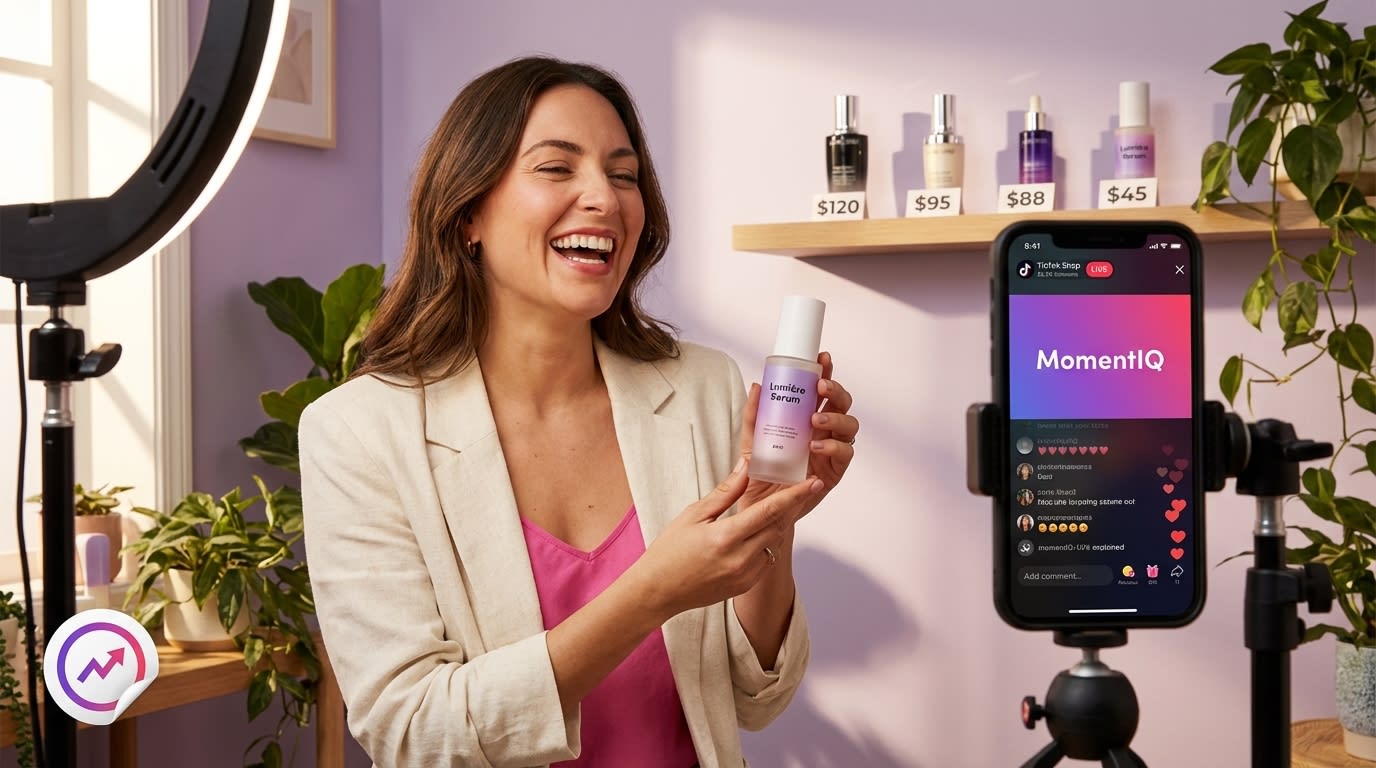
- Retail anchor in creator scripts. The creator mentions the "normal retail price" or "what you'd pay at Sephora/Target/the mall" before revealing the TikTok Shop price. This creates a perceived deal without actually discounting from your intended sell price.
- Visual anchoring. Show the product next to premium competitors. A skincare brand we've seen scaled to $280K/month by having creators compare their $34 serum to $90+ alternatives — the TikTok Shop price was the anchor against the luxury market.- Quantity anchoring. Show the per-unit or per-use cost. "This is literally 47 cents per day for clinical-grade skincare" reframes a $42 product as trivially affordable.
The key insight: On TikTok Shop, the anchor lives in the content, not just the listing.This is why brands working with the right creators can charge 20–35% more — the creator IS the anchor mechanism.
"But we can manage our own creator briefs and pricing messaging."
You can — for 10, maybe 20 creators. But when you need 200+ creators all communicating consistent price anchoring while still feeling authentic, manual management breaks. One beauty brand tried managing 150 affiliates in-house and found that 60% of their creator content never mentioned the pricing anchor at all, resulting in conversion rates 40% below their managed cohort. Scale demands systems.
Tactic 2: The Bundle Psychology Framework for Higher AOV
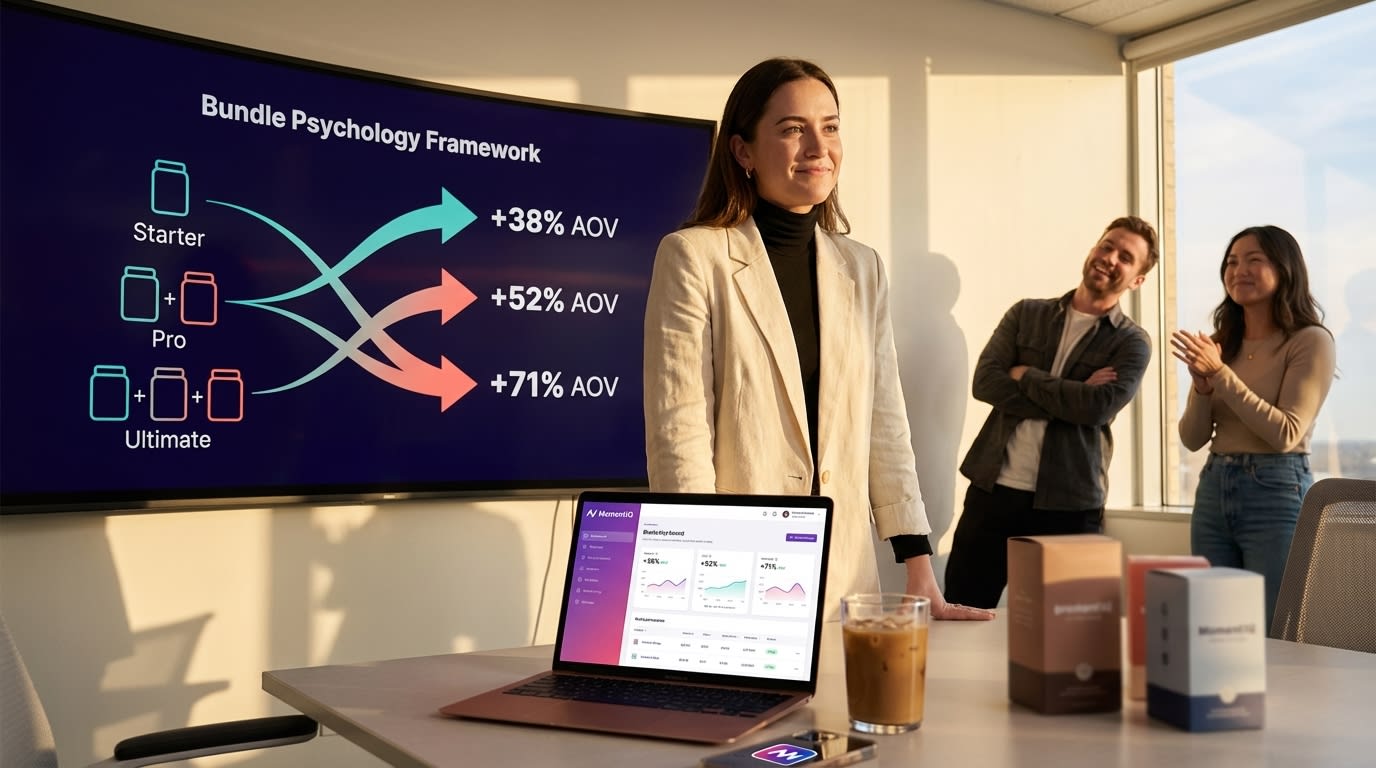
Single-SKU selling on TikTok Shop is a margin death sentence for most categories. Bundling is how you protect margins while giving buyers the perception of extraordinary value.
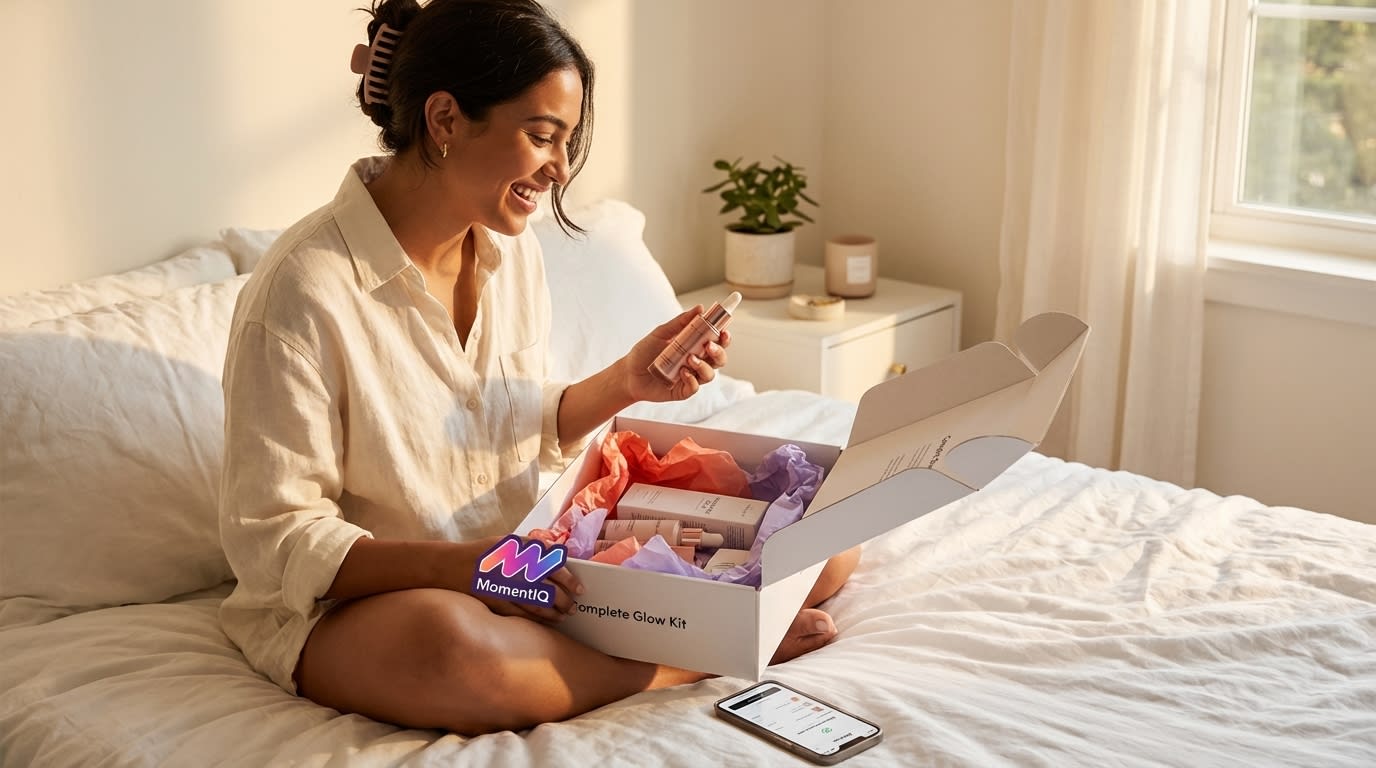
The psychology is simple: buyers can't easily price-compare a bundle. A $49 "Complete Glow Kit" with a cleanser, serum, and moisturizer is psychologically incomparable to individual products on Amazon. You've created a pricing island.
Three bundle structures that work on TikTok Shop in 2025:
- The Starter Kit Bundle — 2-3 hero products at 15-20% below combined individual pricing. This is your volume driver and algorithm feeder.
- The Creator's Pick Bundle — A curated set "chosen by" the creator, priced at a slight premium. This leverages parasocial trust and drives higher AOV.
- The Limited Drop Bundle — Available for 48-72 hours only, combining a bestseller with a new or slow-moving SKU.This creates urgency while moving inventory strategically.
Real results: One supplement brand increased their average order value from $28 to $67 by shifting from single-SKU to a three-tier bundle strategy — while actually improving their conversion rate by 12% because the bundles felt like better deals.
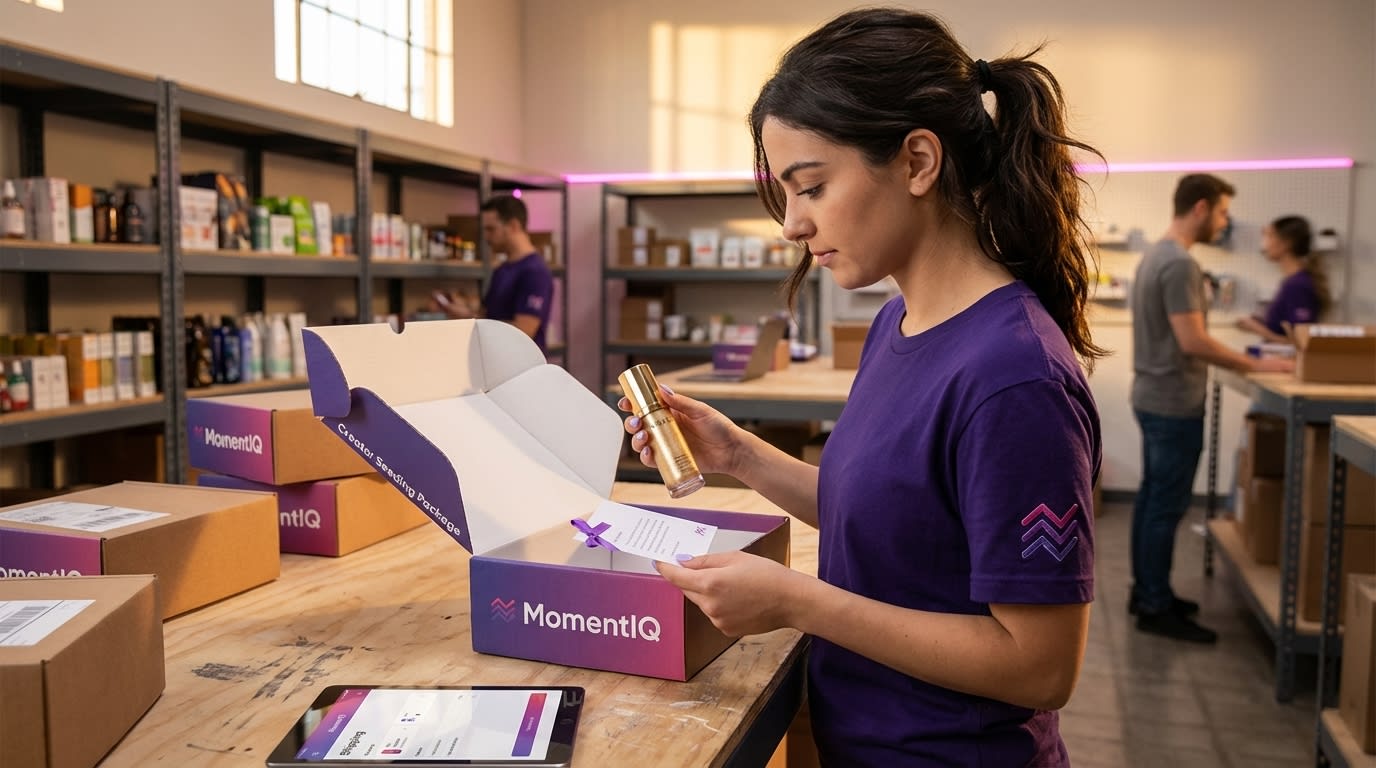
Pro tip: TikTok Shop's platform fees are calculated on GMV. Higher AOV through bundles means your fee-to-margin ratio improves. A $49 bundle with 60% margin pays the same percentage in platform fees as a $19 single product with 30% margin — but you keep significantly more dollars per transaction.
Tactic 3: Creator-Exclusive Pricing Drops
The Pricing Strategy That Turns Creators Into Sales Channels, Not Just Awareness Channels
This is the tactic that separates brands doing $20K/month from brands doing $200K/month on TikTok Shop.
Creator-exclusive pricing means specific creators (or tiers of creators) get unique discount codes or pricing that's only available through their content. This does three things simultaneously:
- Gives creators a genuine value proposition to communicate ("you can ONLY get this price through my link")
- Creates urgency and exclusivity that drives impulse purchases
- Lets you test price elasticity across different audience segments without publicly lowering your base price
Here's the framework:
| Creator Tier | Exclusive Offer | Your Margin Impact | Strategic Purpose |
|---|---|---|---|
| Mega (500K+) | 20-25% off retail | Lower margin, high volume | Algorithm fuel, brand awareness |
| Mid-tier (50K-500K) | 15% off + free gift | Moderate margin, strong AOV | Core revenue driver |
| Micro (10K-50K) | 10% off exclusive bundle | Highest margin | Profit maximizer, long-tail content |
The math that matters: A fitness equipment brand working with MomentIQ used this tiered creator-exclusive pricing model to scale from $18K to $420K/month in 90 days. Their mega-creator content drove visibility and algorithm momentum, while their micro-creator army — armed with higher-margin exclusive bundles — generated 62% of total profit.
This is why algorithmic creator matching matters so much for pricing strategy. You need the right creators at the right tier promoting the right offer at the right margin. Manual outreach can't optimize for this. You need data.
Tactic 4: Dynamic Discounting Based on Algorithmic Signals
Static pricing is lazy pricing. The top TikTok Shop sellers in 2025 are adjusting their pricing dynamically based on real-time signals:
- Time-of-day discounting. TikTok Shop conversion rates vary by up to 340% depending on the hour (per TikTok's 2024 Seller Summit data). Offering flash discounts during peak conversion windows — typically 7-10 PM local time — maximizes revenue per impression.
- Inventory-based pricing. When a product is trending and inventory is strong, hold price. When a video goes viral and you need to capitalize before the algorithm moves on, deploy a 24-hour discount to maximize sell-through.
- Post-live pricing. After a successful live shopping session, maintain a "live replay" discount for 12-24 hours to capture viewers who watched but didn't buy. This can recover 15-25% of additional GMV.
The objection we hear constantly: "Dynamic pricing sounds complicated and expensive to manage."
It doesn't have to be. The brands doing this well aren't manually changing prices 47 times a day. They're using rule-based systems tied to TikTok Shop's analytics. And when you're working with a TikTok Shop Partner of the Year like MomentIQ, this kind of optimization is built into the growth strategy from day one — you're not paying extra for pricing intelligence, you're getting it as part of a full-stack commerce approach.
Tactic 5: The "Perceived Value Multiplier" — Why Creator Content Lets You Charge More
This is the single most important pricing insight for TikTok Shop in 2025, and almost nobody talks about it.
When a trusted creator demonstrates your product, the buyer's perceived value increases by 20-35% compared to seeing the same product in a static listing or paid ad. This isn't speculation — it's consistent across every product category we've analyzed.
Why? Three psychological mechanisms:
- Social proof compression. A creator's endorsement compresses weeks of research and review-reading into 30 seconds of trust transfer.
- Use-case visualization. Buyers see the product in a real context, solving a real problem, which makes the price feel justified against the outcome, not the product.
- Parasocial pricing. Buyers are willing to pay more when they feel they're buying "through" someone they trust. It's the same reason people pay more at boutiques than big-box stores — the relationship adds perceived value.
What this means for your pricing strategy:
If your product's "fair" price based on competitor benchmarking is $29, and you're selling exclusively through strong creator content, you can likely price at $35-39 without conversion rate degradation. That $6-10 difference, at scale, is the difference between a marginally profitable TikTok Shop and a highly profitable one.
But here's the catch: this only works with creators whose audiences trust their product recommendations. A creator with 2 million followers but zero commerce credibility won't move the perceived value needle. This is exactly why MomentIQ's algorithmic creator matching focuses on commerce-relevant metrics — not just reach — when building creator cohorts for brands.
Want to see how creator-driven perceived value could transform your TikTok Shop margins? Schedule a free strategy session with MomentIQ at bemomentiq.com — we'll model the revenue impact for your specific category.
Tactic 6: Commission-Optimized Pricing Architecture
How to Price Products on TikTok Shop When Affiliate Commissions Eat Your Margins
This is the math problem that makes or breaks TikTok Shop profitability, and most sellers get it backwards.


They set their price first, then try to figure out what commission rate they can afford. Top sellers do the opposite: they start with the commission rate needed to attract top-performing creators, then engineer their pricing to support that commission while maintaining target margins.
Here's the framework:
Step 1: Determine the commission rate that attracts quality creators in your category. According to TikTok Shop's 2024 affiliate benchmarks and our own analysis:
- Beauty/Skincare: 15-20% to attract top-tier creators
- Health/Supplements: 18-25%
- Home/Kitchen: 12-18%
- Fashion/Apparel: 15-20%
- Electronics/Gadgets: 8-15%
Step 2: Calculate your all-in platform costs (typically 5-8% including TikTok's referral fee, transaction fee, and any shipping subsidies).
Step 3: Work backwards from your target net margin (we recommend 25-40% minimum for sustainable scaling) to determine your minimum viable price.
The formula:
Minimum Price = COGS ÷ (1 - Commission Rate - Platform Fees - Target Margin)
Example: A product with $8 COGS, 20% commission, 7% platform fees, and 30% target margin:
$8 ÷ (1 - 0.20 - 0.07 - 0.30) = $8 ÷ 0.43 = $18.60 minimum price
If you can't hit this price and still convert, you have a product-market fit problem, not a pricing problem.
This is also why brands that try to manage TikTok Shop pricing in-house often struggle. They don't have visibility into competitive commission rates by category, they don't know which commission thresholds trigger exponential increases in creator acceptance rates, and they end up either overpaying on commissions (killing margins) or underpaying (killing creator recruitment).
eMarketer's 2024 social commerce report found that brands using specialized TikTok Shop agencies saw 2.4x higher affiliate acceptance rates compared to brands managing creator recruitment independently. That acceptance rate directly impacts your pricing power — more creators competing to promote your product means more content, more social proof, and higher perceived value.
Tactic 7: The Flash Sale Ladder — Urgency Without Desperation
Flat discounts signal desperation. Flash sale ladders signal exclusivity.
Here's how the ladder works:
- Hour 1-2: 25% off (drives initial velocity and algorithm signal)
- Hour 3-6: 20% off (still compelling, higher margin)
- Hour 7-12: 15% off (captures FOMO from those who saw early content)
- Hour 13-24: 10% off ("last chance" messaging)
This ascending price structure creates genuine urgency — buyers know the price is literally going up — while your blended discount across all sales is typically only 15-17%, not the 25% a flat flash sale would cost you.
Critical implementation detail: This works best when synchronized with creator posting schedules. Your highest-reach creators post during the deepest discount window, driving maximum volume. Your long-tail creators post throughout, capturing sales at progressively higher margins.
One home goods brand used this exact ladder structure during a 24-hour flash event and generated $127K in GMV with a blended margin of 34% — compared to their previous flat-discount flash sales that averaged 22% margins on similar volume.
Tactic 8: Price Framing Through Content Sequencing
This tactic is where pricing strategy and content strategy become inseparable.

Price framing through content sequencing means deliberately structuring the order in which a potential buyer encounters your pricing information across multiple touchpoints:
- First touch (awareness content): Creator focuses entirely on the problem and the product's effectiveness. No price mentioned. Goal: establish perceived value.
- Second touch (retargeting or follow-up content): Creator or ad reveals the price in context of value. "I can't believe this is only $34 — I've used $120 serums that don't work this well."
- Third touch (conversion content): Direct product showcase with price, discount, and clear CTA. By now, perceived value is established and the price feels like a steal.
Why this works on TikTok specifically: TikTok's algorithm naturally creates content sequencing through its recommendation engine. A user who engages with a product video is more likely to see subsequent content about that product. Smart sellers design their content ecosystem to exploit this, building perceived value before ever revealing price.
According to TikTok's 2024 Path to Purchase study, users who encountered 3+ pieces of content about a product before seeing a price had a 2.8x higher conversion rate than those who saw price in the first piece of content.
This is also why product seeding at scale — getting your product into the hands of dozens or hundreds of creators simultaneously — is such a powerful pricing strategy enabler. More creators making content means more touchpoints in the buyer's content sequence, which means higher perceived value by the time they see your price.
Tactic 9: The "TikTok-Only" Price Positioning
Protecting Your Margins While Making TikTok Shop Feel Special
This is controversial, and it works incredibly well.

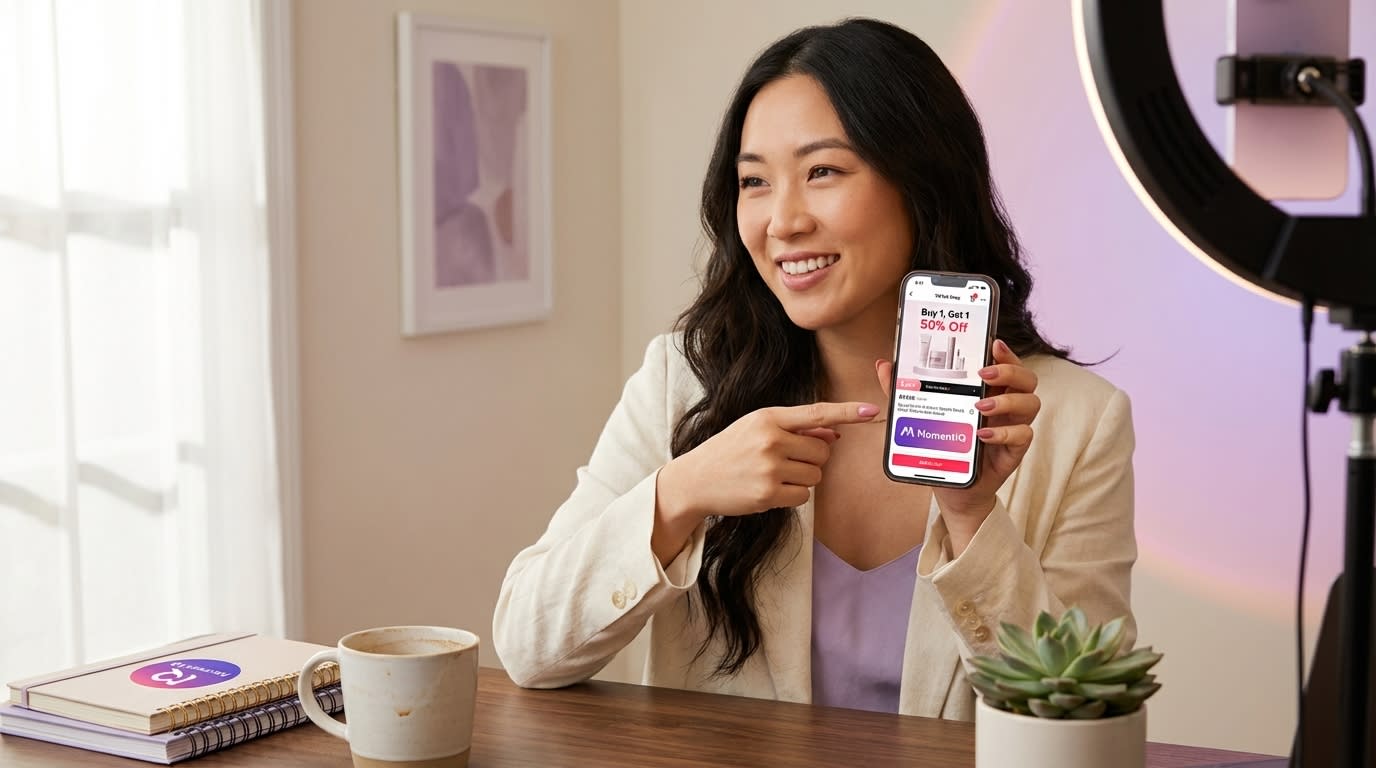
Create TikTok Shop-exclusive SKUs or configurations that can't be directly price-compared to your Amazon, Shopify, or retail listings.
This doesn't mean selling a completely different product. It means:
- Exclusive sizes (a 45-day supply instead of 30 or 60)
- Exclusive bundles (combinations only available on TikTok Shop)
- Exclusive colorways or variants (limited edition packaging or flavors)
- Exclusive "creator edition" products (co-branded with top-performing affiliates)
Why this matters for pricing: When a buyer can't Google your exact SKU and find it cheaper on Amazon, your TikTok Shop price IS the market price. You've eliminated the comparison that kills margins.
A pet care brand implemented TikTok-exclusive bundle sizes and saw their average selling price increase by 28% while their conversion rate actually improved by 8% — because buyers couldn't find a "better deal" elsewhere and the exclusive sizing felt like a better value.
"But won't TikTok-exclusive SKUs cannibalize my other channels?"
The data says no. TikTok Shop's buyer demographic skews significantly younger than Amazon's, and TikTok's 2024 Commerce Report found that 73% of TikTok Shop purchases were from buyers who wouldn't have purchased the product otherwise. You're not cannibalizing — you're expanding your total addressable market.
The Pricing Mistake That Costs Sellers the Most: Ignoring the Algorithm-Margin Feedback Loop
Here's what ties all 9 tactics together, and it's the concept most TikTok Shop sellers completely miss:
TikTok's algorithm rewards conversion velocity. Your pricing directly determines your conversion rate. Your conversion rate determines your algorithmic visibility. Your visibility determines your volume. And your volume determines whether your fixed costs (content production, creator management, platform fees) are spread across enough sales to maintain healthy margins.
This creates a feedback loop:
- Price too high → Low conversion rate → Algorithm suppresses visibility → Low volume → High per-unit fixed costs → Margins collapse anyway
- Price too low → High conversion rate → Great visibility → High volume → But margin per unit is too thin → Profitability collapses
- Price optimally → Strong conversion rate → Algorithm rewards visibility → High volume → Healthy margin per unit → Profitable scaling
Finding that optimal price point requires data. Not gut instinct. Not competitor copying. Data on your specific category, your specific creator cohort's audience demographics, your specific conversion rate curves at different price points.
This is exactly what MomentIQ's proprietary analytics platform is built to deliver. As TikTok Shop Partner of the Year and a TikTok Marketing Partner, MomentIQ has access to commerce data that individual sellers simply can't replicate — and that data directly informs pricing strategy recommendations.
Why Most Sellers Can't Execute These 9 Tactics Alone
Let's be direct about this. If you've read this far, you're probably thinking one of two things:

"This makes sense, but my team can handle it." Maybe — if you're selling one or two products with a handful of creators. But these 9 tactics require coordinating pricing strategy across potentially hundreds of creator relationships, synchronizing flash sale ladders with content posting schedules, managing TikTok-exclusive SKUs, and continuously optimizing based on real-time data. According to a 2024 Forrester study on social commerce operations, brands managing TikTok Shop in-house spend an average of 47 hours per week on creator and pricing management — and still underperform managed brands by 3.2x on GMV.
"We've worked with agencies before and got burned." Fair. Most agencies treating TikTok Shop like another influencer marketing channel don't understand commerce-specific pricing dynamics. They'll get you impressions but not profitable conversions. MomentIQ is different because we're not an influencer agency that bolted on TikTok Shop — we're a TikTok Shop-native commerce partner built from the ground up around the platform's unique mechanics, from algorithmic creator matching through our Reacher platform (reacherapp.com) to full-funnel pricing and conversion optimization.
"TikTok Shop feels too risky to invest in right now." Consider this: TikTok Shop's U.S. GMV grew by over 400% in 2024, reaching an estimated $9 billion according to industry analysts. eMarketer projects social commerce in the U.S. will exceed $100 billion by 2026, with TikTok Shop capturing the largest share of growth. The brands building pricing infrastructure and creator relationships now are building algorithmic advantages that latecomers literally cannot replicate. Every month you wait, your competitors are training the algorithm to favor their products over yours.
Your TikTok Shop Pricing Strategy Action Plan
Here's how to implement these 9 tactics starting this week:
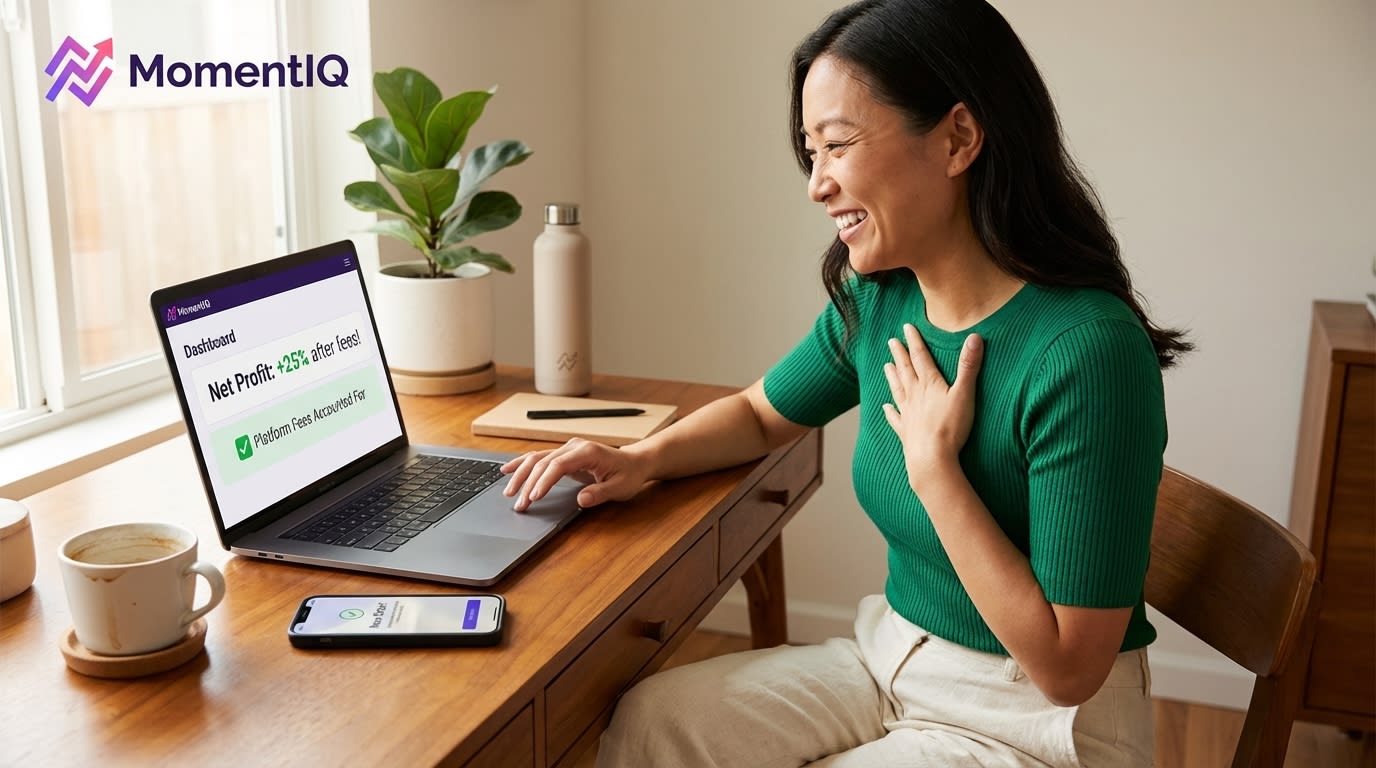

- Audit your current margins using the commission-optimized pricing formula from Tactic 6
- Identify your top 3 SKUs for bundle testing (Tactic 2)
- Create one TikTok-exclusive SKU or bundle that can't be price-compared (Tactic 9)
- Brief your top 5 creators on anchor pricing language (Tactic 1)
- Plan one flash sale ladder for the next 30 days (Tactic 7)
- Map your content sequencing for price framing across touchpoints (Tactic 8)
- Set up creator-exclusive pricing tiers based on creator size (Tactic 3)
- Implement at least one dynamic pricing rule tied to time-of-day data (Tactic 4)
- Measure perceived value lift from creator content vs. organic listings (Tactic 5)
Or skip the learning curve entirely.
Book your free TikTok Shop growth audit with MomentIQ at bemomentiq.com and get a custom pricing strategy built for your category, your margins, and your growth targets. We'll show you exactly where you're leaving money on the table — and build the creator, content, and pricing infrastructure to capture it.
The window for building pricing power on TikTok Shop is open right now. The brands that master these 9 tactics in 2025 will own the margins that fund their growth for years to come.
The brands that keep racing to the bottom will wonder where all the profit went.
Your move.