TikTok Shop Video Shopping Ads vs Spark Ads vs Product
Compare TikTok Shop Video Shopping Ads, Spark Ads & Product Shopping Ads in this 2025 decision matrix. Find the best format for your budget level and maximize R
You're staring at TikTok Ads Manager with $5,000 — or $50,000 — and three ad formats demanding your attention. Video Shopping Ads. Spark Ads. Product Shopping Ads. Each one promises conversions, each one eats budget differently, and the wrong choice at the wrong budget tier doesn't just waste money — it kills your momentum during the most critical growth window TikTok Shop has ever offered.
- Match your ad format to your budget tier and growth stage rather than copying competitors, since misallocation compounds losses over 90 days.
- Expect 18% higher CPMs in 2025 year-over-year, making surgical ad format selection critical to maintaining 5x–8x ROAS benchmarks.
- Use Spark Ads to boost existing organic or creator content while retaining native engagement signals like comments and shares.
- Leverage TikTok Shop's projected $17.5B GMV in 2025 by locking in your ad strategy now before rising competition erodes margins.
- Evaluate your margin profile, product type, and funnel position before choosing between Video Shopping Ads, Spark Ads, or Product Shopping Ads.
Here's what most sellers get wrong: they pick an ad format based on a blog post they skimmed or a competitor they stalked, without understanding how budget level, margin profile, product type, and growth stage fundamentally change which format wins.
This isn't another surface-level TikTok Shop ad types comparison. This is the decision matrix — the one that maps all three formats across budget tiers from $1K to $100K+, so you stop guessing and start scaling with precision.
If you want a team that's already run this playbook across hundreds of brands and millions in ad spend, Talk to a Strategist before your competitors lock in their Q3 advantage.
Why the TikTok Shop Ad Format Decision Matters More in 2025 Than Ever Before
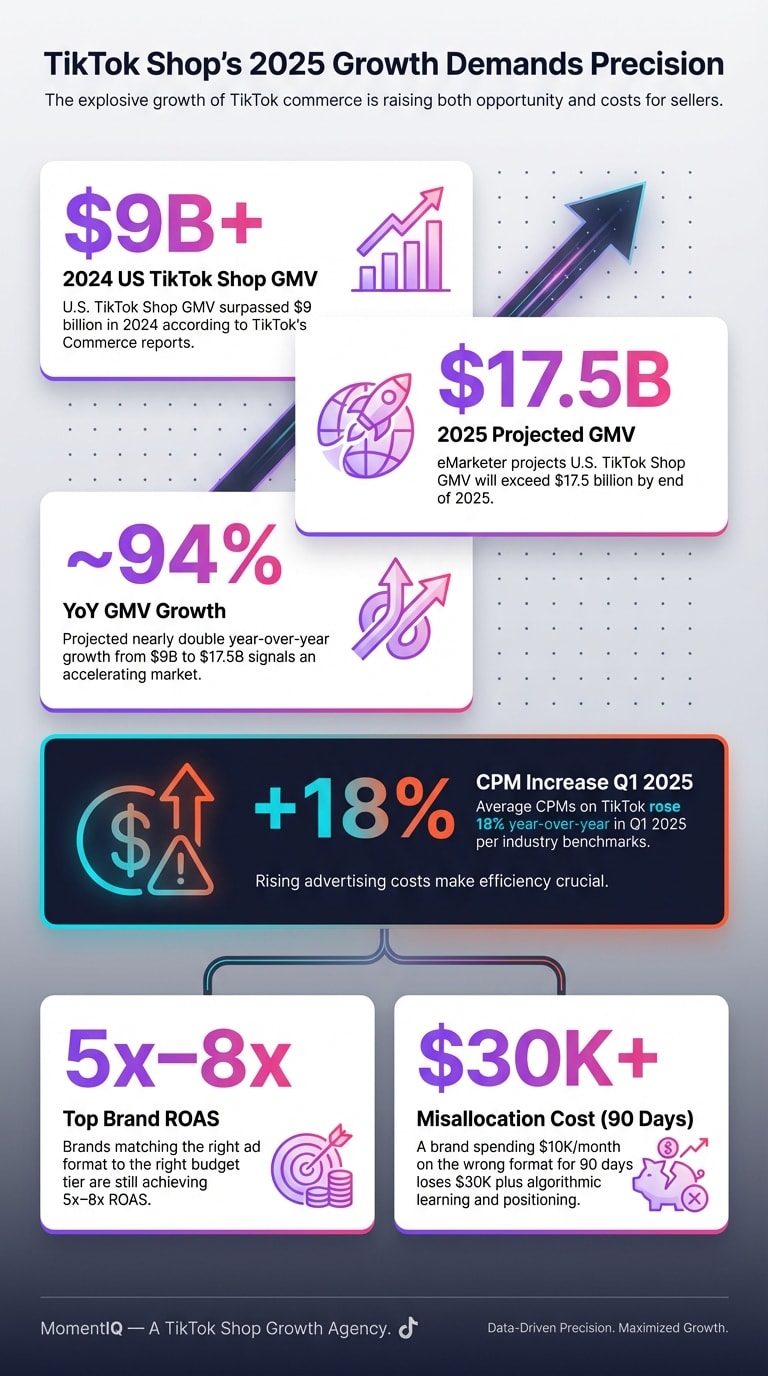
TikTok Shop isn't a side experiment anymore. According to TikTok's own Commerce reports, U.S. TikTok Shop GMV surpassed $9 billion in 2024, and eMarketer projects it will exceed $17.5 billion by the end of 2025. Statista data shows TikTok's share of U.S. social commerce is growing faster than any platform — period.
But here's the uncomfortable truth: **rising competition means rising costs.** Average CPMs on TikTok increased 18% year-over-year in Q1 2025 according to industry benchmarks. The brands that are still printing 5x–8x ROAS aren't doing it by throwing money at the default campaign type.They're doing it by matching the right ad format to the right budget tier with surgical precision.
Every dollar you misallocate today compounds. A brand spending $10K/month on the wrong format for 90 days doesn't just lose $30K — they lose the algorithmic learning, the audience data, and the competitive positioning that their rivals are banking right now.
The window is narrowing.Let's make sure you're on the right side of it.
The Three TikTok Shop Ad Formats: A Quick Breakdown Before We Go Deep
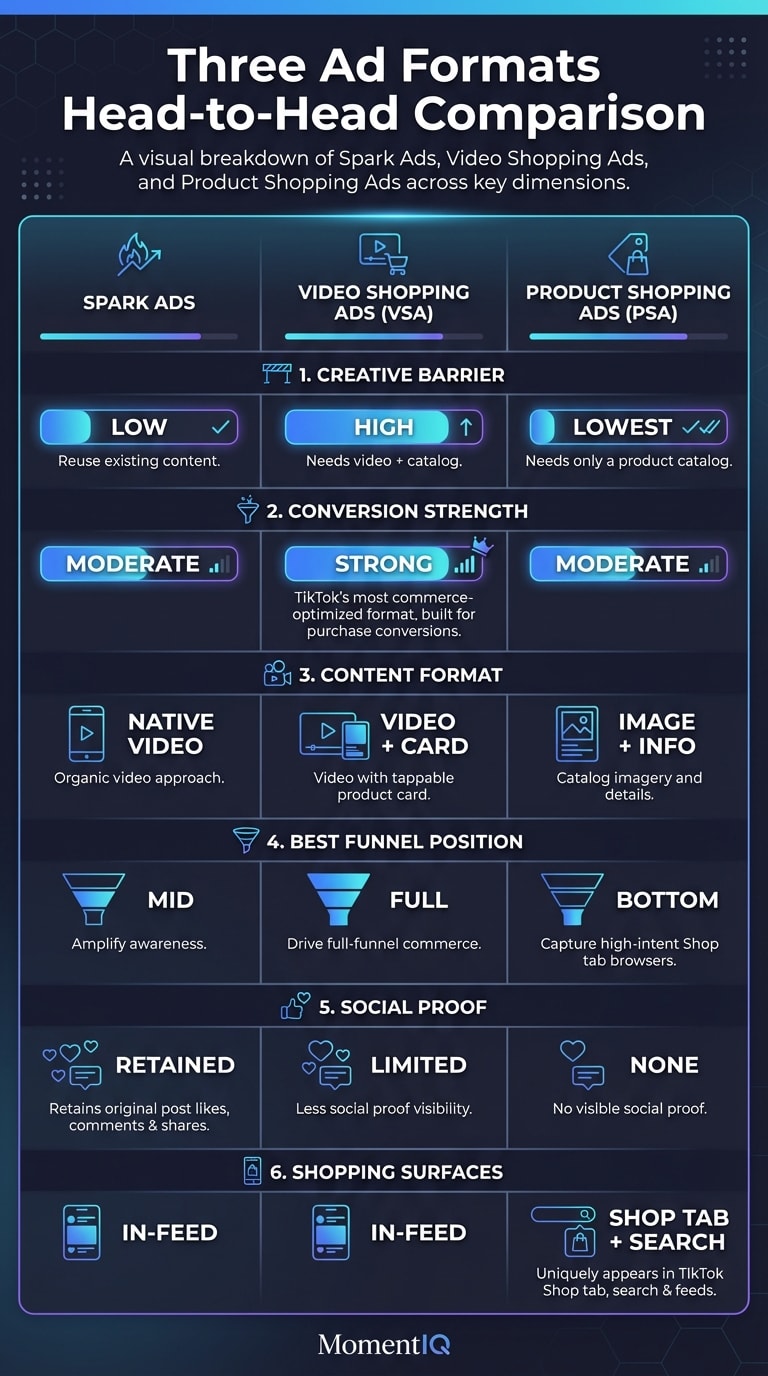
Before we build the decision matrix, let's establish a clear baseline. If you've already read our Complete Guide to Video Shopping Ads, you know the mechanics — but here's the side-by-side snapshot that matters for budget allocation.
Spark Ads: Amplifying Organic and Creator Content

What they are: Spark Ads let you boost existing organic TikTok posts — either from your own brand account or from a creator's account (with their authorization). The post retains its native feel, comments, shares, and engagement.
Key characteristics:
- Leverages existing content (no new creative production required)
- Retains social proof (likes, comments, shares stay visible)
- Can drive traffic to TikTok Shop product pages, your profile, or external links turn organic posts into revenue machines
- Lower creative barrier to entry
- Best for: Amplifying proven organic winners, scaling creator content that's already converting Spark Ads amplification guide
Video Shopping Ads (VSA): The Full-Funnel Commerce Machine
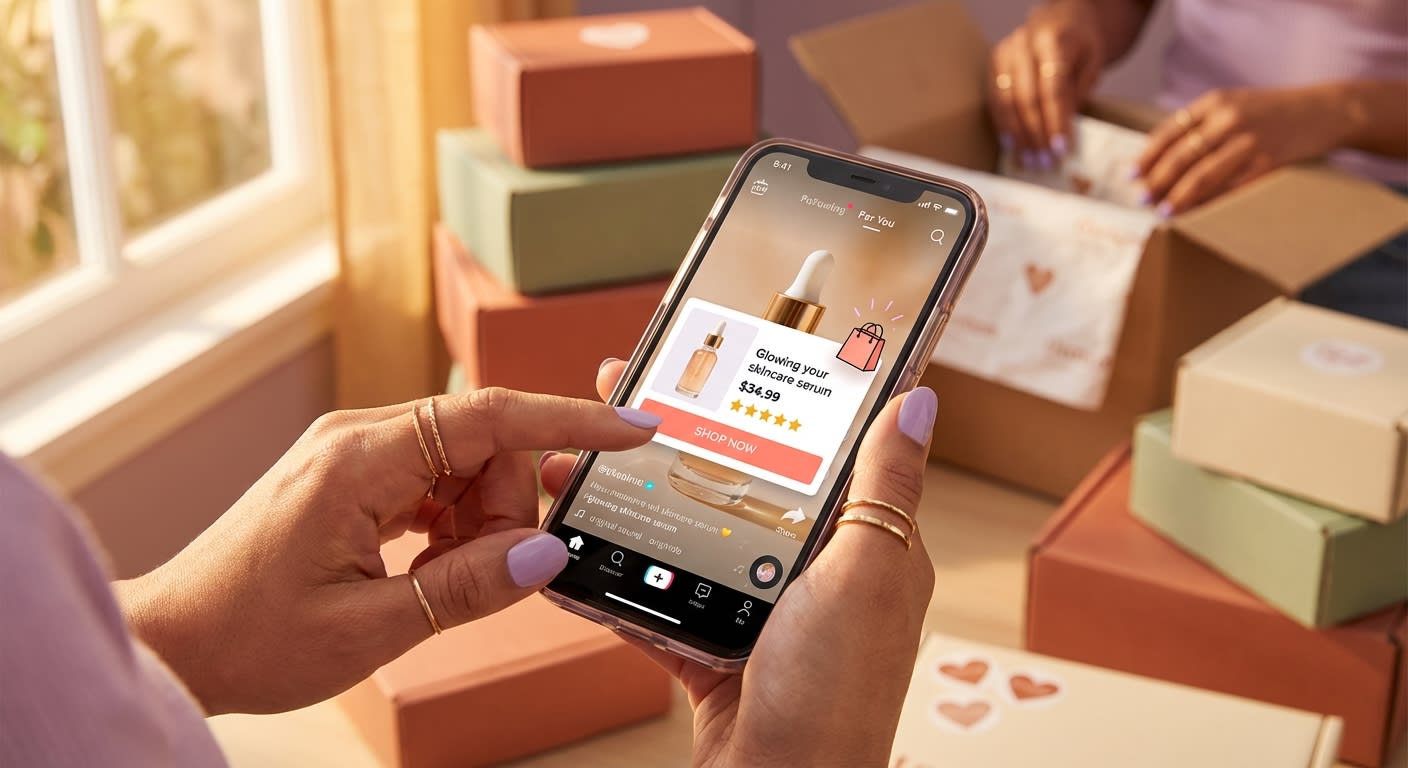
What they are: Video Shopping Ads are TikTok's most commerce-optimized format. They combine video creative with a shoppable product card, enabling in-feed discovery and one-tap purchasing without leaving TikTok.They can pull from your own content, creator content, or dynamically generated creative.
Key characteristics:
- Native product card overlay with pricing, reviews, and "Shop Now" CTA
- Optimized for purchase conversions (not just clicks or views) complete Video Shopping Ads guide
- Supports catalog-based dynamic creative Dynamic Product Ads setup guide- Can leverage creator content through affiliate authorization campaign objective selection guide
- Best for: Direct-response conversion at scale, catalog-heavy brands, scaling proven products
Product Shopping Ads (PSA): Catalog-Driven Discovery

What they are: Product Shopping Ads are catalog-based ads that surface products across TikTok's shopping surfaces — including the Shop tab, search results, and recommended product feeds. They're image-based (not video-based) and function more like a product listing ad.
Key characteristics:
- Image + product info format (similar to Google Shopping)
- Appear in TikTok Shop tab, search, and "You May Also Like" placements TikTok Shop SEO and search rankings
- Lower creative production requirements
- Optimized for high-intent shoppers already browsing the Shop tab
- Best for: Capturing bottom-funnel demand, large catalogs, supplementing video-based campaigns Product Shopping Ads masterclass
The 2025 Decision Matrix: Which TikTok Shop Ad Format Wins at Every Budget Level

This is where we go deeper than any other TikTok Shop ad formats 2025 guide you'll find. We're segmenting by four budget tiers and scoring each format across the dimensions that actually matter.
Budget Tier 1: $1K–$5K/Month (The Scrappy Starter) TikTok Shop ads on small budgets

Your reality: You're testing TikTok Shop viability. Every dollar has to prove itself. You probably don't have a library of creator content yet, and your organic presence is thin.
| Dimension | Spark Ads | Video Shopping Ads | Product Shopping Ads |
|---|---|---|---|
| Creative Requirements | Need existing content to boost | Need video + product catalog | Need product catalog only |
| Minimum Viable Spend | $20–50/day | $30–50/day | $20–30/day |
| Learning Phase Risk | Medium | High (needs more data) | Low |
| Conversion Optimization | Moderate | Strong | Moderate |
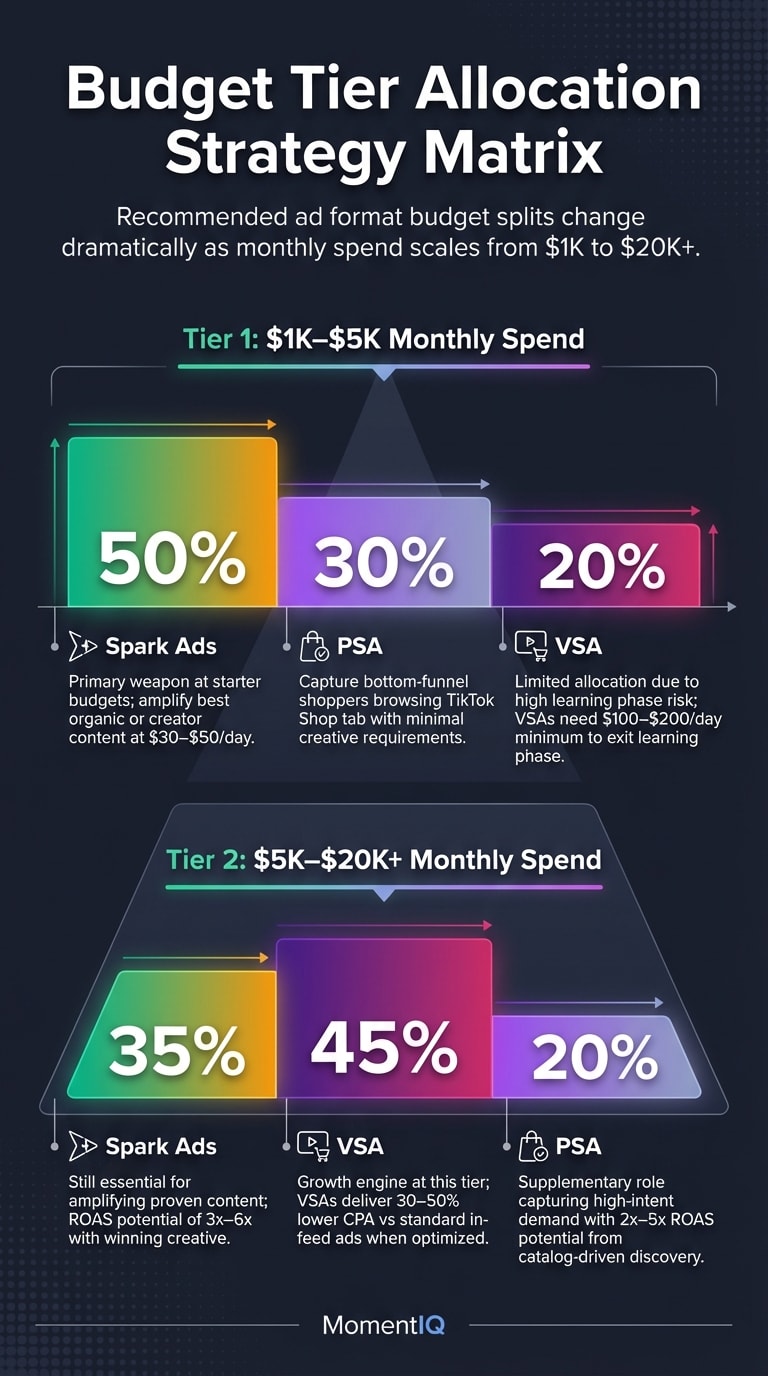
| Recommended Allocation | 50% | 20% | 30% |
The verdict at $1K–$5K: Spark Ads are your primary weapon. Here's why — at this budget, you can't afford the learning phase risk of Video Shopping Ads, which typically need $100–$200/day minimum to exit the learning phase efficiently. But you can identify your best-performing organic content (or your top creator's content) and amplify it with Spark Ads for $30–$50/day.
Pair Spark Ads with Product Shopping Ads to capture the bottom-funnel shoppers who are already browsing TikTok's Shop tab. PSAs require minimal creative — just a solid product catalog — and they convert the high-intent traffic that your Spark Ads generate.
The critical mistake at this tier: Dumping your entire $3K into Video Shopping Ads and watching the algorithm churn through your budget in the learning phase without enough conversion data to optimize. We've seen brands burn through $2,000 in a week with zero attributed sales because they didn't have the budget runway to let VSAs learn.
Pain point check: If you're a seller watching your CAC climb while your GMV stays flat, this budget tier is where most brands get stuck. The format choice isn't just tactical — it's existential.
Budget Tier 2: $5K–$20K/Month (The Growth Builder)
Your reality: You've validated product-market fit on TikTok Shop. You have some creator content, maybe 10–30 active affiliates, and you're ready to scale — but you're terrified of breaking what's working.
| Dimension | Spark Ads | Video Shopping Ads | Product Shopping Ads |
|---|---|---|---|
| Scale Ceiling | Medium (limited by content library) | High | Medium |
| ROAS Potential | 3x–6x (with proven content) | 4x–10x (when optimized) | 2x–5x |
| Creative Velocity Needed | 3–5 new pieces/week | 5–10 new pieces/week | Catalog updates |
| Recommended Allocation | 35% | 45% | 20% |
The verdict at $5K–$20K: This is where Video Shopping Ads become your growth engine. At $150–$500/day, you have enough budget to exit the learning phase and let TikTok's algorithm optimize for purchase conversions. The shoppable product card overlay dramatically reduces friction — industry data shows VSAs deliver 30–50% lower cost-per-acquisition compared to standard in-feed ads when properly optimized.
But here's the catch that kills most sellers at this tier: you need creative velocity. Video Shopping Ads eat content. TikTok's algorithm fatigues creative faster than any other platform — typically within 7–14 days. If you're running three videos and hoping they'll carry you, you'll see CPAs spike within two weeks.
This is exactly why brands at this stage start working with MomentIQ. Our algorithmic creator matching system doesn't just find creators — it matches your product to creators whose audiences have the highest purchase propensity for your category. One supplement brand we worked with scaled from $18K to $420K/month in 90 days by combining MomentIQ's creator content pipeline with a Video Shopping Ads strategy that tested 40+ creative variations per month.
Keep Spark Ads running on your best-performing creator content as a proven-performer amplification layer. And maintain Product Shopping Ads as your always-on bottom-funnel net.
Budget Tier 3: $20K–$50K/Month (The Scale-Up)
Your reality: You're doing real volume. You have 50–200 active creators, a content library, and you're thinking about how to 3x without 3x-ing your workload. Your biggest fear isn't whether TikTok Shop works — it's whether you can scale without margins collapsing.
| Dimension | Spark Ads | Video Shopping Ads | Product Shopping Ads |
|---|---|---|---|
| Scaling Efficiency | Diminishing returns above $300/day per creative | Strong to $2K+/day per ad group | Strong for catalog breadth |
| Audience Expansion | Limited (tied to existing engagement) | Broad (algorithmic prospecting) | Medium (Shop tab traffic) |
| Attribution Clarity | Moderate | Strong (direct purchase tracking) | Strong |
| Recommended Allocation | 25% | 55% | 20% |
The verdict at $20K–$50K: Video Shopping Ads should be the majority of your spend. At this tier, you can run multiple ad groups targeting different audience segments — prospecting, retargeting, lookalikes built from your purchaser data — and the algorithm has enough signal to optimize aggressively.
The game-changer at this tier is creative diversification within VSAs. You should be testing:
- Creator-generated content (authorized through affiliate relationships)
- Brand-produced content styled as UGC
- Dynamic catalog creative that auto-generates product-specific ads
- Mashup formats combining testimonials, demos, and urgency hooks
Spark Ads shift from primary driver to strategic amplifier. Use them exclusively for content that's proven in organic — videos with 100K+ views, strong comment sentiment, and demonstrated purchase intent signals. Don't Spark mediocre content just because you have the budget.
Product Shopping Ads become your catalog expansion play. If you have 20+ SKUs, PSAs let you surface the right product to the right shopper without creating individual video ads for every item.
Objection check: "We can manage this ourselves." At $30K/month in ad spend with 100+ creators producing content, you need someone reviewing creative performance daily, rotating winners into paid, killing losers before they drain budget, and coordinating with creators on new briefs. One brand manager can handle maybe 20 creators before quality collapses. MomentIQ manages this at scale with proprietary systems — not heroic individual effort that burns out your team in 60 days.
Budget Tier 4: $50K–$100K+/Month (The Category Dominator)
Your reality: You're playing to win the category. You need every format working in concert, and the difference between a 4x and 6x ROAS at this spend level is the difference between $200K and $600K in monthly profit.
| Dimension | Spark Ads | Video Shopping Ads | Product Shopping Ads |
|---|---|---|---|
| Role in Full-Funnel | Top-of-funnel awareness + social proof | Mid-to-bottom funnel conversion | Bottom-funnel capture |
| Budget Ceiling | 15–20% of total | 55–65% of total | 15–20% of total |
| Competitive Moat | Moderate | Strong (data compounds) | Moderate |
| Recommended Allocation | 20% | 60% | 20% |
The verdict at $50K–$100K+: You're running a full-funnel ad ecosystem, not individual campaigns. Here's how the formats work together:
Spark Ads drive top-of-funnel awareness by amplifying your highest-performing creator content to cold audiences. The social proof (comments, shares, likes) builds trust before a prospect ever sees a purchase CTA.
Video Shopping Ads do the heavy lifting on conversion. At this budget, you should be running 10–20 active ad groups with daily creative rotation. The brands crushing it at this tier test 50–100 creative variations per month and kill underperformers within 48 hours.
Product Shopping Ads capture the demand you've generated. Every Spark Ad view, every VSA engagement that doesn't immediately convert — PSAs catch those shoppers when they return to the Shop tab.
At this tier, the compounding data advantage is everything. Each purchase feeds the algorithm more signal. Each creative test reveals audience insights. Brands that started scaling 6 months ago have a data moat that latecomers literally cannot replicate without spending 2–3x more to catch up.
Video Shopping Ads vs Spark Ads: The Head-to-Head Breakdown Most Guides Miss
Let's settle the most common debate in every TikTok Shop seller's Slack channel.
When Spark Ads Beat Video Shopping Ads
- You have a viral organic post (100K+ views) and want to pour fuel on the fire
- Your budget is under $5K/month and you can't afford learning phase waste
- You're in a trust-dependent category (supplements, skincare, baby products) where social proof in comments matters more than a product card
- You're testing a new product and want to validate demand before committing to VSA creative production
When Video Shopping Ads Beat Spark Ads
- You're optimizing for purchases, not engagement — VSAs are built for bottom-line conversion
- You have budget to sustain the learning phase ($150+/day per ad group)
- You need to scale beyond the ceiling of existing content — VSAs support dynamic and catalog-based creative that doesn't rely on a single viral post
- You want direct, attributable ROAS tracking — VSAs offer cleaner purchase attribution than Spark Ads
The data tells the story: According to TikTok's internal commerce benchmarks shared at their 2024 Commerce Summit, Video Shopping Ads deliver 2.5x higher conversion rates compared to standard Spark Ads when optimized for purchase events. But Spark Ads deliver 40% lower CPMs, making them more efficient for awareness and consideration.
The answer isn't either/or. It's both — allocated correctly for your budget tier.
The Product Type Matrix: Which Ad Format Wins for Your Category
Budget isn't the only variable. What you sell fundamentally changes which format performs best.
High-Margin Impulse Products ($15–$50 AOV, 60%+ margin)
Think: beauty tools, phone accessories, novelty items, kitchen gadgets
Winner: Video Shopping Ads (60% allocation)
These products convert on impulse. The shoppable product card with visible pricing and one-tap checkout is perfectly designed for the "see it, want it, buy it" behavior. Spark Ads (25%) amplify the best-performing demos, and PSAs (15%) catch browse-and-buy shoppers.
High-Consideration Products ($50–$200 AOV, 40–60% margin)
Think: skincare sets, fitness equipment, premium supplements
Winner: Spark Ads for prospecting, VSAs for retargeting (40/40/20 split)
Higher-AOV products need trust-building before purchase. Spark Ads with authentic creator reviews and visible social proof warm the audience. Then VSAs retarget engaged viewers with the purchase CTA. One fitness equipment brand using this exact strategy saw their conversion rate increase 180% compared to running VSAs alone for cold traffic.
Large Catalog / Multi-SKU Brands (50+ products)
Think: fashion brands, home décor, pet supply companies
Winner: Product Shopping Ads + Video Shopping Ads (25/45/30 split)
You can't create individual video ads for 200 SKUs. PSAs let you surface your full catalog dynamically. VSAs drive conversion for your hero products. Spark Ads amplify your best creator content for top sellers.
The Growth Stage Matrix: Matching Ad Formats to Where You Are
Stage 1: Launch (Months 1–3)
Primary format: Spark Ads (50%) + PSAs (30%) + VSAs (20%)
Goal: Validate product-market fit, build initial data, identify winning content angles
Stage 2: Traction (Months 3–6)
Primary format: VSAs (45%) + Spark Ads (35%) + PSAs (20%)
Goal: Scale proven products, build creative velocity, exit learning phases
Stage 3: Scale (Months 6–12)
Primary format: VSAs (55%) + Spark Ads (25%) + PSAs (20%)
Goal: Maximize ROAS at increasing spend, expand audience segments, build data moat
Stage 4: Dominance (12+ months)
Primary format: VSAs (60%) + Spark Ads (20%) + PSAs (20%)
Goal: Own category, outbid competitors with superior data, full-funnel optimization
Ready to skip the trial-and-error phase? See how MomentIQ's proprietary data analytics can map your custom ad format allocation — schedule a free strategy session at bemomentiq.com.
The 5 Mistakes That Drain TikTok Shop Ad Budgets (And How to Avoid Them)
Mistake #1: Running Video Shopping Ads Without Enough Creative Velocity
VSAs need fresh creative every 7–14 days. If you're running three videos and wondering why CPAs doubled in week two, this is why. The brands winning at VSAs produce 10–20 new creative assets per week through creator networks.
This is where most in-house teams hit a wall. Managing 50+ creators, coordinating content briefs, reviewing assets, and rotating winners into paid — it's a full-time operation. MomentIQ's managed creator programs at scale solve this exact bottleneck, using algorithmic matching to keep your creative pipeline flowing without your team drowning in DMs.
Mistake #2: Sparking Mediocre Content Just Because It Exists
Not every organic post deserves ad spend. Only Spark content that has demonstrated organic conversion signals: high save rates, "link?" comments, share-to-view ratios above 3%. Sparking a video with 50K views but zero purchase intent is burning money for vanity metrics.
Mistake #3: Ignoring Product Shopping Ads Entirely
PSAs are the most underutilized format on TikTok Shop. According to TikTok's 2024 Commerce data, Shop tab traffic grew 134% year-over-year. That's high-intent traffic actively browsing for products — and if you're not running PSAs, your competitors are capturing those shoppers instead.
Mistake #4: Using the Same Budget Allocation Across All Products
Your $12 lip gloss and your $89 serum set need completely different ad format strategies. Apply the product type matrix above. One-size-fits-all allocation is lazy strategy that produces mediocre results.
Mistake #5: Not Connecting Your Affiliate Creator Content to Your Paid Strategy
The most powerful TikTok Shop ad strategy in 2025 combines organic creator content with paid amplification. When a creator's affiliate video starts converting organically, immediately Spark it or use it as VSA creative. This is the flywheel — organic validates, paid scales.
"We've Tried Agencies Before" — Why This Time Is Different
Let's address the elephant in the room. If you've worked with a generic influencer agency or a social media agency that "also does TikTok," you probably got burned. Inconsistent reporting. Creators who posted once and ghosted. Zero understanding of TikTok Shop's unique mechanics — the product card integration, the affiliate commission structures, the Shop tab algorithm.
Here's what makes MomentIQ fundamentally different:
- TikTok Shop Partner of the Year — not a generic social agency that added TikTok to their deck last quarter
- Algorithmic creator matching through our proprietary systems and Reacher platform, not manual outreach that tops out at 20 creators before your team burns out
- Full-stack commerce support from content production to ad management to conversion optimization — not just "we'll find you some influencers"
- FastMoss Visionary Award winner with proprietary data analytics that identify winning products, creators, and content angles before you spend a dollar on ads
One beauty brand came to us after burning $45K with a previous agency that delivered zero trackable GMV. Within 60 days of MomentIQ's managed program, they were generating $180K/month in attributed TikTok Shop revenue with a blended 5.2x ROAS across Spark Ads and Video Shopping Ads.
The difference isn't effort. It's infrastructure.
The Budget Allocation Cheat Sheet: Your Quick-Reference Decision Matrix
| Monthly Budget | Spark Ads | Video Shopping Ads | Product Shopping Ads | Primary Goal |
|---|---|---|---|---|
| $1K–$5K | 50% | 20% | 30% | Validate & learn |
| $5K–$20K | 35% | 45% | 20% | Scale winners |
| $20K–$50K | 25% | 55% | 20% | Dominate category |
| $50K–$100K+ | 20% | 60% | 20% | Full-funnel ownership |
Important caveats:
- These allocations assume a general consumer product with 50%+ margins. Adjust for your specific category using the product type matrix above.
- Shift 5–10% toward Spark Ads if you're in a high-trust category (supplements, baby, health).
- Shift 5–10% toward PSAs if you have 50+ SKUs.
- Re-evaluate allocations every 30 days based on actual performance data.
The Cost of Waiting: Why Your Ad Format Strategy Can't Wait Until Q4
Here's the math that should keep you up at night.
TikTok Shop's advertising auction is a learning system. Every conversion you generate today trains the algorithm to find more buyers like your best customers tomorrow. Brands that started optimizing their ad format mix 6 months ago have a compounding data advantage that translates to 20–40% lower CPAs compared to a brand starting fresh with identical creative and budget.
Statista projects over 40 million U.S. TikTok Shop buyers by the end of 2025. eMarketer estimates TikTok will capture 8.5% of U.S. social commerce by year-end. The brands building their ad infrastructure now will own the algorithmic advantage that latecomers simply cannot replicate without spending 2–3x more.
Every month you delay is a month your competitors are feeding the algorithm, testing creative, and building the data moat that makes it progressively harder — and more expensive — for you to catch up.

Your Next Move: From Decision Matrix to Execution
You now have the framework. You know which ad format wins at your budget level, for your product type, at your growth stage. But frameworks don't generate revenue — execution does.
The gap between knowing the right allocation and actually executing it at scale is where most brands stall. You need:
- A constant pipeline of creator content to fuel Video Shopping Ads (not 3 videos — 30+ per month)
- Real-time performance monitoring to rotate creative before fatigue kills your CPAs
- Cross-format attribution to understand how Spark Ads, VSAs, and PSAs work together — not in isolation
- The discipline to kill underperformers fast and scale winners aggressively
This is exactly what MomentIQ builds for brands every day. As a TikTok Marketing Partner and TikTok Shop Partner of the Year, we don't just advise on ad format strategy — we execute it end-to-end with proprietary data systems that most brands can't build in-house.
Talk to a Strategist and get a custom ad format allocation roadmap built for your specific products, margins, and growth targets. The brands that act now will own the advantage. The ones that wait will pay the premium.
The matrix is clear. The window is open. The only question is whether you'll move before it narrows.