
TikTok Shop Campaign Objective Guide
Learn which TikTok Shop campaign objective—Conversions, Traffic, or Reach—actually drives results for your goals. Stop wasting 60% of ad spend on the wrong choi

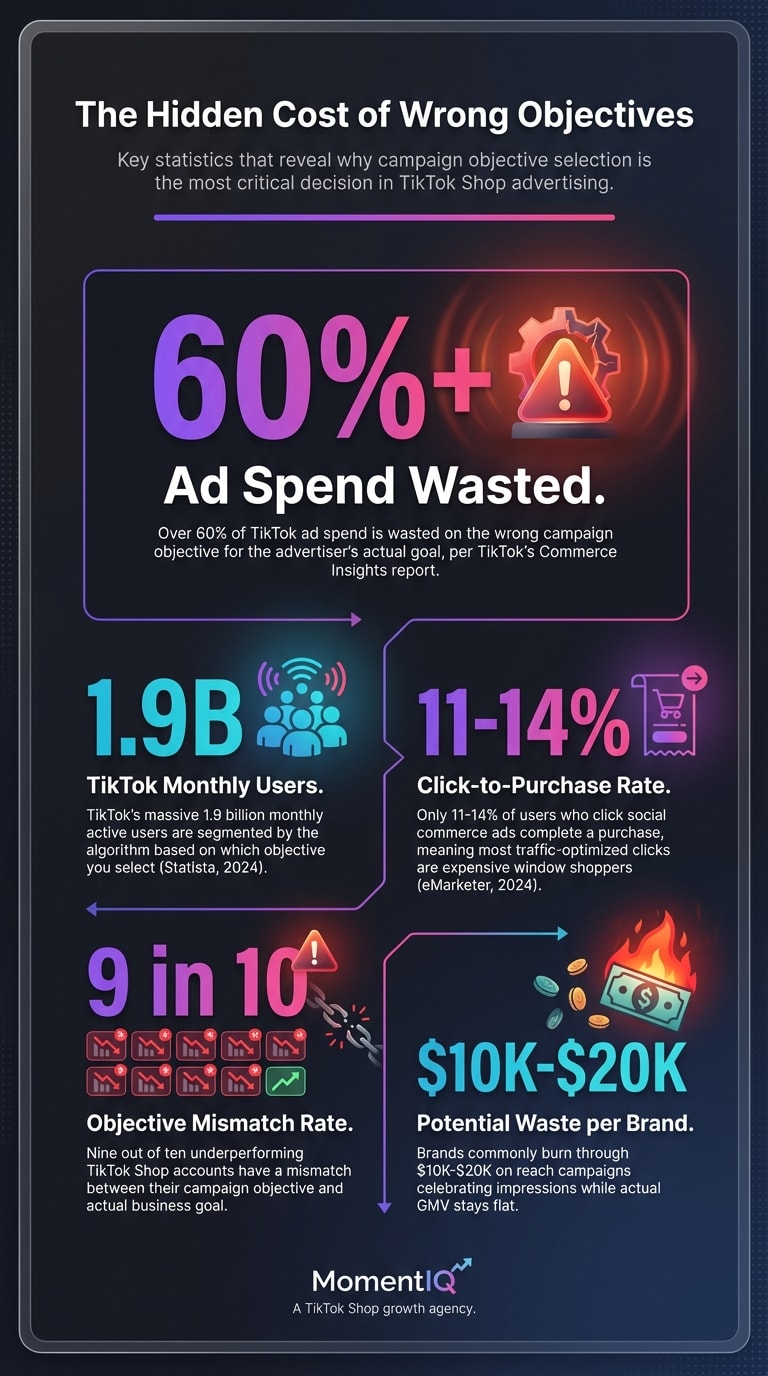
Here's a stat that should make every TikTok Shop seller uncomfortable: according to TikTok's own Commerce Insights report, over 60% of ad spend on the platform is wasted on the wrong campaign objective for the advertiser's actual goal. Not wasted on bad creative. Not wasted on poor targeting. Wasted because someone clicked the wrong radio button during campaign setup.
- Choose the Conversion objective when you want purchases, since only 11-14% of ad clickers actually buy — Traffic optimizes for clickers, not buyers.
- Audit your current campaign objective first: over 60% of TikTok ad spend is wasted simply by selecting the wrong objective during setup.
- Match your objective to your goal — use Reach for awareness, Traffic for clicks, and Conversions for sales — because each targets entirely different user audiences.
- Stack objectives strategically like top TikTok Shop sellers instead of running every campaign under a single objective.
- Before tweaking creative or targeting, verify your campaign objective aligns with your product price point, pixel maturity, and conversion data volume.
That single decision — the campaign objective you select before you even touch your audience settings, your creative, or your budget — determines which slice of TikTok's 1.9 billion monthly active users (Statista, 2024) the algorithm serves your ads to.Choose wrong, and you're essentially paying premium prices to show your product to people the algorithm has pre-classified as unlikely to buy.
This is the guide that should have existed from day one. We're going to break down exactly how each TikTok Shop campaign objective triggers fundamentally different algorithmic optimization, give you decision trees based on your product price point, pixel maturity, and conversion data volume, and show you the objective-stacking strategies that the top-performing TikTok Shop sellers are using right now to crush their competition.
If you're burning through ad budget and watching your ROAS flatline — or worse, decline — the problem might not be your creative or your product.It might be the very first choice you made when you hit "Create Campaign."
Let's fix that.
Why TikTok Shop Campaign Objectives Matter More Than You Think
Most sellers treat campaign objective selection like a formality. A dropdown to click through on the way to the "real" work of audience targeting and creative upload.
That's a $50,000 mistake waiting to happen.
Here's what's actually happening under the hood: when you select a campaign objective, you're telling TikTok's machine learning system which user behavior to optimize for.TikTok then queries its massive behavioral database — billions of signals from scroll patterns, watch times, click behaviors, purchase histories, and engagement rates — to build a delivery audience of users most likely to take that specific action.
Think about that for a second.
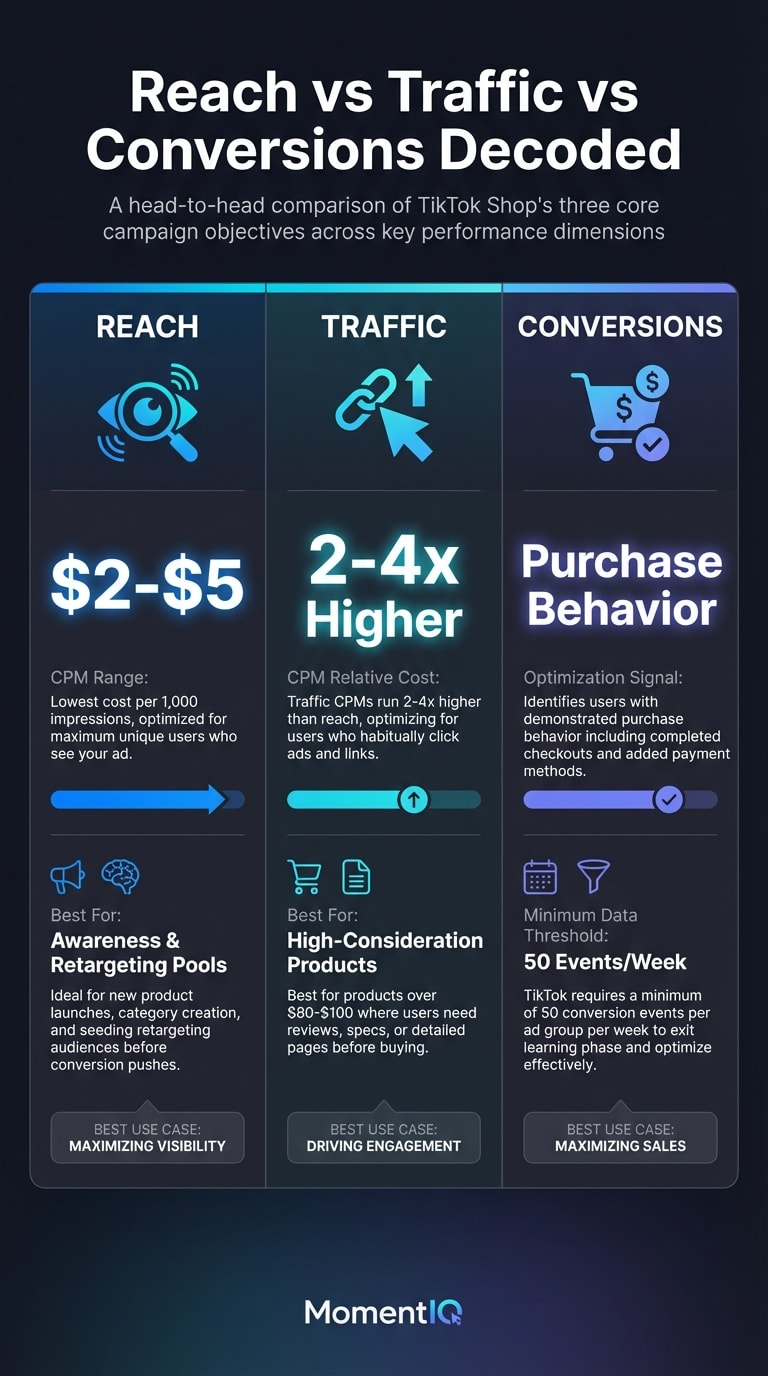
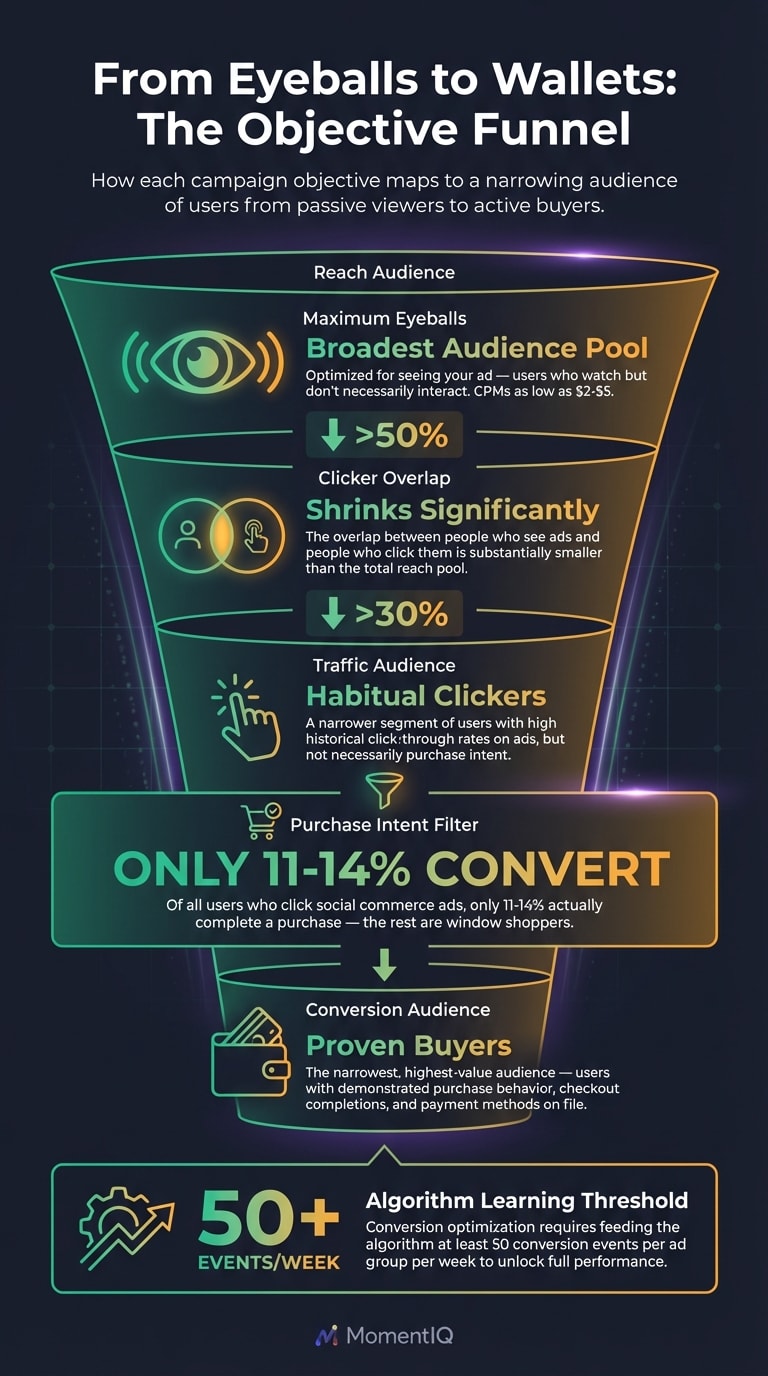
- Reach objective: TikTok serves your ad to the maximum number of unique users at the lowest CPM. These users are optimized for seeing your ad — not clicking, not buying.
- Traffic objective: TikTok finds users who habitually click on ads and links. These are clickers, not necessarily buyers.
- Conversion objective: TikTok identifies users with demonstrated purchase behavior — people who have completed checkout flows, added payment methods, and bought products through TikTok Shop or tracked websites.

These are three entirely different audiences. The overlap between "people who click ads" and "people who buy products" is shockingly small. eMarketer's 2024 social commerce report found that only 11-14% of users who click social commerce ads complete a purchase, meaning the vast majority of traffic-optimized clicks are essentially expensive window shoppers.
So when a brand tells us, "We're running TikTok ads but our ROAS is terrible," the first question we ask at MomentIQ isn't about their creative or targeting. It's: what objective are you running, and does it match your actual business goal?
Nine times out of ten, there's a mismatch. And fixing it is the single highest-leverage change you can make to your TikTok Shop ad performance.
Ready to stop guessing which campaign objective is right for your brand? Talk to a Strategist — we'll analyze your current ad account structure and show you exactly where objective misalignment is costing you money.
The Three Core TikTok Ad Objectives for Shop Sellers — Decoded
Let's break down each objective with the nuance that actually matters for TikTok Shop sellers. This isn't the generic overview you'll find in TikTok's help center. This is what we've learned from managing millions in TikTok Shop ad spend.
Reach: The Brand Awareness Play (and Its Hidden Trap)

What it does: Maximizes the number of unique users who see your ad at the lowest possible cost per 1,000 impressions (CPM).
How the algorithm optimizes: TikTok serves your ad broadly, prioritizing users who are likely to watch (even briefly) but not necessarily interact. You'll see CPMs as low as $2-5 in many categories.
When it actually makes sense for TikTok Shop sellers:
- New product launches where you need rapid awareness before pushing conversion campaigns Spark Ads to amplify organic content
- Category creation — if you're selling something people don't know they need yet
- Retargeting audience building — seeding a large pool of exposed users to retarget later with conversion campaigns
- Seasonal pre-hype — building awareness 2-3 weeks before a major sale event
The hidden trap: Reach campaigns feel amazing in your dashboard.Millions of impressions! Low CPMs! But here's the uncomfortable truth: reach without intent is just noise. If you're a TikTok Shop seller optimizing for GMV, running reach as your primary objective is like hiring a billboard on a highway to sell a product that requires a demo to understand. You'll get eyeballs. You won't get wallets.
We've seen brands burn through $10K-$20K on reach campaigns and celebrate their "brand awareness" while their actual GMV stays flat. Reach has a role — but it's a supporting role, never the lead.
Traffic: The Middle Child With an Identity Crisis

What it does: Optimizes for users who will click through to your TikTok Shop product page, landing page, or profile.
How the algorithm optimizes: TikTok identifies "clickers" — users with high historical click-through rates on ads. These users are served your ad preferentially.
When it actually makes sense for TikTok Shop sellers:
- Higher-consideration products (over $80-100) where users need to read reviews, compare specs, or see detailed product pages before purchasing
- Building pixel data — when your TikTok pixel has fewer than 50 conversion events per week and can't optimize for purchases yet (more on this critical threshold below)
- Driving traffic to a TikTok Shop storefront during a major promotion where the page itself does the selling
- Testing new audiences where you want to gauge interest before committing to conversion optimization
The identity crisis: Traffic sits in an awkward middle ground. It's too expensive for pure awareness (CPMs are 2-4x higher than reach) and too unfocused for direct sales (you're paying for clicks, not purchases). The biggest mistake we see at MomentIQ is brands running traffic campaigns indefinitely because they "want to drive people to the shop."
Driving people to the shop isn't the goal. Driving people who will buy to the shop is the goal. And that's what conversion optimization does.
Conversions: The Money Printer (When You Feed It Right)
What it does: Optimizes for users who will complete a specific action — Add to Cart, Initiate Checkout, or Complete Payment.
How the algorithm optimizes: This is where TikTok's machine learning truly shines. The system identifies users with behavioral patterns matching your existing converters. It considers hundreds of signals: past purchase behavior on TikTok Shop, engagement patterns with similar products, time-of-day purchasing habits, even scroll velocity patterns that correlate with purchase intent.
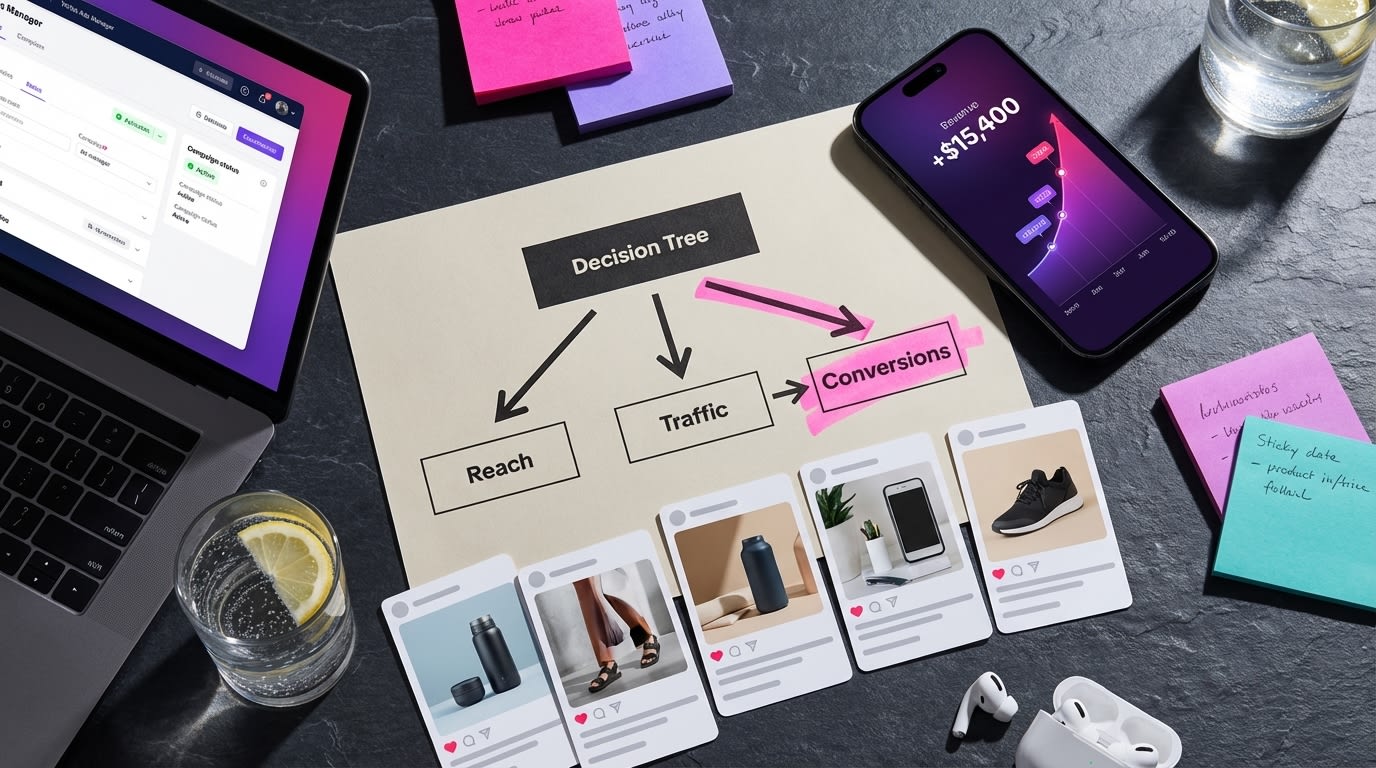
When it makes sense for TikTok Shop sellers:
- Almost always. If your goal is GMV, conversion campaigns should be the backbone of your paid strategy.
- Products with clear, immediate value propositions (beauty, supplements, home goods, fitness accessories)
- When your pixel has sufficient data (the critical threshold we'll cover next)
- When you have creative that demonstrates the product in action
The catch: Conversion campaigns are only as smart as the data you feed them. TikTok's own advertising documentation recommends a minimum of 50 conversion events per ad group per week for the algorithm to exit learning phase and optimize effectively. Below that threshold, the system is essentially guessing — and your CPA will be erratic and inflated.
This is where most sellers get stuck. They know conversion campaigns are the goal, but they don't have enough data to make them work. Which brings us to the most important section of this entire guide.
The Decision Tree: Choosing the Best TikTok Ad Objective for Sales Based on Your Data Maturity

Forget generic advice. Here's the framework that actually works, based on where your TikTok Shop ad account stands right now.
Stage 1: Cold Start (0-20 Pixel Events Per Week)
Your situation: You've just launched TikTok Shop ads, or you've been running them at low volume. Your pixel has minimal purchase data. The algorithm doesn't have enough signal to find buyers.
Recommended objective stack:
- Primary: Traffic campaigns optimized for Landing Page Views → TikTok Shop product pages
- Secondary: Conversion campaigns optimized for Add to Cart (a lower-funnel event that happens more frequently than purchases, giving the algorithm more data points)
- Budget split: 60% traffic / 40% Add to Cart conversion
Why this works: You're using traffic campaigns to generate volume and feed the pixel, while simultaneously running conversion campaigns on a higher-frequency event. As Add to Cart data accumulates, the algorithm learns who your potential buyers are.
Critical mistake to avoid: Don't run conversion campaigns optimized for Complete Payment at this stage. With fewer than 20 purchase events per week, the algorithm will thrash — wildly swinging between audience segments, inflating your CPA, and burning budget on exploration that never converges.

Stage 2: Learning Phase (20-50 Pixel Events Per Week)
Your situation: You're getting consistent sales, but not enough for the algorithm to fully optimize. Your ROAS is inconsistent — some days great, some days terrible.
Recommended objective stack:
- Primary: Conversion campaigns optimized for Complete Payment
- Secondary: Conversion campaigns optimized for Add to Cart (to maintain data volume)
- Tertiary: Traffic campaigns at reduced budget for audience testing
- Budget split: 50% Complete Payment / 30% Add to Cart / 20% Traffic
Why this works: You're pushing toward full purchase optimization while maintaining data volume through Add to Cart campaigns. The traffic campaigns let you test new audiences cheaply before committing conversion budget.
Pro tip: Consolidate your ad groups. One of the most common mistakes at this stage is splitting budget across too many ad groups, each starving for data. Fewer ad groups with more budget each will exit learning phase faster.
Stage 3: Optimized Scale (50+ Pixel Events Per Week)
Your situation: You're consistently generating 50+ purchases per week per ad group. The algorithm has strong signal. Your ROAS is stabilizing.
Recommended objective stack:
- Primary: Conversion campaigns optimized for Complete Payment (this is your money printer)
- Secondary: Reach campaigns for retargeting audience building and new product launches
- Budget split: 80-85% Complete Payment / 15-20% Reach/awareness

Why this works: At this stage, the conversion algorithm is fully trained. It knows exactly who your buyers are and can find more of them at scale. Traffic campaigns become largely unnecessary because your conversion campaigns are already finding people who click AND buy.
This is where the magic happens. Brands at this stage routinely see ROAS of 4-8x on TikTok Shop conversion campaigns. One supplement brand we worked with at MomentIQ scaled from $18K to $420K/month in 90 days after restructuring their campaign objectives using this exact framework — the primary change wasn't creative or targeting, it was moving from a traffic-heavy strategy to a conversion-dominant one once their pixel data matured.
The Price Point Variable: How Your Product Price Changes Everything
Here's something most guides completely ignore: your product price point fundamentally changes which objective works best.

Low-Ticket Products ($5-$30)
Best objective: Conversion → Complete Payment from day one (if possible)
Why: Low-ticket impulse purchases generate high conversion volume quickly. A $15 skincare product might convert at 3-5% from TikTok Shop ads, meaning you can hit the 50-event threshold with relatively modest spend. The faster path to purchase data means you can skip the traffic stage entirely in many cases.
Budget needed to exit learning phase: Roughly $500-$1,500/week per ad group (assuming $15 AOV × 50 conversions × inverse of conversion rate)
Mid-Ticket Products ($30-$100)
Best objective: Start with Add to Cart conversion, graduate to Complete Payment
Why: Mid-ticket products have lower conversion rates (typically 1-3% on TikTok Shop), meaning you need more traffic to generate 50 purchase events. Starting with Add to Cart optimization builds algorithmic intelligence faster.
Budget needed to exit learning phase: $2,000-$5,000/week per ad group
High-Ticket Products ($100+)
Best objective: Traffic → Add to Cart → Complete Payment (the full graduation path)
Why: High-ticket products on TikTok Shop convert at 0.5-1.5% typically. At a $150 price point, you'd need enormous spend to generate 50 weekly purchases per ad group. The staged approach lets the algorithm learn incrementally without requiring a $20K/week budget from day one.
Budget needed to exit learning phase on Complete Payment: $5,000-$15,000/week per ad group
This is exactly why so many high-ticket sellers struggle on TikTok Shop ads. They jump straight to conversion optimization, the algorithm never exits learning phase, and they conclude "TikTok ads don't work for our price point." They do — you just need to feed the machine differently.
The Objective-Stacking Strategy Top Sellers Use (and Most Agencies Don't Know About)

The best TikTok Shop advertisers don't pick one objective. They run layered objective campaigns simultaneously, each serving a specific role in a coordinated system.
Here's the architecture:
Layer 1: Reach campaigns (10-15% of budget)
- Purpose: Fill the top of funnel, build custom audiences of video viewers
- Targeting: Broad interest-based, lookalike from customer lists
- Creative: Brand storytelling, problem-awareness content
Layer 2: Traffic campaigns (5-15% of budget, decreasing over time)
- Purpose: Drive product page views, build pixel data, test new audiences
- Targeting: Narrower interest stacks, behavioral targeting
- Creative: Product demonstrations, benefit-focused content

Layer 3: Conversion campaigns — Add to Cart (15-25% of budget)
- Purpose: Build mid-funnel data, identify high-intent users
- Targeting: Lookalikes from purchasers, retargeting video viewers
- Creative: Social proof, urgency-driven content
Layer 4: Conversion campaigns — Complete Payment (50-70% of budget)
- Purpose: Drive direct sales, maximize ROAS
- Targeting: Lookalikes from purchasers, retargeting Add to Cart users
- Creative: Strongest-performing UGC, creator content, offer-driven ads
The key insight: Each layer feeds the next. Reach campaigns create audiences for traffic campaigns. Traffic campaigns create pixel data for conversion campaigns. Add to Cart campaigns create retargeting pools for Complete Payment campaigns. It's a self-reinforcing system where each objective makes the others more effective.
This is the exact structure we build for brands at MomentIQ, and it's one reason our clients consistently see 40-60% lower CPAs than industry benchmarks within 60 days of restructuring.
Want to see how this objective-stacking framework would work for your specific product and price point? Talk to a Strategist — we'll map your custom campaign architecture and show you the projected ROAS impact.
Five Objective Selection Mistakes That Are Silently Killing Your TikTok Shop ROAS
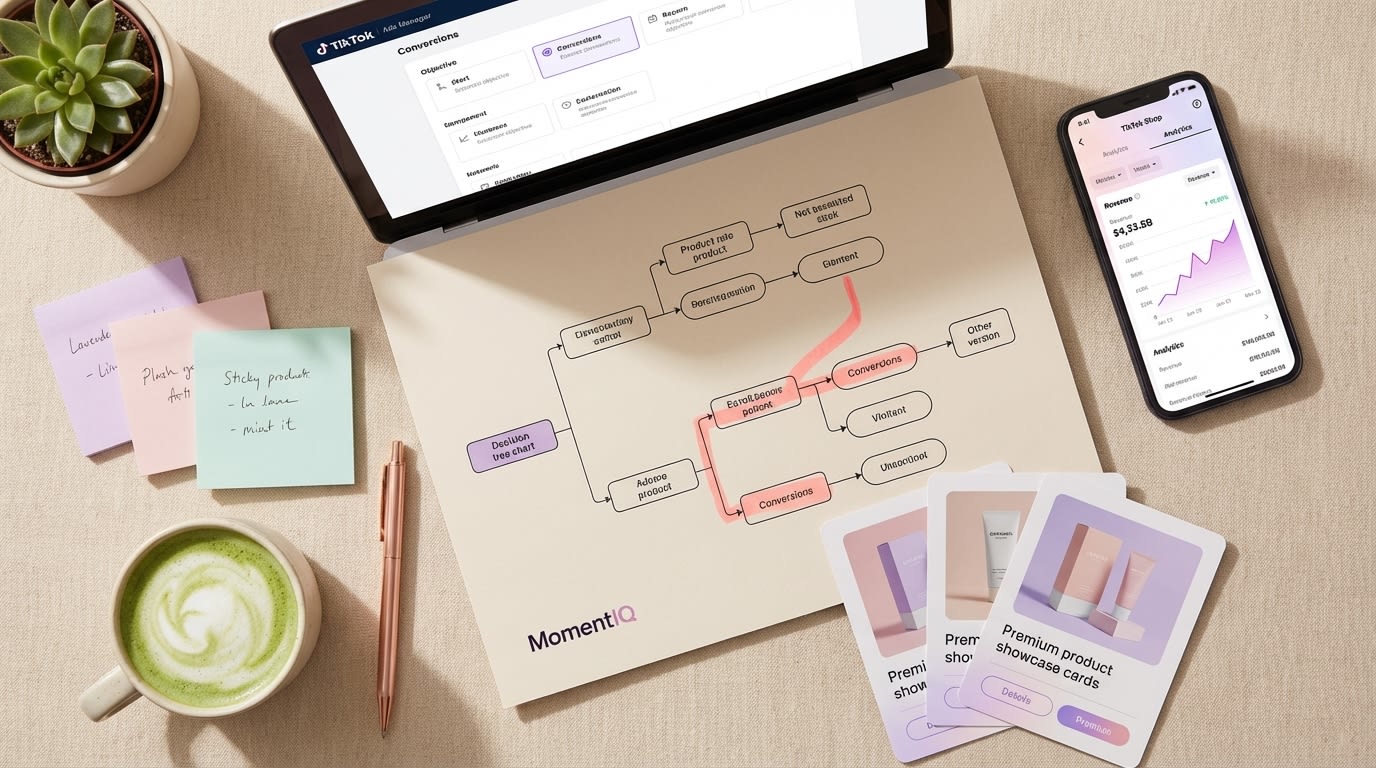
We audit dozens of TikTok Shop ad accounts every month. These are the objective-related mistakes we see over and over:
Mistake #1: Running Conversion Campaigns With Insufficient Data
The symptom: Wildly fluctuating CPA, inconsistent delivery, ad groups stuck in "Learning" status for weeks.
The fix: Drop down to Add to Cart optimization or run parallel traffic campaigns until you hit the 50-event weekly threshold. Patience here saves thousands later.
Mistake #2: Never Graduating From Traffic to Conversions
The symptom: Great CTR, lots of product page views, but GMV stays flat. You're essentially paying to give people a free browsing experience.
The fix: Set a clear graduation trigger. Once you're seeing 30+ Add to Cart events per week organically or through existing campaigns, launch conversion-optimized campaigns and begin shifting budget.
Mistake #3: Using Reach as a Primary Objective for Direct Response
The symptom: Millions of impressions, impressive frequency numbers, but zero correlation with sales. Your CPM looks great. Your ROAS looks terrible.
The fix: Limit reach to 10-15% of total budget, used exclusively for audience building and retargeting pool creation.
Mistake #4: Splitting Budget Across Too Many Ad Groups
The symptom: Ten ad groups each spending $20/day, none with enough conversion data to optimize. Every ad group perpetually in learning phase.
The fix: Consolidate into 2-3 ad groups per campaign. It's better to have two well-fed ad groups than ten starving ones. TikTok's algorithm needs concentration of data to learn.
Mistake #5: Ignoring the Optimization Event Hierarchy
The symptom: Running Complete Payment optimization when your funnel has friction (slow product pages, unclear pricing, poor product images), resulting in tiny conversion volume and failed optimization.
The fix: Optimize for the highest-volume event that still indicates purchase intent. If your product page converts views to Add to Cart at 8% but Add to Cart to Purchase at only 1%, optimize for Add to Cart first and fix your checkout flow simultaneously.
"But Can't I Just Do This Myself?" — Why Objective Strategy Is Harder Than It Looks
Let's address the elephant in the room. You might be reading this and thinking, "Great, I have the framework now. I'll implement it myself."
You can. And for brands spending under $3K/month on TikTok ads, you probably should.
But here's where DIY breaks down:
Scale complexity is exponential, not linear. Managing one campaign with three ad groups is straightforward. Managing an objective-stacking architecture across multiple products, each at different data maturity stages, with creative rotation, audience exclusions, and budget reallocation based on real-time performance signals? That's a full-time job. Actually, it's several full-time jobs.
The data advantage compounds. Agencies like MomentIQ that manage TikTok Shop ad spend across dozens of brands develop pattern recognition that individual sellers simply can't access. We know that beauty products in the $20-35 range typically need 12-18 days to exit learning phase on Complete Payment optimization. We know that fitness accessories perform 40% better on Add to Cart optimization than Complete Payment until they hit 80+ weekly purchase events. This cross-brand intelligence is a competitive moat.
TikTok's ad platform changes constantly. In Q1 2025 alone, TikTok rolled out Smart+ campaigns, updated their conversion API, changed how pixel events are attributed, and modified learning phase thresholds. Keeping up with these changes while also running your business is a recipe for expensive mistakes.
And if you've been burned by agencies before — generic influencer shops that don't understand TikTok Shop's unique mechanics, or social media agencies that treat TikTok like "vertical Instagram" — we get the skepticism. The difference is specialization. MomentIQ is a TikTok Shop Partner of the Year and TikTok Marketing Partner. We don't do Facebook ads, Google ads, or "omnichannel social." We do TikTok Shop. That's it. And that singular focus is why our clients' results look different.
The Compounding Cost of Getting This Wrong

Let's do some quick math that should create a healthy sense of urgency.
Scenario A: Wrong objective (Traffic when you should be running Conversions)
- Monthly ad spend: $10,000
- Average CPC: $0.80
- Clicks: 12,500
- Conversion rate from click to purchase: 1.5% (traffic-optimized audience)
- Purchases: 187
- Average order value: $35
- Revenue: $6,545
- ROAS: 0.65x (losing money)
Scenario B: Right objective (Conversion-optimized for Complete Payment)
- Monthly ad spend: $10,000
- Average CPA: $12 (conversion-optimized audience)
- Purchases: 833
- Average order value: $35
- Revenue: $29,155
- ROAS: 2.9x (profitable and scalable)
The difference: $22,610 in monthly revenue from the same $10,000 spend. Over a quarter, that's nearly $68,000 left on the table. Over a year, it's $271,000.
And here's the FOMO you should actually feel: while you're optimizing for the wrong objective, your competitors who've figured this out are feeding TikTok's algorithm better data, building stronger pixel intelligence, and creating a compounding advantage that gets harder to close every single day.
According to TikTok's 2024 Commerce Report, TikTok Shop GMV grew 300% year-over-year in the US, and eMarketer projects social commerce will hit $80 billion in the US by 2025. The brands building their algorithmic foundation now — with the right objectives, the right data architecture, the right creative pipeline — will own the positions that latecomers can't buy their way into.
The window is open. But it's not open forever.
Your Objective Selection Cheat Sheet

Bookmark this. Reference it every time you create a new campaign.
| Your Situation | Recommended Primary Objective | Optimization Event | Budget Allocation |
|---|---|---|---|
| Brand new to TikTok ads, <20 weekly conversions | Traffic | Landing Page View | 60% traffic, 40% ATC conversion |
| Some traction, 20-50 weekly conversions | Conversion | Add to Cart → Complete Payment | 50% purchase, 30% ATC, 20% traffic |
| Established, 50+ weekly conversions | Conversion | Complete Payment | 80%+ purchase, 15-20% reach |
| High-ticket product ($100+), cold start | Traffic | Landing Page View | Staged graduation over 4-6 weeks |
| Low-ticket product (<$30), any stage | Conversion | Complete Payment (from day one if budget allows) | 85% purchase, 15% reach |
| Pre-launch / new product | Reach | N/A | 100% reach for 1-2 weeks, then transition |
How MomentIQ Builds Objective Architectures That Scale to Seven Figures

At MomentIQ, campaign objective selection is just one piece of the full-stack TikTok Shop growth system we build for brands. Here's what the complete picture looks like:
- Algorithmic creator matching through our proprietary systems and the Reacher platform — not manual outreach, but data-driven identification of creators whose audience demographics and engagement patterns match your ideal buyer profile
- Product seeding at scale — getting your product into the hands of 100-500+ creators per month, generating the UGC content that feeds your conversion campaigns with fresh, high-performing creative
- Full-funnel ad architecture — the objective-stacking framework described above, customized to your product, price point, and data maturity, managed by strategists who eat and breathe TikTok Shop
- Live commerce strategy — because the best TikTok Shop sellers combine paid ads with live selling and organic content for a compounding growth engine
- Proprietary analytics — real-time dashboards tracking not just ad metrics, but creator performance, content velocity, and GMV attribution across every channel
We're not a generic agency that bolted on "TikTok services" last year. We're the TikTok Shop Partner of the Year and a FastMoss Visionary Award winner. One home goods brand came to us running 100% traffic campaigns with a 0.8x ROAS. Within 60 days, we restructured their objective architecture, scaled their creator content pipeline, and they hit a 4.2x ROAS at 3x the spend. A beauty brand went from $12K to $340K/month in 90 days after we rebuilt their campaign structure from the objective level up.
These aren't outliers. They're what happens when objective selection, creative strategy, creator content, and data architecture all work together as a system.

Stop leaving money on the table with misaligned campaign objectives. See your custom TikTok Shop scaling roadmap — book a free strategy session with MomentIQ at bemomentiq.com. We'll audit your current campaign structure, identify objective misalignment, and show you the exact changes that will move your ROAS within 30 days.
The Bottom Line: Your Campaign Objective Is Your Algorithm Instruction Manual

Every time you select a campaign objective, you're writing an instruction manual for one of the most powerful recommendation algorithms ever built. Tell it to find viewers, and it will find viewers. Tell it to find clickers, and it will find clickers. Tell it to find buyers, and it will find buyers.
But the algorithm can only follow the instructions you give it — and it can only optimize with the data you feed it.
Get the objective right. Feed the pixel properly. Graduate through the data maturity stages. Stack your objectives into a self-reinforcing system. And watch TikTok's algorithm do what it does best: find the people who are ready to buy your product, at scale, at a cost that makes your CFO smile.
The brands that master this in 2025 won't just win on TikTok Shop. They'll build algorithmic advantages — pixel intelligence, creator content libraries, audience data — that compound over time and become nearly impossible for competitors to replicate.
The question isn't whether to invest in getting this right. It's whether you can afford not to.