TikTok Shop Multi-Platform Influencers: 4X Your Reach.
Learn how to partner with creators who promote your TikTok Shop products across TikTok, Instagram, and YouTube simultaneously. Get 4X the reach from every influ

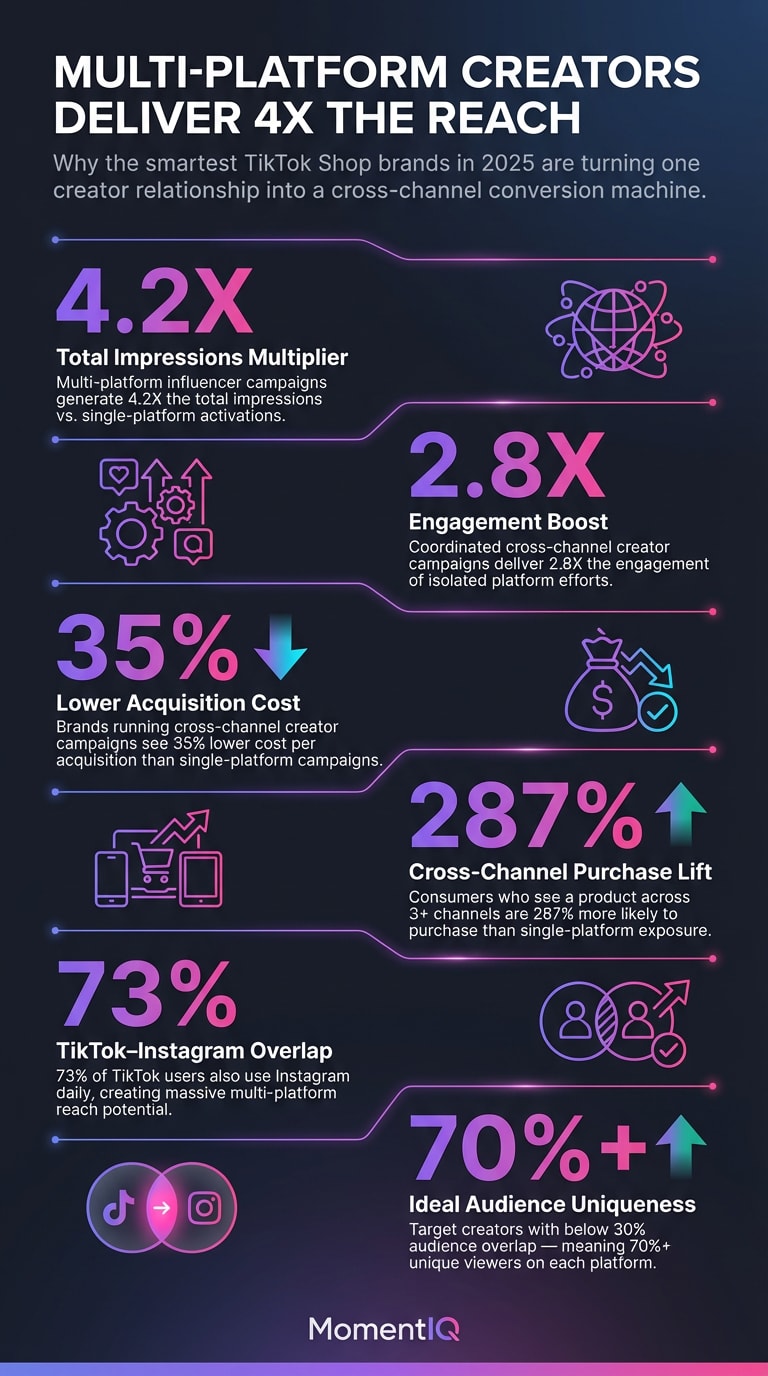
Here's the brutal truth about single-platform influencer campaigns: you're leaving 75% of your potential reach on the table.
- Negotiate multi-platform deals compensating creators without overspending with creators to achieve 4.2X total impressions and 2.8X engagement versus single-platform activations.
- Use TikTok Shop as your central conversion hub while leveraging Instagram and YouTube for awareness and trust-building.
- Structure cross-channel creator campaigns to reduce your cost per acquisition by up to 35% compared to isolated platform campaigns.
- Activate creators across TikTok, Instagram, and YouTube simultaneously amplify top creator content with Spark Ads to build a multi-touchpoint conversion funnel mirroring real buyer journeys.
- Maximize every creator relationship by tapping their full cross-platform audience, since 73% of TikTok users also use Instagram daily.
That creator you just partnered with for a TikTok Shop video? They probably have 80K followers on Instagram, a growing YouTube channel with 25K subscribers, and an audience that doesn't perfectly overlap across any of those platforms. Yet most brands negotiate a single TikTok deliverable, collect their views, and move on.
Meanwhile, the smartest TikTok Shop brands in 2025 are structuring multi-platform influencer deals that turn one creator relationship into a cross-channel awareness machine — with TikTok Shop sitting at the center as the conversion hub.

The results speak for themselves. According to a 2024 CreatorIQ report, multi-platform influencer campaigns generate 4.2X the total impressions and 2.8X the engagement compared to single-platform activations. A separate study by Influencer Marketing Hub found that brands running coordinated cross-channel creator campaigns saw a 35% lower cost per acquisition than those running isolated platform campaigns.
This isn't about spreading your budget thin. It's about maximizing the value of every creator relationship you build.
In this guide, you'll learn exactly how to negotiate multi-platform deals, structure contracts that protect your brand, price these partnerships correctly, and ensure TikTok Shop remains the revenue engine while Instagram and YouTube do the heavy lifting on awareness and trust-building.
Let's build your cross-channel creator empire.
Why a Multi-Platform Influencer Strategy Is Essential for TikTok Shop Brands in 2025

The consumer journey in 2025 is not linear, and it's definitely not contained to a single app.
Google's research on the "messy middle" of purchase decisions has evolved into something even more fragmented. Today's buyer might discover your product in a YouTube review, see it again in an Instagram Story, and finally convert through a TikTok Shop link — all within 48 hours. According to TikTok's own commerce research, 73% of TikTok users also use Instagram daily, and 44% regularly consume YouTube content.
Here's what that means for your brand: a creator who posts about your product on TikTok alone is only reaching a fraction of their total audience. And the audience segments on each platform behave differently:
- TikTok drives discovery and impulse purchases through short-form entertainment
- Instagram reinforces social proof and aspirational lifestyle positioning through Stories, Reels, and carousel posts
- YouTube builds deep trust and purchase confidence through long-form reviews and tutorials TikTok Shop versus YouTube Live
When you activate all three channels through a single creator, you're not just tripling impressions — you're engineering a multi-touchpoint conversion funnel that mirrors how real people actually shop.
The Cross-Channel Halo Effect on TikTok Shop Conversions
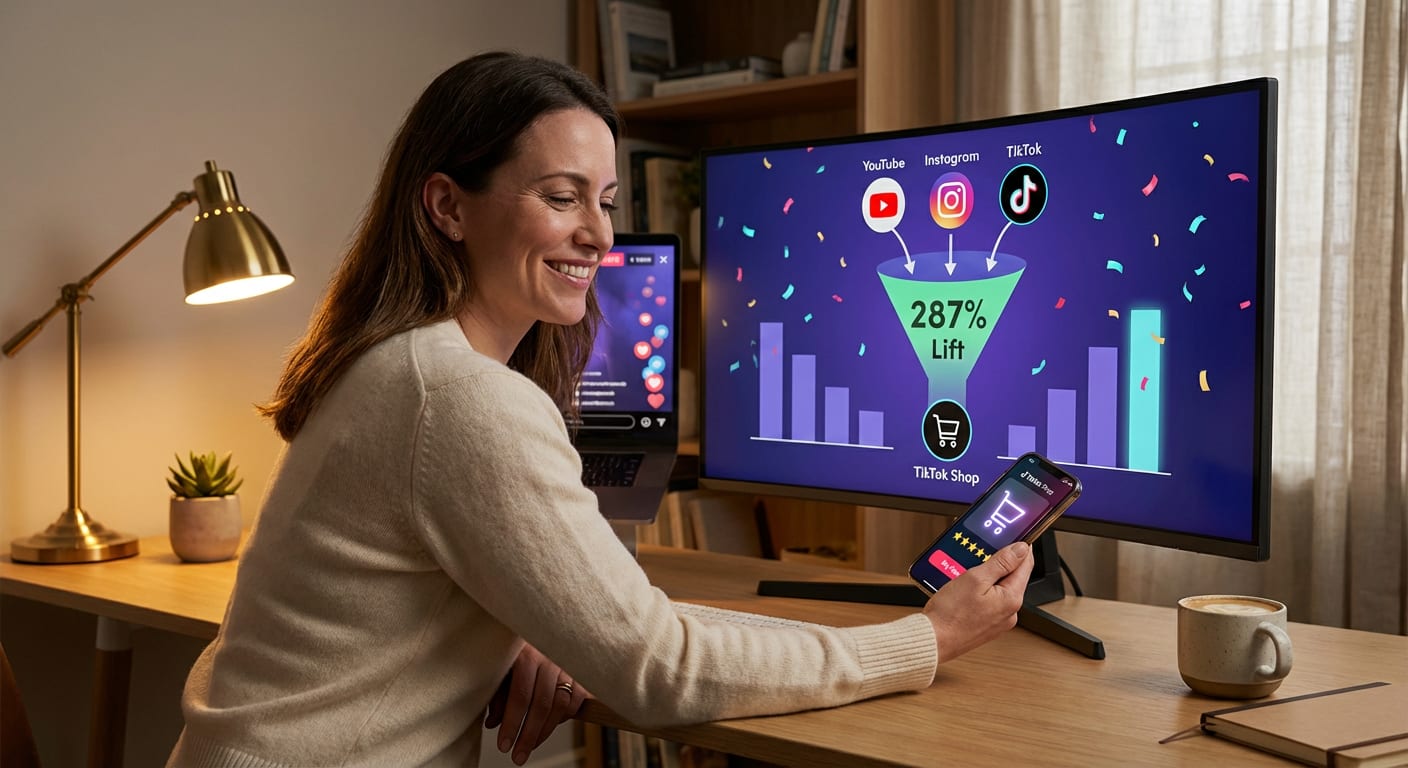
Here's a data point that should change how you think about creator partnerships forever: according to Nielsen's 2024 Trust in Advertising report, consumers who encounter a product recommendation across three or more channels are 287% more likely to purchase than those who see it on a single platform.
For TikTok Shop specifically, this creates what we call the cross-channel halo effect. When a potential buyer has already seen a YouTube review and an Instagram carousel before they encounter the TikTok Shop video, the conversion friction drops dramatically. They've already been pre-sold. The TikTok Shop link becomes the easy "yes" at the end of a trust-building journey.
This is why brands working with MomentIQ increasingly request multi-platform creator matching — because the algorithmic approach to finding the right creators becomes exponentially more powerful when you can identify creators with strong, complementary audiences across TikTok, Instagram, and YouTube simultaneously.
How to Identify Creators Who Can Deliver Across TikTok, Instagram, and YouTube
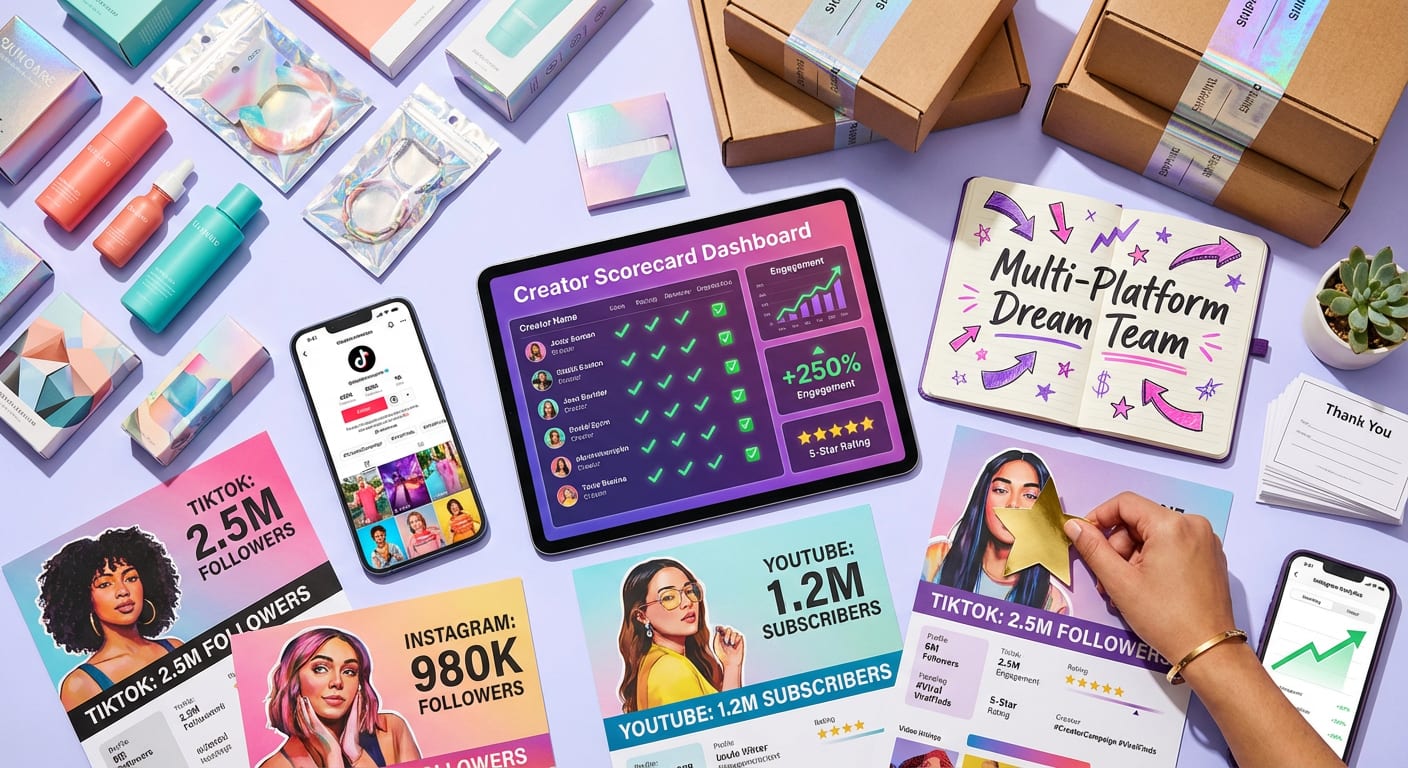
Not every creator is built for multi-platform campaigns. You need partners who are genuinely active and engaged across multiple channels — not someone with a dormant Instagram account they haven't posted on since 2022.
Here's the framework for evaluating multi-platform creator fit discover creators by niche category:
The Multi-Platform Creator Scorecard
Rate each potential creator across these five dimensions on a 1-5 scale:
Platform Activity Score: Are they posting consistently on all target platforms? Look for at least 3+ posts per week on TikTok, 4+ on Instagram (including Stories), and 2+ per month on YouTube.
Audience Overlap Analysis: You actually want low overlap between their platform audiences. Use tools like social listening platforms to estimate cross-platform audience duplication. Ideal overlap is below 30%, meaning 70%+ of the audience on each platform is unique.
Content Format Versatility: Can they create compelling short-form AND long-form content? A creator who makes incredible 30-second TikToks but can't hold attention for a 10-minute YouTube review won't deliver value across all channels.
Engagement Rate Parity: Check that engagement rates are healthy across all platforms. A creator with 5% engagement on TikTok but 0.3% on Instagram is effectively a single-platform creator with extra accounts.
Commerce Track Record: Have they driven sales before? Look for evidence of affiliate link usage, product tagging, discount code promotions, or TikTok Shop affiliate activity across any platform.
Target Score: 20+ out of 25 for premium multi-platform partnerships. Anything below 15 suggests you're better off with a single-platform deal.
Where to Find Multi-Platform Creators at Scale
Manually vetting creators across three platforms is painfully slow. This is where automation becomes critical.
For TikTok Shop affiliate recruitment specifically can help you automate outreach at scale, while MomentIQ's algorithmic creator matching identifies creators whose multi-platform profiles align with your brand's target demographics, content style, and commerce readiness.
The key is to start your search on TikTok (since that's your conversion hub), then cross-reference each promising creator's presence on Instagram and YouTube. Look for creators who:
- Link to all their platforms in their TikTok bio
- Repurpose content across channels (showing they understand multi-platform strategy)
- Have growing audiences on newer platforms (indicating momentum, not stagnation)
- Already participate in TikTok Shop's affiliate program
How to Structure Multi-Platform Creator Deals: Pricing Models That Work

This is where most brands get it wrong. They either try to get multi-platform deliverables for single-platform pricing (which insults creators and kills relationships) or they overpay by simply multiplying the single-platform rate by three (which destroys ROI).
The sweet spot is a bundled pricing model that rewards creators for the incremental effort while giving your brand a volume discount on the total package.
Three Proven Pricing Models for Cross-Channel Creator Partnerships

Model 1: The Platform-Weighted Bundle
Assign a weight to each platform based on its role in your funnel:
- TikTok (Conversion Hub): 50% of total budget
- YouTube (Trust Builder): 30% of total budget
- Instagram (Social Proof Amplifier): 20% of total budget
Example: If a creator's standard TikTok-only rate is $2,000 per video, your multi-platform bundle would be:
- TikTok video: $2,000 (base rate)
- YouTube integration (dedicated review or mention): $1,200 (60% of TikTok rate)
- Instagram package (Reel + 3 Stories): $800 (40% of TikTok rate)
- Total before bundle discount: $4,000
- Bundle discount (15-20%): -$700
- Final multi-platform package: $3,300
This gives the creator a 65% increase in total compensation for a multi-platform deal, while you get 3X+ the reach at only 1.65X the cost. Everyone wins.
Model 2: The Hybrid Commission Model
Pay a reduced flat fee plus performance-based commissions tied to TikTok Shop sales:
- Flat fee: 50-60% of standard single-platform rate (covers content creation costs)
- Commission: 15-25% on all TikTok Shop sales attributed to the creator across a 30-day window
- Bonus tier: Additional 5% commission if sales exceed a predetermined threshold
This model works exceptionally well because it aligns creator incentives with your TikTok Shop revenue goals. The Instagram and YouTube content becomes the creator's investment in driving more commission-generating traffic to TikTok Shop.
Model 3: The Content Licensing Package
Negotiate a multi-platform deal that includes content licensing rights:
- Creator fee: Standard rate + 25-40% premium
- What you get: Deliverables across all three platforms PLUS 90-day licensing rights to repurpose all content as paid ads
- Why it works: You can use the YouTube review as a long-form ad, the Instagram content as retargeting creative, and the TikTok video as a Spark Ad — multiplying your content's value exponentially
If you're already running TikTok Shop Video Shopping Ads (and you should be — check out our complete guide to Video Shopping Ads), licensed multi-platform content gives you a massive creative library to test and scale.
Contract Addendums for Multi-Platform Influencer Campaigns
Your standard influencer contract needs specific additions when you're running cross-channel creator partnerships. Here are the critical clauses to include:
Essential Multi-Platform Contract Addendums
1. Platform-Specific Deliverable Schedule
Spell out exactly what gets posted where and when. Timing matters enormously in multi-platform campaigns.
Sample Deliverable Schedule:
- Day 1: YouTube video published (long-form review, 8-15 minutes)
- Day 2: TikTok video published with TikTok Shop product link
- Day 2: Instagram Reel published (adapted from TikTok content)
- Days 2-4: Instagram Stories (3 minimum, including swipe-up/link sticker to TikTok Shop)
- Day 7: TikTok follow-up video (results, Q&A, or "still using it" update)
Why this sequence? YouTube goes first to build deep trust and search visibility. TikTok follows to capture the conversion moment when awareness is fresh. Instagram reinforces throughout the window.
2. Cross-Platform Linking Requirements
Specify that all platforms must drive traffic to TikTok Shop as the primary purchase destination:
- YouTube description must include TikTok Shop product link
- Instagram bio link or Stories link sticker must point to TikTok Shop listing
- TikTok video must use native TikTok Shop product tagging
- All platforms must use the assigned tracking links or discount codes
3. Content Consistency Clause
Require that core messaging and product claims remain consistent across all platforms while allowing the creator to adapt tone and format for each audience. Include:
- Mandatory talking points (3-5 key product benefits)
- Prohibited claims list
- Required disclosures (FTC compliance across all platforms)
- Brand asset usage guidelines
4. Performance Reporting Requirements
Creators must provide platform analytics within 7 and 30 days of posting:
- TikTok: Views, likes, comments, shares, product link clicks, Shop sales
- YouTube: Views, watch time, click-through rate on description links
- Instagram: Reach, engagement, Story views, link clicks
5. Exclusivity and Competitive Protection
Multi-platform deals warrant stronger exclusivity clauses. Specify:
- Category exclusivity period (typically 30-60 days across all platforms)
- Which competitor categories are restricted
- Whether the creator can promote competing products on platforms NOT included in your deal
The Multi-Platform Campaign Execution Framework: Step by Step
Here's the exact playbook for launching a cross-channel creator partnership with TikTok Shop as your conversion hub.
Step 1: Campaign Architecture (Week 1)
Define your campaign structure before reaching out to a single creator:
- Primary KPI: TikTok Shop revenue (this is non-negotiable — everything ladders up to sales)
- Secondary KPIs: Total cross-platform impressions, new TikTok Shop product page visits, email/SMS list growth
- Campaign duration: 14-30 days per creator activation
- Budget allocation: Follow the 50/30/20 platform weighting model
- Creator cohort size: Start with 3-5 multi-platform creators per campaign wave
Step 2: Creator Identification and Vetting (Week 2)
Use the Multi-Platform Creator Scorecard to build your shortlist. Prioritize creators who:
- Already have TikTok Shop affiliate experience
- Show authentic enthusiasm for your product category
- Have demonstrated commerce-driving ability on at least two platforms
- Maintain audience demographics that match your target buyer
Step 3: Outreach and Negotiation (Week 3)
Lead with value in your outreach. Multi-platform deals are attractive to creators because they represent higher total compensation and a more professional brand relationship. Frame it as a partnership, not a transaction.
Key negotiation tips:
- Present the full package upfront — don't start with a single-platform ask and try to "upsell" to multi-platform later
- Show the creator how the cross-platform approach benefits them — more content, more engagement, more affiliate commission potential
- Be flexible on creative execution — prescribe the strategy, not the exact creative. Creators know their audiences best
- Offer content licensing as a separate line item — don't try to bundle it in for free
Step 4: Product Seeding and Briefing (Week 4)
Send product with a comprehensive multi-platform brief that includes:
- Platform-specific content guidelines (what works on each channel)
- TikTok Shop linking instructions and affiliate setup
- Key messaging framework with required and optional talking points
- Visual brand guidelines adapted for each platform's format
- The posting schedule with specific dates and times
For a deeper dive on creating briefs that get exceptional content, check out our guide on building TikTok Shop creator briefs that actually get great content.
Step 5: Content Review and Approval (Week 5)
Review all content across all platforms before publishing. Look for:
- Message consistency across channels
- Proper TikTok Shop product linking
- FTC disclosure compliance on every platform
- Brand guideline adherence
- Accurate product claims
Pro tip: Approve TikTok content last, since it's your conversion piece. You want it to reflect any learnings from reviewing the YouTube and Instagram content first.
Step 6: Coordinated Launch and Amplification (Weeks 6-7)
Execute the posting schedule and immediately amplify top-performing content:
- Boost the TikTok video as a Spark Ad to extend reach to lookalike audiences
- Run the YouTube content as a pre-roll ad targeting your product category
- Promote the Instagram Reel through paid partnership ads
- Retarget viewers of YouTube and Instagram content with TikTok Shop ads
This amplification layer is where multi-platform campaigns truly separate from single-platform plays. You're creating a paid media surround-sound effect that makes your product feel omnipresent.
Step 7: Measurement and Optimization (Week 8+)
Analyze performance across all platforms using a unified attribution framework:
- Direct attribution: TikTok Shop sales from creator's affiliate link
- Assisted attribution: TikTok Shop sales that occurred within 7 days of a user viewing YouTube or Instagram content (tracked via UTM parameters and discount codes)
- Halo metrics: Organic TikTok Shop search volume lift, product page traffic increase, branded search growth
Multi-Platform Campaign Budget Templates by Brand Size
Here's how to allocate your multi-platform influencer budget based on your current TikTok Shop revenue:
Emerging Brand ($10K-$50K/month TikTok Shop revenue)
- Monthly multi-platform budget: $5,000-$15,000
- Creator tier: Micro-influencers (10K-100K followers)
- Number of creators per month: 3-5 multi-platform partners
- Average cost per multi-platform package: $1,500-$3,000
- Amplification budget: 30% of total (for Spark Ads and cross-platform boosting)
Growth Brand ($50K-$250K/month TikTok Shop revenue)
- Monthly multi-platform budget: $15,000-$50,000
- Creator tier: Mix of micro and mid-tier (50K-500K followers)
- Number of creators per month: 5-12 multi-platform partners
- Average cost per multi-platform package: $3,000-$8,000
- Amplification budget: 35% of total
Scale Brand ($250K+/month TikTok Shop revenue)
- Monthly multi-platform budget: $50,000-$150,000+
- Creator tier: Mid-tier to macro (100K-2M+ followers)
- Number of creators per month: 10-25+ multi-platform partners
- Average cost per multi-platform package: $5,000-$25,000
- Amplification budget: 40% of total
Common Mistakes That Kill Multi-Platform TikTok Shop Campaigns
Avoid these pitfalls that sabotage even well-planned cross-channel creator partnerships:
Mistake 1: Treating Every Platform Identically
The same script doesn't work across TikTok, Instagram, and YouTube. Each platform has different audience expectations, content formats, and algorithmic preferences. Your brief should provide platform-specific guidance while maintaining message consistency.
Mistake 2: Burying the TikTok Shop Link
If YouTube and Instagram content doesn't clearly direct viewers to TikTok Shop, you've built an awareness campaign with no conversion mechanism. Every piece of content across every platform needs a clear, friction-free path to your TikTok Shop listing.
Mistake 3: Launching All Content Simultaneously
Staggered posting creates a narrative arc. YouTube builds trust → TikTok captures the impulse purchase → Instagram reinforces social proof. Posting everything at once creates noise, not a funnel.
Mistake 4: Ignoring Platform-Specific Analytics
A video that gets 500K views on TikTok but zero product link clicks is not a success. Measure each platform against its role in the funnel: YouTube for watch time and link clicks, TikTok for Shop conversions, Instagram for reach and Story engagement.
Mistake 5: Negotiating Platforms Separately
Never approach a creator with "Hey, that TikTok did great — want to also post on Instagram?" This piecemeal approach costs more, creates inconsistent messaging, and signals that you don't have a cohesive strategy. Always negotiate the full multi-platform package upfront.
How to Measure True ROI on Multi-Platform TikTok Shop Influencer Campaigns
Single-platform ROI is straightforward: spend vs. sales. Multi-platform ROI requires a more sophisticated approach.
The Multi-Platform Attribution Framework
Tier 1 — Direct Revenue (easiest to measure):
- TikTok Shop affiliate sales directly attributed to the creator
- Sales using the creator's unique discount code (across all platforms)
- Click-through purchases from tracked UTM links
Tier 2 — Influenced Revenue (requires tracking infrastructure):
- New TikTok Shop visitors who arrived via YouTube or Instagram referral links within the campaign window
- Increase in organic TikTok Shop search for your brand or product name during the campaign period
- Lift in TikTok Shop conversion rate during the campaign window (indicating pre-sold traffic)
Tier 3 — Brand Equity Value (long-term measurement):
- Growth in branded search volume across Google and TikTok
- Increase in organic follower growth across your brand's social channels
- User-generated content inspired by the creator's campaign
- Email/SMS list growth attributed to campaign landing pages
The most successful TikTok Shop brands we've seen measure all three tiers and calculate a blended ROAS that accounts for both immediate sales and downstream revenue impact.
Why the Brands Winning on TikTok Shop Are Thinking Multi-Platform
The era of single-platform influencer marketing is ending. The brands that will dominate TikTok Shop in 2025 and beyond are the ones building integrated creator ecosystems where every partnership extends across channels, every piece of content reinforces the next, and every viewer touchpoint drives closer to a TikTok Shop conversion.
Consider this: a supplement brand running multi-platform creator campaigns could structure their strategy so that a YouTube "day in my life" video naturally features the product, the TikTok video shows a quick transformation or routine, and the Instagram Stories provide real-time updates and Q&A — all pointing to the same TikTok Shop listing. The viewer who sees all three isn't just aware; they're convinced.
This is the kind of strategic, full-funnel approach that MomentIQ specializes in. By leveraging algorithmic creator matching that evaluates creators across platforms — not just TikTok — MomentIQ helps brands identify the multi-platform partners who will drive the highest total ROI, negotiate deals that make financial sense, and execute campaigns that turn creator content into a cross-channel revenue engine.
Start Building Your Multi-Platform Creator Strategy Today
You now have the frameworks, pricing models, contract addendums, and execution playbook to launch multi-platform influencer campaigns that deliver 4X the reach while keeping TikTok Shop as your revenue engine.
But here's the reality: identifying the right multi-platform creators, negotiating bundled deals, coordinating cross-channel launches, and measuring blended attribution is complex work that requires specialized infrastructure and deep platform expertise.
That's exactly what MomentIQ was built for.
Talk to a Strategist and discover how our algorithmic creator matching, product seeding programs, and full-funnel commerce strategy can help you build a multi-platform creator engine that doesn't just generate impressions — it generates revenue.
Your competitors are already thinking beyond TikTok-only campaigns. The question is whether you'll lead or follow.