TikTok Shop Live vs Facebook Live Shopping
Compare TikTok Shop Live vs Facebook Live Shopping in 2025: revenue data, conversion rates, fees & our decision matrix to pick the best live selling platform fo
If you're a brand manager or DTC founder trying to figure out the best platform for live selling in 2025, you're facing a decision that will define your revenue trajectory for the next 12–24 months. And here's the uncomfortable truth most people won't tell you: one of these platforms is actively retreating from live commerce while the other is doubling down with billions in infrastructure investment.
- Shift your live commerce budget to TikTok Shop, which processed over $33 billion in global GMV in 2024 with 400% U.S. year-over-year growth.
- Stop investing in Facebook Live Shopping — Meta killed native checkout in 2022, forcing viewers off-platform and adding fatal purchase friction.
- Leverage TikTok's algorithm to reach non-followers; even brands with 5,000 followers can reach 50,000+ viewers per stream with strong engagement signals.
- Maximize real-time engagement signals like comments during live streams, as TikTok's algorithm compounds reach based on active viewer interaction.
- Target live commerce now — the U.S. market is projected to hit $55 billion by 2026, and TikTok Shop captures the dominant share.
The TikTok Shop live vs Facebook live shopping debate isn't even close anymore — but the why matters more than the headline. Algorithm reach, checkout friction, audience buying behavior, average order value, and monetization features all tell a story that should radically reshape where you invest your live commerce budget.
This isn't a fluffy "both platforms have pros and cons" piece. This is a data-backed, head-to-head breakdown with a decision matrix at the end so you can stop guessing and start scaling.
Already know TikTok Shop live is where you need to be but struggling with creator management, inconsistent GMV, or streams that flatline? Talk to a Strategist — we'll show you exactly where your live commerce revenue is leaking.
The State of Live Commerce in 2025: Where the Money Actually Flows
Live commerce is projected to generate $55 billion in U.S. revenue by 2026, according to Coresight Research. But that number masks a critical shift in where that revenue concentrates.
Here's what happened between 2023 and 2025:
- Meta officially shut down Facebook Live Shopping in October 2022 and has not reinstated native checkout functionality for live streams. Facebook Live still exists for engagement, but there is no integrated purchase flow — viewers must click out to external links.
- TikTok Shop processed over $33 billion in global GMV in 2024, with live commerce accounting for an estimated 30–40% of total platform transactions in key markets (Statista, 2024).
- TikTok's U.S. live commerce GMV grew over 400% year-over-year from 2023 to 2024, driven by native checkout, algorithmic discovery, and aggressive seller incentives.
The fundamental question of TikTok live commerce vs Facebook isn't really a comparison anymore — it's a lesson in platform commitment.Meta pivoted away from live shopping to focus on Reels monetization and AI. TikTok went all-in on building the most frictionless live-to-purchase experience in Western e-commerce.
But let's break it down dimension by dimension, because the details matter for your specific brand.
Algorithm Reach: Discovery vs. Distribution
TikTok Shop Live: The Algorithm That Sells for You
TikTok's algorithm is the single greatest distribution engine in social commerce history.Here's why it matters specifically for live selling:
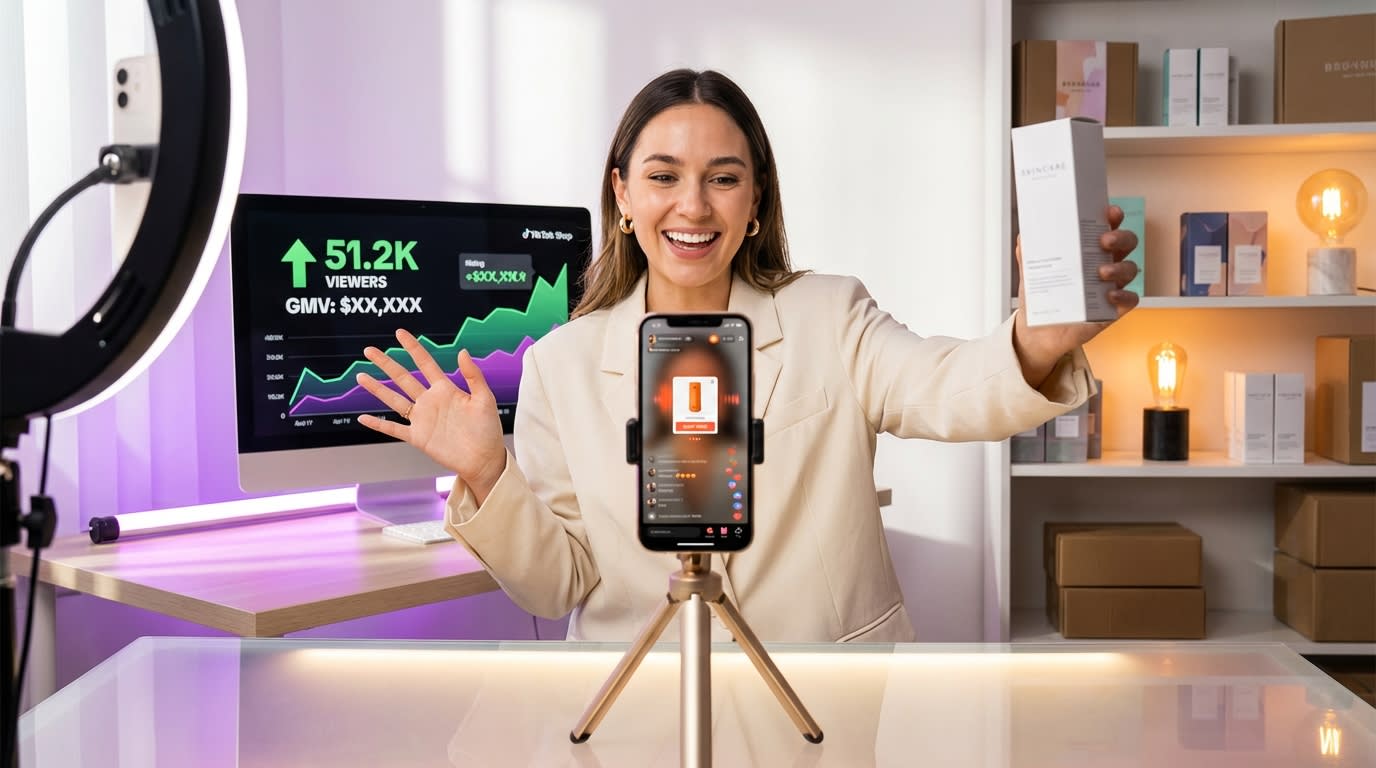
- TikTok actively pushes live streams to non-followers. The For You Page algorithm surfaces live rooms to users based on interest signals, not just follower relationships. A brand with 5,000 followers can reach 50,000+ viewers in a single stream if engagement signals are strong.
- Real-time engagement signals compound reach. Comments, shares, pin clicks, and purchases during a live stream trigger algorithmic amplification within minutes.The more people buy, the more people TikTok shows your stream to.
- TikTok's "shopping intent" signal layer prioritizes users who have previously browsed, carted, or purchased through TikTok Shop.Your live stream isn't just reaching random scrollers — it's being served to pre-qualified buyers.
According to TikTok's own commerce reports, live streams with native product links see 2–5x higher viewer retention than those without shoppable features. The algorithm literally rewards commerce-enabled content.
Facebook Live: Reach in Decline
Facebook Live still has distribution, but it's fighting headwinds:
- Organic reach on Facebook has declined to approximately 5.2% for brand pages (Hootsuite, 2024). Your live stream primarily reaches existing followers — and a shrinking percentage of them.
- No commerce-specific algorithmic boost. Since Facebook removed native live shopping, there's no purchase-intent signal layer. The algorithm treats your live stream like any other video content.
- Group-based distribution is the workaround, but it requires building and maintaining Facebook Groups — essentially creating your own distribution channel from scratch.

The verdict: TikTok's algorithm is a revenue multiplier. Facebook's algorithm is a reach limiter. For brands asking about the best platform for live selling in 2025, this single dimension often settles the debate.
Checkout Friction: The Revenue Killer Nobody Talks About
This is where the comparison becomes almost unfair.
TikTok Shop: Two Taps to Purchase
TikTok Shop's native checkout is integrated directly into the live stream experience:
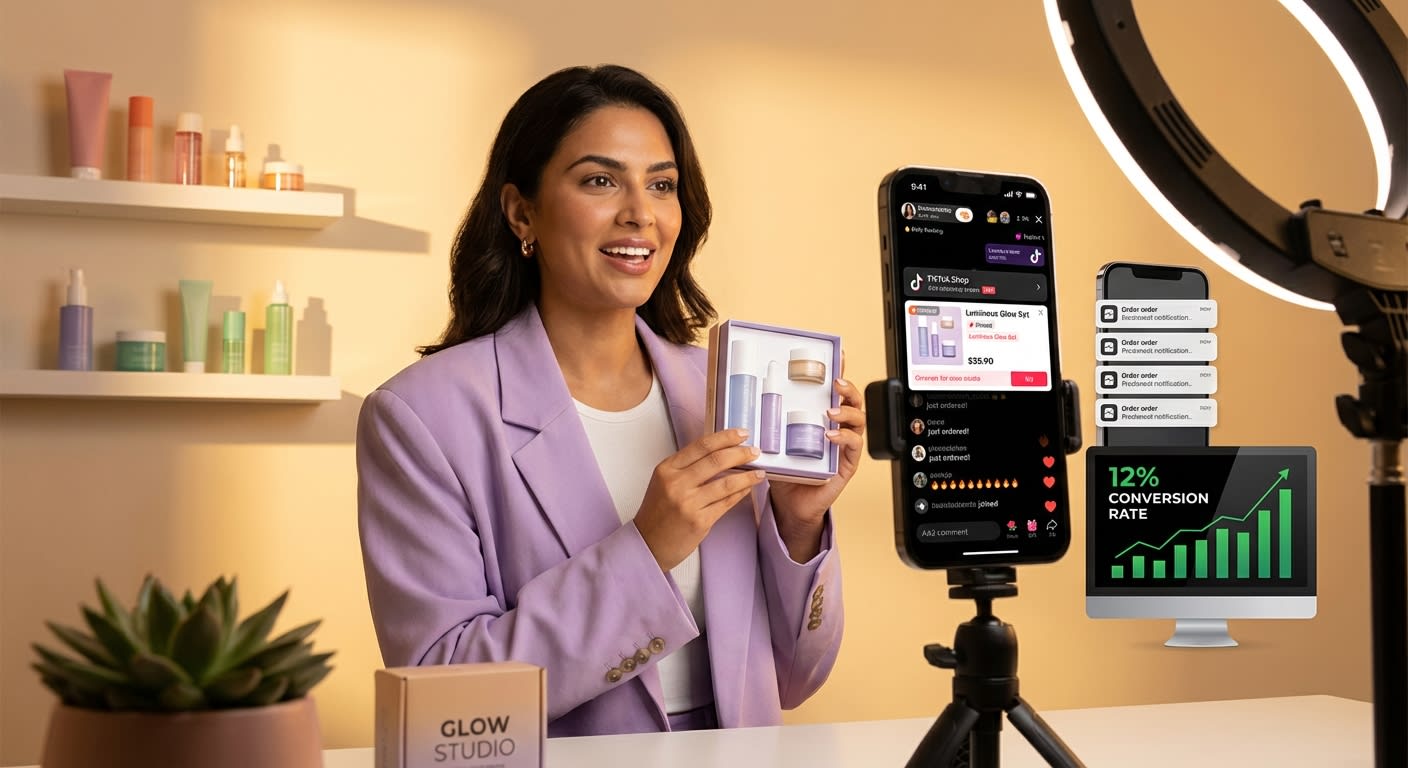
- Product pins appear on-screen during the stream.Viewers tap the pin, see product details, and purchase — all without leaving TikTok.
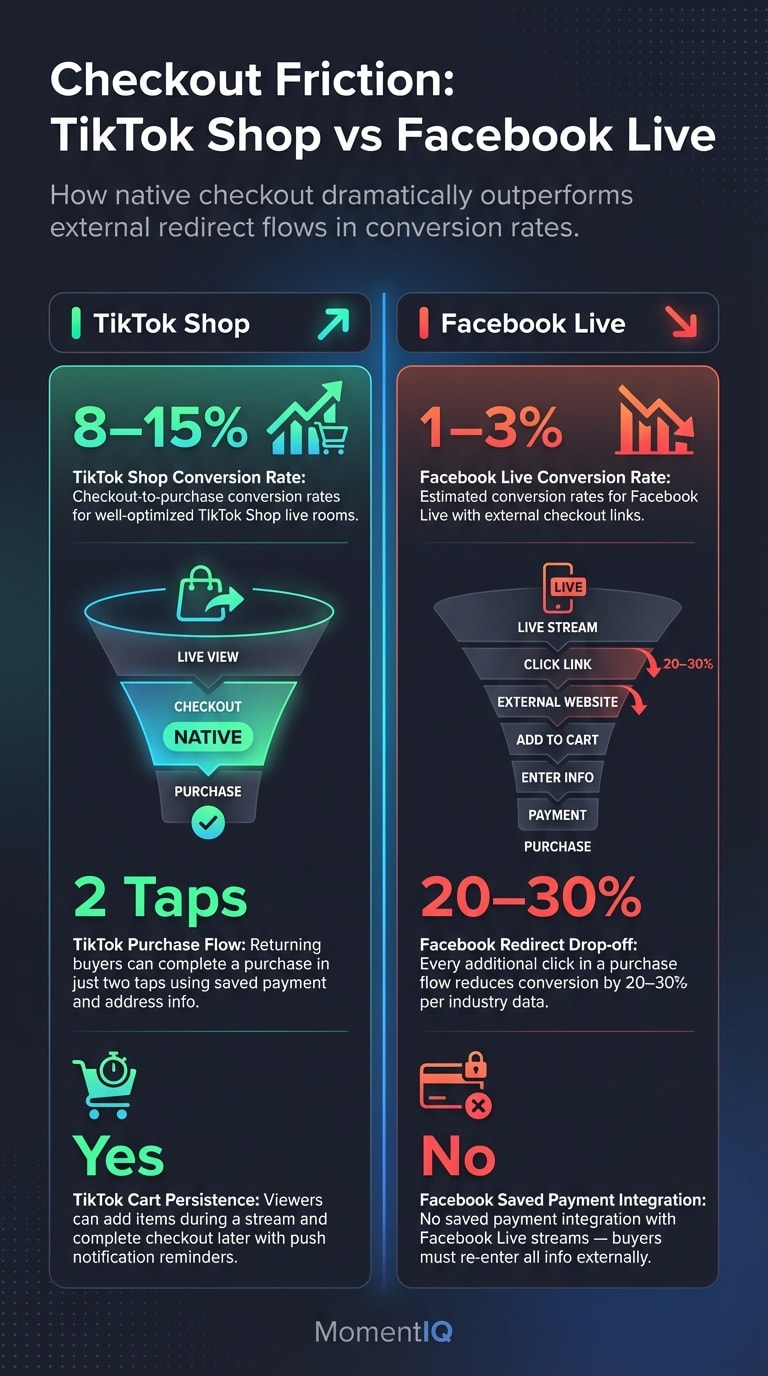
- Saved payment methods and TikTok Shop addresses mean returning buyers can complete a purchase in literally two taps.
- Cart persistence allows viewers to add items during a stream and complete checkout later, with TikTok sending push notification reminders.
- Estimated checkout-to-purchase conversion rates on TikTok Shop live streams range from 8–15% for well-optimized rooms, according to aggregated seller data from FastMoss analytics.
Facebook Live: The Redirect Problem
Without native checkout, Facebook Live sellers face a brutal reality:
- Viewers must click a link in comments or the description, which opens an external browser or app.
- Each redirect introduces a drop-off point. Industry data suggests that every additional click in a purchase flow reduces conversion by 20–30%.
- No saved payment integration with the live stream. Buyers must enter shipping and payment information on whatever external site they land on.
- Estimated conversion rates for Facebook Live with external checkout links hover around 1–3% — a fraction of TikTok's native experience.

Let that sink in: the same product, the same pitch, the same audience enthusiasm — but TikTok's native checkout can deliver 3–5x higher conversion rates simply because there's less friction between "I want this" and "I bought this."
This is the single biggest reason brands comparing TikTok Shop live vs Facebook live shopping overwhelmingly choose TikTok for revenue generation.
Audience Demographics: Who's Actually Buying?
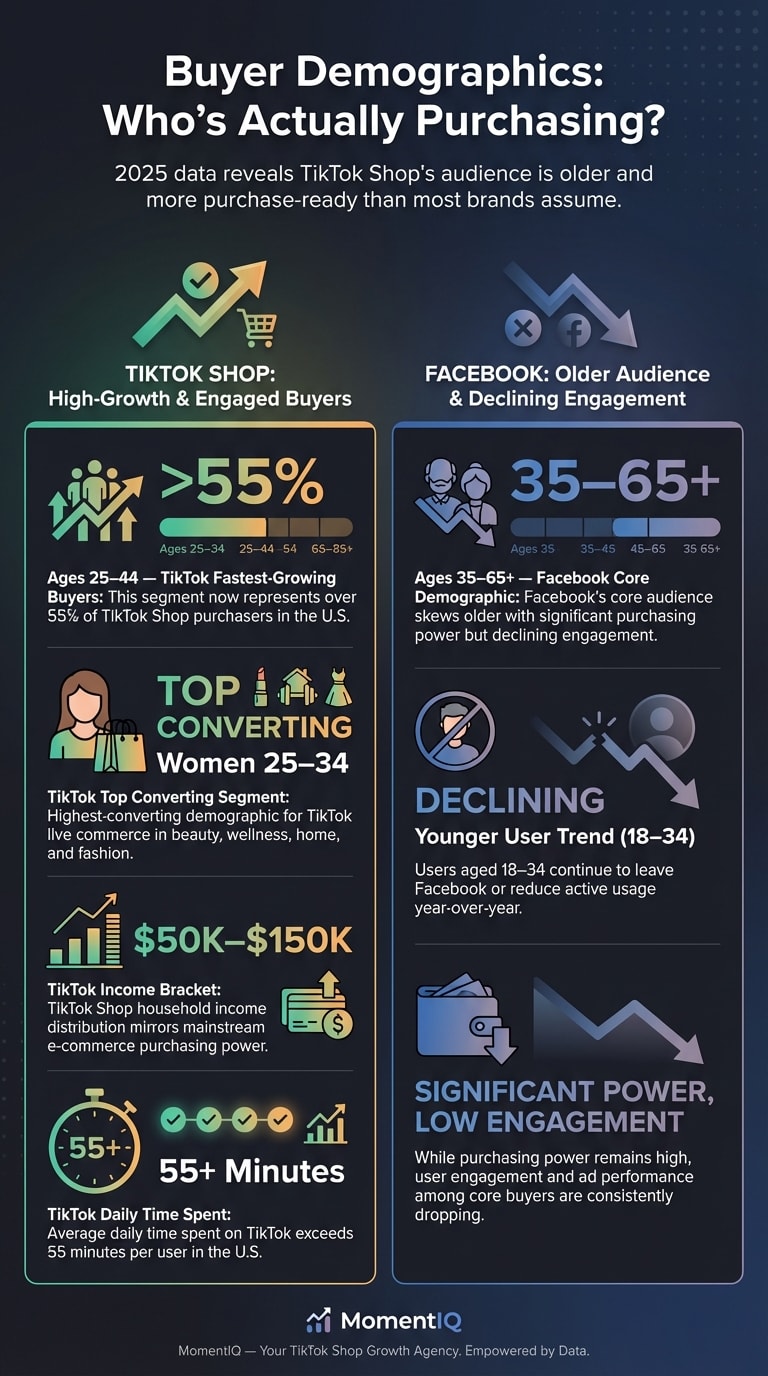
A common misconception is that TikTok is "just Gen Z" while Facebook has the "real buyers with money." The 2025 data tells a very different story.
TikTok Shop's Buyer Demographics in 2025
- The fastest-growing buyer segment on TikTok Shop is ages 25–44, which now represents over 55% of TikTok Shop purchasers in the U.S. (eMarketer, 2024).
- Household income distribution mirrors mainstream e-commerce, with significant purchasing power in the $50K–$150K income bracket.
- Women ages 25–34 are the highest-converting demographic for live commerce on TikTok, particularly in beauty, wellness, home, and fashion categories.
- TikTok has over 150 million monthly active users in the U.S. as of early 2025, with average daily time spent exceeding 55 minutes.
Facebook's Audience Reality
- Facebook's core demographic skews 35–65+, which does represent significant purchasing power.
- However, engagement rates have declined year-over-year, particularly for video content.
- Facebook Marketplace activity remains strong for local/secondhand commerce, but this is a different buying behavior than live commerce impulse purchasing.
- Younger demographics (18–34) continue to leave Facebook or reduce active usage, creating a shrinking pool of the impulse-buy-prone audience that live commerce depends on.
The key insight: TikTok's audience isn't just younger — it's more engaged and more conditioned to purchase within the app. Facebook's audience has purchasing power but lacks the behavioral conditioning for live commerce buying.
Average Order Value and Revenue Per Stream
Let's talk money.
TikTok Shop Live Revenue Benchmarks
- Average order value on TikTok Shop live streams ranges from $25–$65 depending on category, with beauty and wellness at the lower end and electronics/home goods at the higher end.
- Top-performing live rooms generate $5,000–$50,000+ per stream, with elite sellers consistently hitting six figures during promotional events.
- Revenue per viewer hour is the metric that matters most, and well-optimized TikTok live rooms average $2–$8 per concurrent viewer per hour — a metric that compounds dramatically with algorithmic reach.
One supplement brand working with MomentIQ scaled from $18K to $420K/month in 90 days by combining algorithmic creator matching with a structured live commerce strategy. That's not a typo — and it's not an outlier among brands that approach TikTok Shop live with the right infrastructure.
Facebook Live Revenue Reality
Without native checkout, Facebook Live revenue metrics are harder to track and significantly lower:
- Attribution is murky — sellers often can't directly tie a purchase to a specific live stream moment.
- Average revenue per stream for Facebook Live sellers (using external checkout) typically ranges from $200–$2,000 for small-to-mid brands.
- The exception is Facebook Group-based selling (particularly in collectibles, fashion resale, and boutique clothing), where loyal communities can drive meaningful revenue — but this model doesn't scale algorithmically.
Monetization Features: The Full Stack Comparison
Here's a side-by-side breakdown of the monetization infrastructure each platform offers live sellers in 2025:
| Feature | TikTok Shop Live | Facebook Live |
|---|---|---|
| Native in-stream checkout | ✅ Full integration | ❌ Removed in 2022 |
| Product pinning during stream | ✅ Multiple product pins | ❌ Not available |
| Affiliate/creator commission system | ✅ Built-in with tiered rates | ❌ No native system |
| Live-specific ad amplification | ✅ Live Shopping Ads (LSA) | ⚠️ Limited boost options |
| Flash sale/coupon tools | ✅ In-stream flash deals | ❌ Not available |
| Real-time analytics dashboard | ✅ GMV, CTR, conversion tracking | ⚠️ Basic viewer metrics only |
| Cart abandonment recovery | ✅ Push notifications + retargeting | ❌ Not available |
| Creator marketplace for live hosts | ✅ TikTok Creator Marketplace | ❌ No equivalent |
| Algorithmic discovery boost for live | ✅ Active prioritization | ❌ No commerce signal boost |
| Integrated shipping/fulfillment | ✅ TikTok Fulfilled by TikTok (FBT) | ❌ Not available |
This isn't a close comparison. TikTok has built a complete commerce operating system around live selling. Facebook has a video streaming tool with no commerce infrastructure.
The Objections You're Already Thinking (And Why They Don't Hold Up)
"TikTok Shop Is Too New — It's Risky to Go All-In"
TikTok Shop processed $33+ billion in global GMV in 2024. It's a TikTok Marketing Partner ecosystem with established fulfillment infrastructure, buyer protection programs, and enterprise-grade seller tools. "Too new" was a valid concern in 2022. In 2025, it's the fastest-growing commerce channel in North America.
The actual risk? Waiting. Brands building live commerce muscle on TikTok now are accumulating algorithmic advantages — follower bases, creator relationships, content libraries, and conversion data — that latecomers simply cannot replicate. Every month you delay, your competitors compound their head start.

"We Can Manage Live Commerce In-House"
You can — until you can't. Running one or two live streams per week with an internal team is manageable. But scaling to daily streams, managing 50+ affiliate creators doing live selling on your behalf, optimizing product pins in real-time, and analyzing conversion data across hundreds of sessions? That's where in-house teams break.
The math is simple: a single experienced live commerce manager costs $60K–$90K/year in salary alone. They can realistically manage 3–5 creator relationships and 5–10 streams per week. An agency like MomentIQ deploys algorithmic creator matching and managed product seeding at scale — activating hundreds of creators simultaneously while optimizing every stream for conversion. The ROI gap between DIY and scaled infrastructure isn't 10–20%. It's often 5–10x.
"We've Tried Agencies Before and Got Burned"
Most agencies that claim to "do TikTok" are really Instagram influencer agencies who added TikTok as a line item. They don't understand TikTok Shop's unique mechanics — the affiliate commission structures, the algorithm's commerce signals, the live room optimization levers, or the creator compensation models that actually retain top performers.
MomentIQ is a TikTok Shop Partner of the Year and TikTok Marketing Partner — not a generic social media agency that dabbles in short-form video. The difference shows up in results: one beauty brand scaled from $12K to $340K/month in 90 days using MomentIQ's creator matching system and live commerce playbooks. That kind of outcome requires TikTok-native expertise, proprietary data, and infrastructure that generalist agencies simply don't have.
"We Don't Have the Budget for an Agency"
Consider the cost of not scaling. If your TikTok Shop is generating $15K/month and you know the platform can support $150K+, every month at $15K represents $135K in unrealized revenue. Over a quarter, that's $405K left on the table.
The brands crushing it on TikTok Shop don't view agency investment as an expense — they view it as the lever that unlocks revenue they physically cannot access with their current team size. The question isn't whether you can afford an agency. It's whether you can afford the opportunity cost of not having one.
The Decision Matrix: Which Platform Is Right for Your Brand?
Not every brand has the same starting point. Here's a practical decision matrix based on brand type, category, and goals:
Choose TikTok Shop Live If:
- ✅ You sell physical products in beauty, wellness, fashion, home, food, supplements, fitness, or electronics
- ✅ Your average price point is $10–$150 (the sweet spot for impulse live commerce purchases)
- ✅ You want algorithmic discovery to drive new customer acquisition, not just sell to existing followers
- ✅ You're willing to invest in creator-led live selling (either hosting yourself or activating affiliate creators)
- ✅ You want full attribution from impression to purchase within a single platform
- ✅ You're building a scalable commerce channel, not just running occasional promotional events
- ✅ You want access to Live Shopping Ads to amplify high-performing streams with paid media
Consider Facebook Live (With Heavy Caveats) If:
- ⚠️ You have an existing, highly engaged Facebook Group with 10,000+ active members
- ⚠️ Your audience skews 45+ and is not active on TikTok
- ⚠️ You sell high-consideration, high-ticket items ($500+) where the live stream is educational/consultative and the purchase happens later via your website
- ⚠️ You're using live video purely for brand awareness and community building, not direct revenue
- ⚠️ You're in a local/regional business where Facebook's local reach still has relevance
The Hybrid Approach (And Why TikTok Should Still Lead)
Some brands simulcast to both platforms. This can work for awareness, but your commerce infrastructure should be built on TikTok Shop. Here's why:
- Revenue attribution only works where native checkout exists (TikTok)
- Creator affiliate programs only function within TikTok's ecosystem
- Algorithm amplification based on purchase signals only happens on TikTok
- Your live commerce team's optimization efforts should focus on the platform that actually converts
Simulcast for reach. Optimize for TikTok. Monetize through TikTok Shop.
Why the Window Is Narrowing (And What Smart Brands Are Doing Right Now)
Here's what most sellers miss about live commerce in 2025: the competitive landscape is compounding, not linear.
Brands that started building their TikTok Shop live presence in 2023–2024 now have:
- Established creator networks with proven conversion data
- Algorithmic momentum — TikTok's algorithm rewards accounts with consistent live commerce history
- Content libraries of live stream clips being repurposed as short-form video shopping ads
- Customer data from thousands of in-app transactions, enabling retargeting and repeat purchase flows
- Operational playbooks refined over hundreds of streams
Every one of those advantages takes time to build and cannot be purchased overnight. The brands starting today are already 12–18 months behind the leaders. The brands starting in six months will be 18–24 months behind.
This is the compounding cost of delay in live commerce. It's not just lost revenue today — it's a widening competitive gap that becomes exponentially harder to close.
If you're reading this and feeling the urgency, that's the right instinct. Talk to a Strategist and get a custom scaling roadmap for your brand's TikTok Shop live commerce program. We'll show you exactly where you stand relative to competitors in your category and what it takes to close the gap.
How MomentIQ Helps Brands Win the TikTok Shop Live Commerce Race
Let's be direct about what makes MomentIQ different from every other agency claiming to "help with TikTok."
Algorithmic Creator Matching (Not Manual Outreach)
Most agencies assign a junior coordinator to manually scroll through TikTok profiles and send DMs. MomentIQ uses proprietary algorithmic matching to identify creators based on audience overlap, content style, engagement quality, and — critically — historical conversion performance on TikTok Shop.
This isn't influencer marketing. This is commerce-optimized creator activation powered by data that generic agencies don't have access to.
Our Reacher platform (reacherapp.com) automates creator outreach at scale, enabling brands to build pipelines of 100+ qualified creators per month — something that would take an in-house team months to replicate manually.
Product Seeding at Scale
Getting products into creators' hands is one of the biggest operational bottlenecks in TikTok Shop. MomentIQ manages the entire product seeding pipeline — from creator vetting and address collection to shipment tracking and content verification. We've built the infrastructure to seed products to hundreds of creators simultaneously without the logistical chaos that buries in-house teams.
Full-Funnel Commerce Support
MomentIQ doesn't just find creators and walk away. We provide:
- Live commerce strategy and stream optimization
- Affiliate commission structure design (with P&L modeling)
- Content-to-conversion gap analysis
- TikTok Shop ad amplification for high-performing live streams and creator content
- Real-time analytics and KPI dashboards
The Credentials That Matter
- TikTok Shop Partner of the Year — awarded by TikTok to the top-performing agency partner
- TikTok Marketing Partner — official recognition of platform expertise and performance
- FastMoss Visionary Award — recognized for innovation in TikTok commerce analytics
These aren't self-awarded badges. They're platform-verified credentials that reflect consistent, measurable results for the brands we work with.
The Bottom Line: TikTok Shop Live vs Facebook Live Shopping in 2025
Let's summarize the TikTok live commerce vs Facebook comparison with brutal honesty:
| Dimension | Winner | Margin |
|---|---|---|
| Algorithm reach & discovery | TikTok Shop | Overwhelming |
| Checkout friction | TikTok Shop | Decisive |
| Audience buying behavior | TikTok Shop | Significant |
| Average order value | Comparable | Slight edge to Facebook for high-ticket |
| Monetization features | TikTok Shop | No contest |
| Platform investment in live commerce | TikTok Shop | Facebook has exited |
| Creator/affiliate ecosystem | TikTok Shop | Overwhelming |
| Analytics & attribution | TikTok Shop | Decisive |
Facebook Live is a video engagement tool. TikTok Shop Live is a revenue engine.
If your goal is community engagement with an older demographic, Facebook Live still has a role. If your goal is building a scalable, measurable, high-converting live commerce channel — there is only one serious option in 2025.
The brands that recognized this 12 months ago are now generating six and seven figures monthly through TikTok Shop live commerce. The brands recognizing it today still have time to build meaningful market position. The brands that wait another quarter? They'll be playing catch-up against entrenched competitors with algorithmic advantages that compound daily.
Ready to Build Your TikTok Shop Live Commerce Engine?
Stop debating platforms and start scaling revenue. Talk to a Strategist and get:
- A category-specific competitive analysis showing where you stand vs. competitors on TikTok Shop
- A custom creator matching strategy identifying the exact creator profiles that will drive conversions for your products
- A live commerce scaling roadmap with projected GMV milestones and the infrastructure needed to hit them
- ROI modeling so you can see the revenue impact before you invest a dollar
The window for building first-mover advantage in TikTok Shop live commerce is open right now. But it won't stay open forever. The brands that move today will own the algorithmic advantages that latecomers simply can't replicate.