TikTok Shop Product Photography & Video Thumbnails
Discover 15 proven TikTok Shop visual optimization secrets for product photos & video thumbnails that 3X your click-through rate. Stop the scroll & boost sales.
Your product is great. Your price is competitive. Your reviews are solid.
- Replace white-background hero images with lifestyle shots to achieve up to 2.1x higher click-through rates on TikTok Shop listings.
- Design thumbnails for 0.3-second scroll decisions — if your product image looks like an ad, users will instinctively skip it.
- Use lifestyle imagery for beauty, fashion, and home décor, but lead with clean studio shots for electronics and supplements requiring quick product clarity.
- A/B test your hero images since only 12% of sellers do, creating a major competitive advantage for those who optimize visuals.
- Optimize visuals before scaling ad spend — products with optimized hero images see 2.8x to 3.4x higher CTR versus standard manufacturer photos.
So why is nobody clicking?
Here's the uncomfortable truth most TikTok Shop sellers refuse to confront: your product images and video thumbnails are killing your conversion pipeline before it even starts. In a feed-driven commerce environment where users make split-second scroll-or-stop decisions, your visual merchandising isn't just "nice to have" — it's the single highest-leverage variable between a $15K month and a $150K month.
According to TikTok's own Commerce Insights report, products with optimized hero images see 2.8x to 3.4x higher click-through rates compared to listings using standard manufacturer photos. That's not a marginal improvement. That's the difference between profitability and burning through ad spend wondering why your ROAS keeps cratering.
If you've already dialed in your product listing copywriting and your affiliate program structure, but your GMV is still inconsistent, the visual layer is almost certainly where you're leaking revenue.
Let's fix that. Here are 15 visual optimization secrets — drawn from category-specific benchmarks, mobile UX research, and the patterns we see across hundreds of TikTok Shop listings at MomentIQ — that will transform your click-through rate.
Why TikTok Shop Product Photography Is Different From Every Other Platform
Before we dive into tactics, you need to understand something fundamental: TikTok Shop is not Amazon. It's not Shopify. It's not Instagram Shopping.
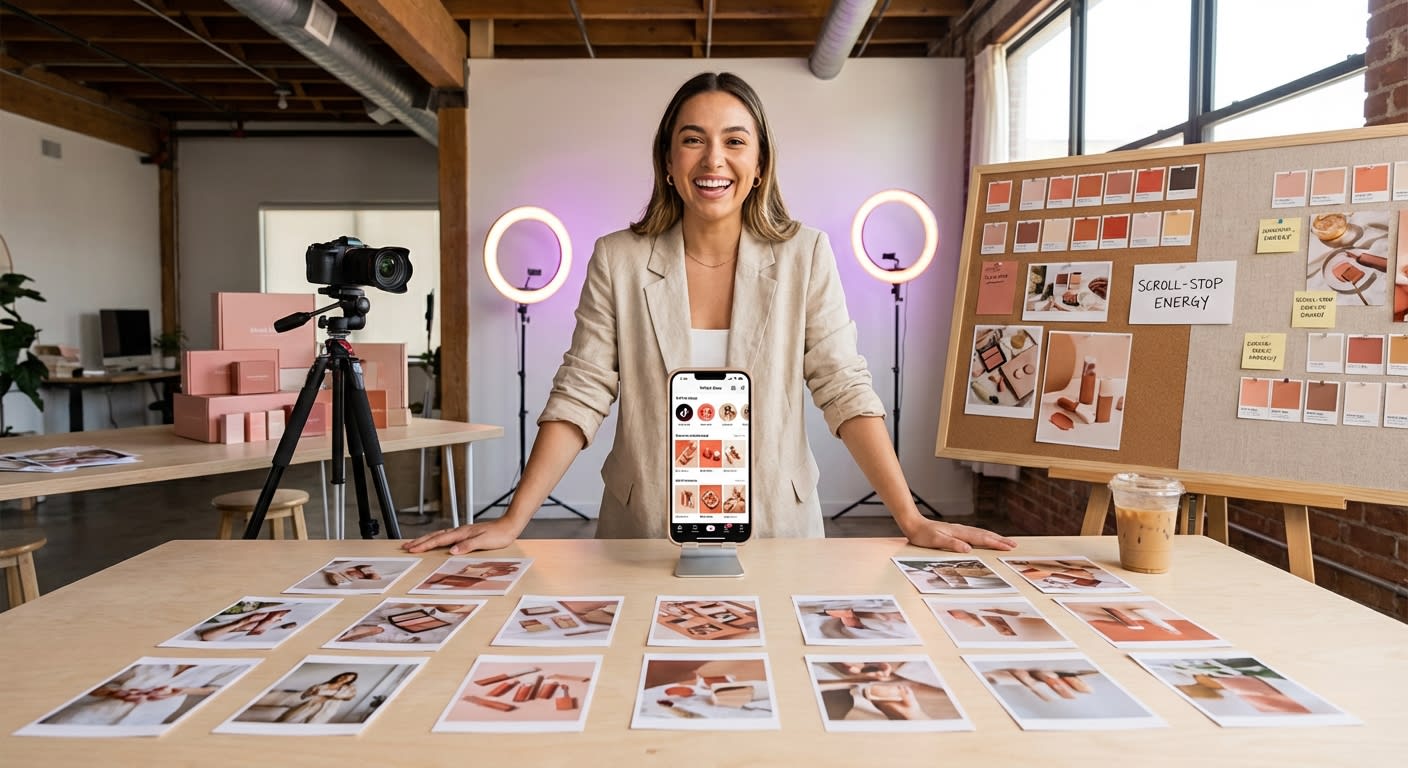
The visual rules that work on traditional e-commerce platforms will actively hurt you here. Why?
- Discovery is algorithmic, not search-driven. Your product appears in feeds, live streams, and creator content — not on a search results page where users are already intent-qualified.
- The viewing context is vertical, mobile-first, and fast. Users are scrolling at speed.You have roughly 0.3 seconds to earn a thumb-stop.
- Social proof is baked into the visual layer. TikTok Shop thumbnails compete directly with organic content.If your product image looks like an ad, users scroll past it instinctively.
A 2024 Statista report on social commerce found that 67% of TikTok users have purchased a product they discovered through the platform's feed, compared to just 41% on Instagram. But that same data shows that the gap between top-performing and average product listings is widening — the best visuals capture disproportionate attention, while generic imagery gets buried.
This is the visual merchandising gap.And it's where the biggest untapped opportunity sits for brands serious about scaling on TikTok Shop.
Secret #1: Lead With Lifestyle, Not Studio — But Know When to Break This Rule
The single most impactful change most sellers can make? Replace your sterile white-background hero image with a lifestyle shot that shows the product in context.
TikTok's internal merchandising guidelines recommend lifestyle-forward imagery because it mirrors the native content experience. A skincare serum photographed on a marble bathroom counter with morning light outperforms the same serum floating on white space by an average of 2.1x in click-through rate, according to aggregated TikTok Shop category benchmarks.
But here's the nuance most guides miss: certain categories actually perform better with clean studio shots as the hero image. Electronics, supplements, and anything with complex packaging benefit from clarity-first imagery where users need to quickly understand what the product is.
The rule of thumb:
- Beauty, fashion, home décor, food & beverage → lifestyle hero
- Supplements, electronics, tools, accessories → studio hero with lifestyle in slots 2-3
Pro tip: Test both.Which brings us to Secret #2.
Secret #2: A/B Test Your Hero Image Ruthlessly (Most Sellers Never Do This)
Here's what most sellers get wrong: they upload their product images once and never touch them again.
The brands crushing it on TikTok Shop treat their hero image like a landing page headline — something that gets tested, iterated, and optimized continuously.
TikTok Shop's native listing tools allow you to swap hero images and track performance shifts. Yet according to a 2024 eMarketer survey of social commerce sellers, only 12% regularly A/B test their product imagery. That means 88% of your competitors are leaving massive CTR gains on the table.
Here's a simple testing framework:
- Week 1-2: Run your current hero image as the control
- Week 3-4: Swap to a lifestyle variant and compare CTR
- Week 5-6: Test a UGC-style hero (more on this in Secret #5)
- Week 7+: Lock in the winner, then test secondary image slots
One home goods brand working with MomentIQ increased their product page visit rate by 187% simply by testing four hero image variants over six weeks. The winning image? A close-up lifestyle shot with warm lighting and a human hand in frame — not the professionally styled flat lay they'd assumed would win.
Secret #3: Optimize for the Thumbnail Grid, Not the Product Page
Most of your potential customers will never reach your product page. They'll see your product as a tiny thumbnail in the Shop tab, in a creator's product showcase, or in a search results grid.
This means your TikTok Shop thumbnail optimization strategy needs to prioritize legibility at small sizes.
Key rules for thumbnail-first design:
- Use high contrast between product and background. Low-contrast images disappear in the grid.
- Keep the product occupying 60-80% of the frame. Too much negative space makes it unrecognizable at thumbnail scale.
- Avoid text overlays smaller than 24pt. If you can't read it on a phone screen at arm's length, remove it.
- Use a single focal point. Multiple products in one thumbnail create visual confusion.
Bold, simple, high-contrast thumbnails consistently outperform complex compositions by 40-60% in grid click-through rate across TikTok Shop categories, based on aggregated performance data from FastMoss analytics.
Secret #4: The 3-Second Video Thumbnail Rule
For video-based product listings and affiliate content, your video thumbnail is arguably more important than the video itself.
TikTok's algorithm evaluates early engagement signals — including click-through from the thumbnail — to determine distribution. A weak thumbnail doesn't just cost you one click; it costs you algorithmic reach across the entire lifecycle of that content.
The highest-performing video thumbnails follow what we call the 3-Second Rule:
- Second 1: Pattern interrupt. The thumbnail must break the scroll pattern. Bold colors, unexpected compositions, or expressive human faces work best.
- Second 2: Promise. The viewer must instantly understand what they'll get from watching. "Before/after," "unboxing," or "transformation" visual cues signal value.
- Second 3: Curiosity gap. The thumbnail should create a question the viewer needs answered. Show a result without revealing the method.
This is exactly why creator selection matters as much as visual strategy. The best thumbnail in the world means nothing if the creator's content doesn't convert viewers into buyers. If you're struggling with creator-content alignment, Talk to a Strategist — our algorithmic creator matching system pairs your products with creators whose content style and audience demographics are proven converters in your category.
Secret #5: UGC-Style Product Images Outperform Polished Shots (With One Critical Caveat)
TikTok's entire ecosystem is built on authenticity. So it shouldn't surprise you that product images styled to look like user-generated content consistently outperform traditional e-commerce photography on the platform.
A 2023 TikTok for Business report found that ads using UGC-style creative saw 27% higher ad recall and 2.1x higher engagement compared to polished brand creative. This principle extends directly to product listing imagery.
What "UGC-style" means for product photography:
- Natural lighting (not studio strobes)
- Real environments (kitchen counters, bathroom shelves, gym bags)
- Imperfect compositions (slightly off-center, casual angles)
- Human elements (hands holding products, products in use)
The critical caveat: UGC-style doesn't mean low quality. Your images still need to be sharp, well-lit, and high-resolution. The goal is to look authentic, not amateur. There's a significant difference — and the brands that nail this distinction see the biggest CTR gains.
Secret #6: Color Psychology Drives Thumb-Stops More Than You Think
In a feed dominated by cool blues and neutral tones, warm colors create disproportionate visual interruption.
Analysis of top-performing TikTok Shop listings across beauty, wellness, and home categories reveals a clear pattern:
- Orange and coral tones in product imagery correlate with 35-45% higher thumb-stop rates
- Deep jewel tones (emerald, sapphire) perform well in premium/luxury positioning
- Neon accents work for Gen Z-targeted products but can feel off-brand for older demographics
- All-white imagery consistently underperforms in the feed (it blends into TikTok's UI)
The actionable insight: If your product itself is neutral-colored, use your background, props, and styling to introduce color contrast. A beige supplement bottle photographed against a rich terracotta background will dramatically outperform the same bottle on white.
Secret #7: The "Scroll-Stop Stack" — Optimizing All Five Image Slots
Most TikTok Shop sellers obsess over the hero image and neglect slots 2 through 5. This is a mistake.
Your image stack tells a visual story, and each slot serves a specific psychological function:
| Slot | Purpose | Best Practice |
|---|---|---|
| Slot 1 (Hero) | Thumb-stop & click driver | Lifestyle or UGC-style, high contrast |
| Slot 2 | Product clarity | Clean shot showing full product, packaging, size reference |
| Slot 3 | Social proof / results | Before/after, testimonial overlay, or "as seen on TikTok" badge |
| Slot 4 | Feature breakdown | Infographic-style with key benefits called out |
| Slot 5 | Trust & credibility | Certifications, ingredient lists, comparison charts |
Brands that optimize all five slots see 22-30% higher add-to-cart rates compared to those using only 2-3 images, according to TikTok Shop's seller education resources.
Secret #8: Mobile-First Composition Rules That Most Photographers Ignore
Here's a stat that should reshape your entire visual strategy: 93% of TikTok users access the platform exclusively on mobile devices (DataReportal, 2024).
Yet most product photography is still shot, edited, and reviewed on desktop monitors. This creates a dangerous disconnect.
Mobile-first TikTok Shop product images best practices:
- Shoot and review in vertical orientation (9:16 or 1:1). Never crop a horizontal image down — it always looks compromised.
- Place key visual elements in the center 70% of the frame. TikTok's UI overlays (price badges, shop icons, engagement buttons) eat into the edges.
- Increase font sizes on any text overlays by 40% compared to what looks good on desktop.
- Test every image by viewing it on your phone at arm's length. If the product isn't immediately identifiable, the composition needs rework.
This is one of the most common mistakes we see brands making when they try to manage TikTok Shop visuals in-house. Desktop-optimized imagery gets uploaded to a mobile-first platform, CTR suffers, and the team blames the algorithm instead of the asset. If your click-through rates are stagnant despite strong products, Talk to a Strategist — we'll audit your visual merchandising alongside your creator strategy and ad performance to identify exactly where revenue is leaking.
Secret #9: Category-Specific Visual Benchmarks You Should Be Tracking
Not all TikTok Shop categories play by the same visual rules. What works in beauty will fail in electronics, and what converts in fitness will flop in home décor.
Here are category-specific visual benchmarks based on aggregated TikTok Shop performance data:
Beauty & Skincare
- Hero image: Close-up texture shot or application moment (not just the bottle)
- CTR benchmark: Top 10% listings achieve 4.2%+ CTR
- Key differentiator: Before/after imagery in slot 3 increases conversion by 38%
Health & Supplements
- Hero image: Clean product shot with ingredient callouts
- CTR benchmark: Top 10% listings achieve 3.1%+ CTR
- Key differentiator: Certification badges and clinical study references in imagery boost trust signals
Fashion & Accessories
- Hero image: On-body lifestyle shot (never flat lay as hero)
- CTR benchmark: Top 10% listings achieve 3.8%+ CTR
- Key differentiator: Multiple angle shots showing fit and scale dramatically reduce return rates
Home & Kitchen
- Hero image: Product in a styled room setting
- CTR benchmark: Top 10% listings achieve 2.9%+ CTR
- Key differentiator: Scale reference images (product next to common household items) increase add-to-cart by 25%
If you're not benchmarking against category-specific standards, you're optimizing blind. Generic "best practices" will only get you to average. Category intelligence gets you to the top 10%.
Secret #10: Text Overlays — The Fine Line Between Helpful and Harmful
Text on product images is one of the most debated topics in TikTok Shop optimization. Here's what the data actually says:
Strategic text overlays can increase CTR by 15-25% — but only when they follow strict rules:
- Maximum 5-7 words. Anything more creates cognitive overload at scroll speed.
- Use benefit-driven language, not feature language. "Clears skin in 7 days" beats "Contains 2% salicylic acid."
- High-contrast text with subtle drop shadows. Ensure legibility against any background.
- Never cover more than 20% of the image. TikTok's content policies can flag overly text-heavy images, and users perceive them as ads.
Effective text overlay examples:
- ✅ "#1 Best Seller" (social proof)
- ✅ "As Seen on TikTok" (platform-native credibility)
- ✅ "30-Day Results" (outcome promise)
- ❌ "Premium Quality Organic Cold-Pressed Vitamin C Serum With Hyaluronic Acid" (information overload)
Secret #11: The "Unboxing Frame" Thumbnail Strategy for Video Content
For affiliate and brand-created video content, one thumbnail framework consistently outperforms all others: the unboxing frame.
This is a carefully selected (or custom-designed) thumbnail that shows the product partially revealed — emerging from packaging, being unwrapped, or held up for the first time.
Why it works: The unboxing frame triggers two powerful psychological mechanisms simultaneously:
- Curiosity — "What's inside? Is it worth it?"
- Vicarious excitement — The viewer experiences the dopamine hit of receiving something new
TikTok's algorithm rewards thumbnails that drive high click-through, and unboxing frames consistently achieve 1.8-2.4x higher CTR than static product thumbnails for video content.
The key to making this work at scale? Briefing your affiliate creators with specific thumbnail guidance. Most creators default to whatever frame TikTok auto-selects — which is almost never the optimal choice. Brands that provide thumbnail templates or frame guidance to their creator network see significantly better content performance.
This is where creator management at scale becomes critical — and where most brands hit a wall. Manually briefing 50, 100, or 500 creators on thumbnail best practices is operationally impossible without systems. MomentIQ's managed creator programs include visual briefing templates and performance feedback loops that ensure every piece of affiliate content is optimized from thumbnail to checkout.
Secret #12: Leverage TikTok's Native Editing Tools for Authentic Thumbnails
Here's a counterintuitive insight: thumbnails created using TikTok's native editing tools (filters, text, stickers) often outperform professionally designed alternatives.
Why? Because they look native to the platform. They don't trigger the "this is an ad" filter that users have developed through years of social media consumption.
Specific tactics:
- Use TikTok's native text styles for any overlay copy on video thumbnails
- Apply subtle TikTok filters that match trending aesthetic styles
- Include native stickers or emojis that signal authenticity (the 🔥, ✨, and 😍 emojis consistently drive engagement in commerce content)
- Mirror the visual language of trending organic content in your category
This doesn't mean abandoning quality. It means wrapping quality in a native-feeling package.
Secret #13: The Price Anchor Visual Strategy
One of the most underutilized TikTok Shop product photography techniques is visual price anchoring — using your image stack to make your price feel like a steal before the user even reads the listing.
How to execute:
- Slot 3 or 4: Include a comparison image showing your product alongside a higher-priced competitor (without naming them) with a "vs." visual treatment
- Show quantity/value: If you sell a multi-pack or bundle, photograph all items spread out to emphasize volume
- Premium styling: Photograph your $29 product with the same production quality as a $150 product. The visual quality creates a perceived value gap that makes the actual price feel like a bargain.
One supplement brand used this price anchoring strategy and saw their conversion rate increase by 44% — without changing the actual price, product, or listing copy. The only change was the visual framing.
Secret #14: Seasonal and Trend-Responsive Image Rotation
The brands seeing the most consistent GMV on TikTok Shop don't set their product images and forget them. They rotate visual assets seasonally and in response to trending aesthetics.
This means:
- Q4 holiday season: Warm lighting, gift-wrapping context, cozy lifestyle settings
- Summer: Bright, saturated colors, outdoor settings, high-energy compositions
- Trending aesthetics: When "clean girl," "cottagecore," or "dark academia" aesthetics trend, brands that adapt their product imagery to match see measurable CTR lifts
TikTok's algorithm favors freshness. Listings with recently updated images often see a temporary distribution boost — similar to how refreshed content gets re-evaluated by the recommendation engine.
Build an image rotation calendar. Update your hero images at minimum quarterly. Test trend-responsive variants monthly.
Secret #15: The Visual-Creator Alignment Framework
This is the secret that ties everything together — and it's the one most sellers completely miss.
Your product imagery and your creator content need to exist in the same visual universe.
When a user sees a creator's video featuring your product, then clicks through to your product listing, the visual transition should feel seamless. If the creator's content is warm, authentic, and lifestyle-driven, but your product page features cold, clinical studio shots, you create cognitive dissonance that kills conversion.
The fix:
- Audit your top-performing creator content and identify the visual themes (lighting, color palette, styling, composition)
- Align your product listing imagery to match those themes
- Brief new creators with visual guidelines that match your listing aesthetic
- Create a feedback loop where listing imagery and creator content continuously inform each other
This visual-creator alignment is one of the core reasons brands working with MomentIQ see dramatically better full-funnel conversion rates. Our algorithmic creator matching doesn't just consider audience demographics and engagement rates — it factors in content style, visual aesthetic, and production quality to ensure every piece of creator content reinforces your product's visual narrative.
One beauty brand implemented this alignment framework and saw their click-to-purchase conversion rate increase by 62% within 60 days — with the same products, same prices, and same creator roster. The only change was visual coherence across the funnel.
Why Most Brands Can't Execute This Alone (And Why That's Okay)
Let's be honest: reading these 15 secrets is the easy part. Executing them consistently, across dozens of SKUs, while managing creators, running ads, optimizing listings, and keeping up with TikTok's constantly evolving platform — that's where brands break.
Here are the objections we hear most often, and the reality behind each:
"We can handle this in-house."
Maybe — if you have a dedicated TikTok Shop visual strategist, a product photographer who understands mobile-first commerce, a creator management team, and a data analyst tracking category-specific benchmarks. Most brands have a marketing coordinator trying to do all of this between meetings. The result is generic imagery that performs at the 50th percentile while competitors with optimized visuals capture disproportionate algorithmic attention.
"We don't have the budget for an agency."
Consider this math: if your current CTR is 1.2% and optimization lifts it to 3.6% (the 3x improvement these strategies deliver), you've tripled your product page traffic without spending a single additional dollar on ads. On a $50K/month ad spend, that's the equivalent of $100K in additional traffic value. The ROI on professional visual optimization pays for itself within weeks, not months.
"We've tried agencies before and they didn't understand TikTok."
This is the most valid concern — and the most important to address. Generic influencer agencies and traditional e-commerce agencies don't understand TikTok Shop's unique mechanics. They apply Instagram strategies to a fundamentally different platform. MomentIQ is a TikTok Shop Partner of the Year and TikTok Marketing Partner — not a generalist agency that added "TikTok" to their services page last quarter. Every strategy, every visual recommendation, and every creator match is built on proprietary TikTok Shop performance data.
"TikTok Shop is still too new and risky to invest heavily in."
TikTok Shop generated over $20 billion in global GMV in 2023 (Financial Times). The U.S. market alone is projected to exceed $17.5 billion by 2025 (eMarketer). This isn't an experiment anymore — it's a primary commerce channel. The brands building visual excellence now are establishing algorithmic advantages that latecomers simply cannot replicate. TikTok's recommendation engine rewards consistent, high-performing listings with compounding distribution. Every month you wait, the gap widens.
The Compounding Cost of Bad Visuals
Let's quantify what suboptimal TikTok Shop product photography is actually costing you:
- Lower CTR means fewer product page visits per impression
- Fewer page visits means less data for TikTok's algorithm to optimize your distribution
- Less distribution means fewer organic impressions, higher reliance on paid traffic, and rising CAC
- Higher CAC means tighter margins, less budget for creator partnerships, and slower scaling
- Slower scaling means your competitors — the ones who optimized their visuals three months ago — are capturing the market share you're leaving behind
This is a compounding problem. Every day with unoptimized visuals doesn't just cost you today's sales. It costs you the algorithmic momentum that would have driven tomorrow's organic growth.
One fitness equipment brand came to MomentIQ with exactly this problem: solid products, competitive pricing, but stagnant GMV hovering around $22K/month. After a comprehensive visual overhaul combined with our managed creator program, they scaled to $310K/month within 90 days. The visual optimization alone accounted for a 2.8x improvement in listing CTR — which unlocked the algorithmic distribution that made everything else work.
Your Visual Optimization Action Plan
Here's how to start implementing these secrets today:
Week 1: Audit
- Screenshot your current hero images at thumbnail size on mobile
- Compare against top-performing competitors in your category
- Identify the biggest gaps (contrast, composition, style)
Week 2-3: Create
- Shoot 3-4 hero image variants following the guidelines above
- Optimize all five image slots using the Scroll-Stop Stack framework
- Create category-appropriate lifestyle and UGC-style alternatives
Week 4-6: Test
- A/B test hero images tracking CTR as the primary metric
- Monitor add-to-cart rate as a secondary conversion signal
- Lock in winners and begin testing secondary slots
Week 7+: Scale
- Align creator briefings with your optimized visual framework
- Build a seasonal rotation calendar
- Continuously benchmark against category-specific standards
Or — skip the learning curve entirely. Talk to a Strategist and let our team of TikTok-native strategists build a visual optimization roadmap custom-tailored to your category, products, and growth targets. As TikTok's Shop Partner of the Year, we've helped brands across beauty, wellness, home, fitness, and consumer electronics transform their visual merchandising — and their revenue — in weeks, not quarters.
The window for building visual dominance on TikTok Shop is open right now. The brands that optimize today will own the algorithmic advantage that defines the next era of social commerce. The brands that wait will spend 3x more trying to catch up.
Which one will you be?
MomentIQ is a TikTok Marketing Partner and TikTok Shop Partner of the Year, specializing in algorithmic creator matching, product seeding at scale, and full-funnel commerce strategy. See your custom TikTok Shop scaling roadmap at bemomentiq.com.