TikTok Shop Tax & Accounting Guide for Sellers
Learn how TikTok Shop taxes work in 2025—sales tax collection, 1099-K reporting, deductions, and state compliance simplified for sellers and creators.
You've cracked the algorithm. Your TikTok Shop GMV is climbing.Creators are posting content that actually converts. And then April rolls around — and you realize you have no idea how TikTok Shop taxes actually work.
You're not alone. According to a 2024 National Small Business Association survey, 73% of small business owners cite tax complexity as a significant burden, and that number skyrockets for sellers operating on newer marketplace platforms like TikTok Shop. The rules around TikTok Shop sales tax, 1099-K reporting thresholds, deductible expenses, and state nexus compliance are evolving fast — and getting them wrong can cost you thousands in penalties, missed deductions, or worse, an IRS audit.
Here's what most TikTok Shop sellers get wrong: they treat tax and accounting as an afterthought instead of a growth lever. The brandson TikTok Shop?They have their financial infrastructure dialed in from day one. They know exactly which expenses to write off (including product seeding — yes, that's deductible). They understand marketplace facilitator laws so they're not double-collecting sales tax.And they've structured their books so every dollar of GMV is trackable, taxable, and optimized.
This guide breaks down everything you need to know about TikTok Shop taxes in 2025 — from sales tax collection and 1099-K accounting to legitimate write-offs and state compliance — so you can focus on scaling instead of scrambling during tax season.
And if you're ready to scale the revenue side while your accountant handles the tax side, book a free TikTok Shop growth audit with MomentIQ strategists at bemomentiq.com](https://bemomentiq.com/contact-us) — because the fastest-growing brands on TikTok Shop aren't just tax-compliant, they're operationally dominant.
How TikTok Shop Sales Tax Works: Marketplace Facilitator Laws Explained
Let's start with the question that confuses 90%

of new TikTok Shop sellers: "Am I responsible for collecting and remitting sales tax on TikTok Shop orders?"
The short answer for most sellers: No — TikTok handles it for you. But the details matter.
What Is a Marketplace Facilitator?

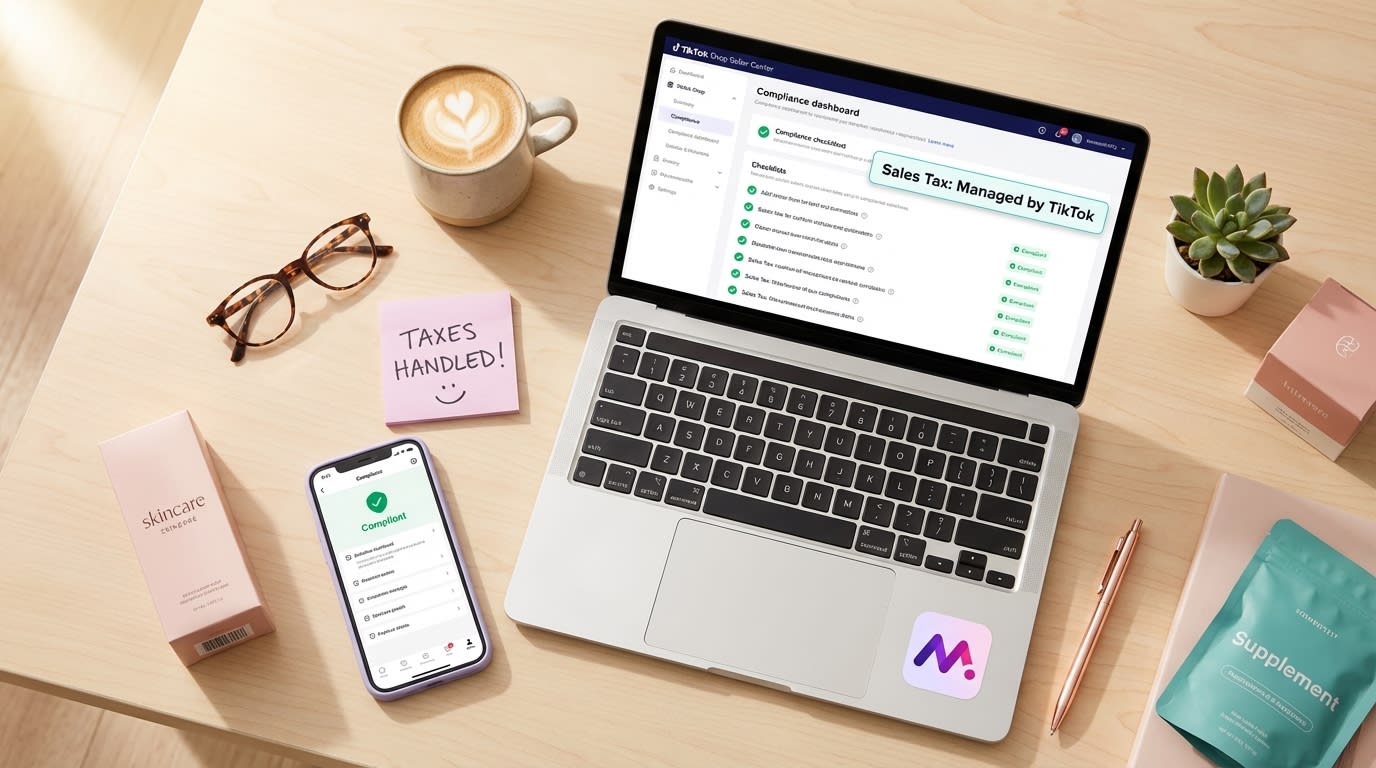
Since the landmark South Dakota v. Wayfair Supreme Court decision in 2018, states have been aggressively expanding their sales tax reach to online sellers. Most states have also passed marketplace facilitator laws, which shift the responsibility for collecting and remitting sales tax from individual sellers to the marketplace platform itself.
As of 2025, all 45 states that impose a sales tax (plus Washington D.C.) have enacted marketplace facilitator legislation. TikTok Shop operates as a marketplace facilitator in all of these jurisdictions.
**What this means for you:
**
- TikTok Shop calculates, collects, and remits sales tax on orders shipped to customers in states with marketplace
facilitator laws
- You do not need to register for sales tax permits in every state where TikTok Shop customers are located (solely for TikTok Shop sales)
- The tax is collected from the buyer at checkout — it's not deducted from your payout
- TikTok reports these tax collections separately in your seller dashboard
When You're Still on the Hook for Sales Tax
ing a viral TikTok Shop video on a smartphone.](https://res.cloudinary.com/dyj6g3mtf/image/upload/f_auto,q_auto/v1773188301/momentiq/blog/tiktok-shop-tax-accounting-guide-for-sellers-in-2025-sales-tax-1099-k-write-offs-lively-creator-team-brainstorming-in-a-s-a.jpg)


Here's where it gets nuanced. TikTok Shop handling sales tax as a marketplace facilitator only covers sales made through the TikTok Shop platform. selling through multiple channels selling on multiple marketplace platforms If you're also selling through:
- Your own Shopify or DTC website
- Amazon, Walmart Marketplace, or Etsy
- Wholesale or B2B channels
- In-person events or pop-ups
…you may have economic nexus obligations in states where your combined sales exceed thresholds (typically $100,000 in sales or 200 transactions per year in a given state). Each channel's sales can count toward those thresholds.
Pro tip: Even though TikTok Shop handles the tax remittance, your TikTok Shop sales volume can still create nexus for your other sales channels. If you're doing $300K/month on TikTok Shop across dozens of states, your DTC site may now have nexus in states you never expected. Talk to a tax professional who understands multi-channel e-commerce.
TikTok Shop 1099-K Accounting: What You'll Receive and How to Report It
The 1099-K is the tax form that keeps TikTok Shop sellers up at night. Let's demystify it.

The 2025 1099-K Threshold
reporting threshold changes from pre-2022 at $20,000 plus 200 transactions, to $5,000 in 2024, to an expected $600 in 2025 for TikTok Shop sellers](https://res.cloudinary.com/dyj6g3mtf/image/upload/f_auto,q_auto/momentiq/blog/tiktok-shop-tax-accounting-guide-for-sellers-in-20-infographic-101.png)


After years of delays and phase-ins, the IRS has been progressively lowering the 1099-K reporting threshold. Here's the current landscape:
- Pre-2022: Platforms issued 1099-Ks only if you exceeded $20,000 AND 200 transactions
- 2024 tax year: The IRS implemented a $5,000 threshold as a transitional step
- 2025 tax year: The threshold is expected to drop further toward the originally planned $600 threshold, though the IRS has signaled additional transitional relief may apply
The bottom line: If you're generating any meaningful revenue on TikTok Shop, you will receive a 1099-K. Plan for it.
What's Included on Your TikTok Shop 1099-K
This is wh

ere sellers frequently make costly mistakes. Your 1099-K from TikTok Shop reports gross payment volume — not your actual profit. That means it includes:
- Total sales revenue (before TikTok's commission and fees)
- Shipping charges paid by customers
- Sales tax collected (in some cases, depending on reporting methodology)
- Refunded orders that were processed during the tax year
It does NOT account for:
- T
ikTok Shop's platform commission (typically 2-8% depending on category) TikTok Shop commission rates by category
- Affiliate commissions paid to creators tracking creator performance and ROI affiliate commissions paid to creators
- Shipping costs you paid
- Product costs (COGS)
- Returns and refunds (unless separately adjusted)
This is critical: your 1099-K will almost certainly show a higher number than what actually hit your bank account. If you report the 1099-K amount as income without deducting legitimate expenses, you'll massively overpay on taxes.
How to Reconcile Your 1099-K
Follow this framework every month (not just at tax time):

- Download your TikTok Shop settlement reports — these break down gross sales, commissions, fees, shipping subsidies, and net payouts
- Match settlement totals to your bank deposits — identify any discrepancies immediately
3.Track refunds and chargebacks separately — these reduce your taxable income - [handling returns and refunds eff
ectively](/blog/tiktok-shop-return-refund-policy-playbook-2025-how-to-craft-buyer-friendly-polic) Document all platform fees — TikTok's commission, payment processing fees, and any promotional subsidies
5. Reconcile monthly essential tools for TikTok Shop sellers — waiting until year-end to sort through 12 months of transactions is a nightmare (and expensive if you're paying an acco key metrics every seller should trackuntant hourly)
TikTok Shop Tax Write-Offs: Every Deductible Expense Sellers Miss
Here's where smart TikTok Shop sellers turn tax compliance into a competitive advantage. Every legitimate deduction reduces your taxable income — and most sellers leave thousands on the table because they don't realize what qualifies.

Product Seeding Is a Deductible Business Expense
This is the one that shocks sellers the most. Product seeding — sending free inventory to creators for content creation — is a legitimate, deductible business expense.

According to IRS guidelines, promotional products given away for business purposes (including influencer marketing and product sampling) are deductible as advertising or promotional expenses. Here's how to handle it:
- Track the cost of goods seeded (not the retail value — the actual COGS)
- Document the business purpose — maintain records of which creators received products, the expected content deliverables, and the business rationale
- Categorize correctly — product seeding typically falls under "Advertising & Promotion" or "Marketing Expenses" on your Schedule C or corporate tax return
Consider the math: if you're seeding 500 units per month at a $12 COGS, that's **$6,000/month or $
72,000/year in deductible expenses.** At a 30% effective tax rate, that's $21,600 in tax savings — just from properly categorizing your seeding program.
**Brands working with MomentIQ
on managed product seeding campaigns get detailed seeding reports that make this documentation effortless** — every unit shipped, every creator matched, every piece of content tracked. That's the kind of operational infrastructure that pays for itself at tax time.
The Complete TikTok Shop Deduction Checklist
Beyond product seeding, here's every expense TikTok Shop sellers should be tracking:

Platform & Transaction Fees:
- TikTok Shop platform commission (2-8%)
- Payment processing fees
- TikTok Shop Ads spend (Spark Ads, Product Shopping Ads)
- Affiliate commission payments to creators
**Product &
Fulfillment Costs:**
- Cost of goods sold (COGS)
- Packaging materials and branded inserts
- Shipping and fulfillment costs (including TikTok's Fulfilled by TikTok fees)
- Warehousing and storage fees
- Inventory shrinkage and damaged goods
Marketing & Content:
- Product seeding costs (as discussed above)
- Creator payments for sponsored content
- Photography and videography equipment
- Content editing software subscriptions
- Agency fees (including TikTok Shop growth agencies like MomentIQ)
- Graphic design tools and templates
Technology & Operations:
- E-commerce platform subscriptions (Shopify, etc.)
- Analytics and tracking tools
- Inventory management software
- Customer service tools and automation
- Accounting and bookkeeping software
Business Operations:
- Home office deduction (if applicable)
- Business insurance
- Professional services (accountant, tax preparer, attorney)
- Business travel related to supplier visits, trade shows, or creator events
- Business entity formation and maintenance fees
Bold this and tape it to your monitor: if an expense is "ordinary and necessary" for your TikTok Shop business, it's likely deductible. The key is documentation. Keep receipts, maintain records, and categorize everything in real-time.
State Tax Compliance for TikTok Shop Sellers: Nexus, Registration & Filing
Even with TikTok Shop handling sales tax collection as a marketplace facilitator, you still have state-level compliance obligations that can trip you up.

Understanding Economic Nexus in a TikTok Shop Context
Economic nexus means that selling a certain volume into a state creates a tax obligation — even if you have no physical presence there. While TikTok Shop handles the sales tax piece, economic nexus can also trigger:

- State income tax obligations — some states require businesses with economic nexus to file state income tax returns
- Business registration requirements — certain states require foreign entity registration once you exceed sales thresholds
- Franchise tax obligations — states like Texas and California have franchise/gross receipts taxes that apply regardless of marketplace facilitator laws
According to the Tax Foundation, as of 2025, over 30 states have some form of economic nexus standard that extends beyond just sales tax. If your TikTok Shop is generating significant revenue across multiple states, you may have filing obligations you don't know about.
States That Require Extra Attention
Some states have unique rules that catch TikTok Shop sellers off guard:

- California: Requires annual $800 minimum franchise tax for LLCs registered or doing business in the state, regardless of income
- New York: Has aggressive nexus standards and requires quarterly sales tax filing even for marketplace-only sellers in some cases
- Texas: Imposes a franchise (margin) tax on businesses with Texas revenue exceeding $2.47 million
- Washington State: Has a Business & Occupation (B&O) tax that applies to gross receipts — not profit — with relatively low thresholds
- Colorado and Louisiana: Have complex local tax jurisdictions that can create additional compliance headaches
The takeaway: Don't assume that TikTok Shop handling sales tax means you're fully compliant in every state. As your GMV scales, your state tax obligations scale with it.
Bookkeeping Best Practices for TikTok Shop Sellers
The difference between a TikTok Shop seller who panics at tax time and one who breezes through it? Systems built from day one.

Set Up Your Chart of Accounts Correctly
Most sellers dump everything into generic categories. Instead, create specific accounts for:
- TikTok Shop Revenue (separate from other channel revenue)
- TikTok Shop Platform Fees (commission, processing)
- TikTok Shop Affiliate Commissions (creator payouts)
- TikTok Shop Advertising (Spark Ads, Shopping Ads)
- Product Seeding Expense (separate from paid creator partnerships)
- TikTok Shop Shipping (inbound and outbound)
- TikTok Shop Returns & Refunds
This granularity gives you real-time visibility into your TikTok Shop profitability — not just top-line GMV, but actual margin after all costs. According to a 2024 QuickBooks survey, businesses that maintain channel-specific bookkeeping are 40% more likely to identify profitability issues before they become critical.
Monthly Financial Hygiene Checklist
Do this every month without fail:

- Download and file TikTok Shop settlement statements
- Reconcile TikTok Shop payouts with bank deposits
- Categorize all TikTok Shop-related expenses
- Update product seeding log (units, COGS, creators, dates)
- Review affiliate commission reports
- Track ad spend vs. attributed revenue
- Update inventory valuation (for COGS accuracy)
- Set aside estimated tax payments (25-30% of net profit as a baseline)
Estimated Tax Payments: Don't Get Hit With Penalties
If you expect to owe $1,000 or more in federal taxes for the year, the IRS requires quarterly estimated tax payments. The deadlines for 2025:

- Q1: April 15, 2025
- Q2: June 16, 2025
- Q3: September 15, 2025
- Q4: January 15, 2026
Missing these deadlines triggers underpayment penalties — typically around 8% annualized in the current interest rate environment. For a seller netting $200K/year on TikTok Shop, skipping estimated payments could mean $4,000+ in avoidable penalties.
How Your Business Entity Structure Affects TikTok Shop Taxes
The entity you choose has massive implications for how your TikTok Shop income is taxed.
Sole Proprietorship / Single-Member LLC
- Income reported on Schedule C of your personal tax return

- Subject to self-employment tax (15.3%) on net earnings
- Simplest structure but highest tax burden at scale
- Makes sense for sellers under ~$50K net profit
S-Corporation Election
- Can significantly reduce self-employment taxes by splitting income between salary and distributions

- Requires reasonable salary, payroll processing, and additional compliance
- Generally becomes advantageous when net profits exceed $50K-$80K/year
- A seller netting $150K could save $10,000-$15,000/year in self-employment taxes with an S-Corp election
C-Corporation
- Taxed at a flat 21% corporate rate

- Subject to double taxation on distributions
- Rarely optimal for TikTok Shop sellers unless you're reinvesting heavily and planning for venture funding
If your TikTok Shop is generating over $80K in annual net profit and you're still operating as a sole proprietorship, you're likely overpaying taxes by thousands. Consult a CPA who understands e-commerce to evaluate whether an S-Corp election makes sense for your situation.
The Hidden Tax Implications of TikTok Shop Creator Programs
Running an affiliate or creator program on TikTok Shop creates tax obligations on both sides of the relationship — and most sellers only think about their own.
1099-NEC Obligations for Creator Payments
If you're making direct payments to creators (outside of TikTok Shop's built-in affiliate commission system) totaling $600 or more per year, you're required to issue a 1099-NEC to that creator and file a copy with the IRS.
This applies to:
- Flat-fee sponsored content payments
- Bonus payments for performance milestones
- Payments for exclusivity agreements
- Any direct compensation outside the TikTok Shop platform
It does NOT apply to:
- Affiliate commissions processed through TikTok Shop (TikTok handles that reporting)
- Product seeding (no cash changes hands)
- Reimbursements for pre-approved expenses
Failure to issue required 1099s can result in penalties of $60-$310 per form, depending on how late you file. If the IRS determines intentional disregard, penalties jump to $630 per form with no cap.
Why This Matters for Scaling
Here's where tax compliance intersects with growth strategy. If you're managing 20 creators, tracking 1099 obligations is manageable. If you're scaling to 200+ creators — which is what it takes to consistently drive six-figure monthly GMV — the administrative burden becomes overwhelming.
This is exactly why brands partner with agencies like MomentIQ. When your creator program is managed through MomentIQ's infrastructure, the payment tracking, documentation, and compliance reporting is built into the system. You're not chasing W-9 forms from 200 creators in January. You're not wondering which payments crossed the $600 threshold. It's handled.
One supplement brand that partnered with MomentIQ scaled from $18K to $420K/month in 90 days through algorithmic creator matching — and their finance team reported that the structured reporting alone saved them 40+ hours per quarter in tax prep time.
Common TikTok Shop Tax Mistakes That Cost Sellers Thousands
After working with hundreds of scaling TikTok Shop brands, these are the mistakes we see over and over:
Mistake #1: Reporting Gross 1099-K as Net Income
Your 1099-K shows $500K. Your actual profit after COGS, fees, commissions, and expenses is $120K. If you (or your accountant) report $500K as income without properly deducting expenses, you're paying taxes on $380K of phantom income. This happens more often than you'd think.
Mistake #2: Not Tracking Product Seeding as a Deduction
As discussed above, product seeding is deductible — but only if you track it. Sellers who seed hundreds of units per month without documentation are leaving tens of thousands in deductions unclaimed.
Mistake #3: Ignoring State Income Tax Obligations
Marketplace facilitator laws cover sales tax. They don't cover state income tax. If you're generating significant revenue in states like California, New York, or Illinois, you may owe state income tax even if TikTok is handling sales tax.
Mistake #4: Mixing Personal and Business Finances
Still running TikTok Shop revenue through your personal checking account? This makes bookkeeping a nightmare, increases audit risk, and can jeopardize your LLC's liability protection. Open a dedicated business bank account and business credit card. It's non-negotiable.
Mistake #5: Waiting Until Year-End to Organize Finances
By December, you've got 12 months of tangled transactions, missing receipts, and foggy memories about what that $3,400 charge was for. Monthly bookkeeping takes 2-3 hours. Year-end catch-up takes 30+ hours and costs 5x more in accountant fees.
Why Financial Infrastructure Is a Growth Accelerator (Not Just a Compliance Checkbox)
Here's the perspective shift that separates six-figure TikTok Shop sellers from seven-figure ones: your financial infrastructure isn't overhead — it's a growth accelerator.
When your books are clean and your tax strategy is optimized:
- You know your true unit economics — not just GMV, but actual profit per order after all costs including creator commissions, seeding, ads, and platform fees
- You can scale confidently — because you know exactly how much cash you need to reserve for taxes versus reinvest in inventory and creator programs
- You make better decisions about creator spend — understanding that a $15 product seeding cost is effectively $10.50 after the tax deduction changes your ROI math
- You're ready for growth milestones — whether that's bringing on investors, applying for financing, or negotiating better supplier terms, clean books are table stakes
According to TikTok's 2024 Commerce Report, TikTok Shop's U.S. GMV exceeded $9 billion in 2024, with projections from eMarketer suggesting it could reach $17.5 billion by 2026. The brands building financial infrastructure now — not just marketing infrastructure — will be the ones positioned to capture disproportionate share of that growth.
The window of opportunity on TikTok Shop is still wide open, but it won't stay that way. Competitors are already scaling, and the brands that build both revenue engines AND financial systems today will have compounding advantages that latecomers simply can't replicate.
When to Hire a TikTok Shop-Savvy Accountant
Not all CPAs understand e-commerce, and even fewer understand TikTok Shop's unique financial mechanics. Here's when to level up your financial team:
- Under $50K/year in TikTok Shop revenue: DIY with accounting software (QuickBooks, Xero) and educate yourself on the basics in this guide
- $50K-$250K/year: Hire a CPA who specializes in e-commerce. Expect to pay $2,000-$5,000/year for tax prep and advisory
- $250K+/year: You need a CPA AND a bookkeeper, plus potentially a fractional CFO. Entity structure optimization, multi-state compliance, and strategic tax planning become essential
Look for accountants who specifically understand:
- Marketplace facilitator laws and 1099-K reconciliation
- Inventory accounting methods (FIFO vs. weighted average)
- E-commerce-specific deductions (including product seeding and creator payments)
- Multi-state nexus analysis
- S-Corp election timing and optimization
Scale Your Revenue While Your Tax Strategy Scales With It
Here's the reality most TikTok Shop sellers face: you got into this to build a brand, not to become a tax expert. And that's completely valid.
But the financial side can't be ignored. The sellers who treat tax and accounting as a strategic function — not a dreaded annual chore — are the ones who scale fastest, keep more of what they earn, and avoid the nasty surprises that derail growth.
On the revenue side, the same principle applies. You can try to manage creator outreach, product seeding, affiliate optimization, and content strategy yourself — and many sellers do, up to a point. But there's a ceiling. Managing 50+ creators, tracking performance across hundreds of SKUs, and optimizing affiliate commissions in real-time requires infrastructure that most in-house teams simply can't build fast enough.
That's where MomentIQ comes in. As TikTok Shop Partner of the Year and a certified TikTok Marketing Partner, MomentIQ provides the full-stack commerce support that scaling brands need:
- Algorithmic creator matching that identifies high-converting creators for your specific product and category — not manual outreach, not guesswork
- Managed product seeding at scale with full tracking and documentation (your accountant will thank you)
- Live commerce strategy that drives real-time conversion events
- Proprietary analytics that connect creator activity to actual GMV impact
One beauty brand went from $12K to $340K/month in 90 days using MomentIQ's creator matching system. A home goods seller 3x'd their affiliate GMV within 60 days of switching from manual creator outreach to MomentIQ's algorithmic approach. These aren't outliers — they're the result of systems built to scale.
"We don't have the budget for an agency" is the most common objection we hear — and it's the easiest to dismantle. If MomentIQ's system drives an incremental $100K/month in GMV at a 25% margin, that's $25K in gross profit. Even after agency fees, the ROI is overwhelmingly positive. The real question isn't whether you can afford an agency — it's whether you can afford the opportunity cost of not having one.
"We've tried agencies before" is the second most common. Here's what makes MomentIQ different: we're not a generic influencer agency that bolted on a TikTok offering. We're TikTok-native. Our entire infrastructure — from our proprietary Reacher platform (reacherapp.com) for creator outreach automation to our algorithmic matching engine — was built specifically for TikTok Shop's unique commerce mechanics. Generic agencies don't understand TikTok Shop's affiliate commission structures, content-to-conversion pathways, or algorithmic amplification. We do.
Ready to get your revenue scaling while your financial house stays in order? Talk to a Strategist and see what algorithmic creator matching, managed seeding, and full-funnel commerce support can do for your brand.
Key Takeaways: Your TikTok Shop Tax Compliance Checklist for 2025
Bookmark this summary and revisit it quarterly:
- ✅ Sales tax: TikTok Shop handles collection and remittance as a marketplace facilitator in all 45 sales-tax states — but monitor your multi-channel nexus obligations
- ✅ 1099-K: You'll receive one if you exceed the threshold. Reconcile it against your actual expenses — never report gross as net income
- ✅ Product seeding: It's deductible. Track every unit, every creator, every shipment
- ✅ Creator payments: Issue 1099-NECs for direct payments over $600/year. Affiliate commissions through TikTok's system are reported by TikTok
- ✅ Entity structure: Evaluate S-Corp election once net profits exceed $50K-$80K/year
- ✅ Estimated taxes: Pay quarterly to avoid underpayment penalties
- ✅ Monthly bookkeeping: Reconcile TikTok Shop settlements, categorize expenses, and update your seeding log every single month
- ✅ State compliance: Don't assume marketplace facilitator laws cover all your state obligations — especially income tax and franchise tax
The brands that will dominate TikTok Shop in 2025 and beyond aren't just the ones with the best content or the most creators. They're the ones with the tightest operations — from creator matching to tax compliance. Build both sides of the equation, and you'll be positioned to scale faster, keep more profit, and sleep soundly when the IRS comes knocking.
This guide is for informational purposes only and does not constitute tax, legal, or accounting advice. Consult a qualified tax professional for advice specific to your situation.